
What it's like to be a Twin
Statistics and what to expect from the perspective of a twin

Statistics
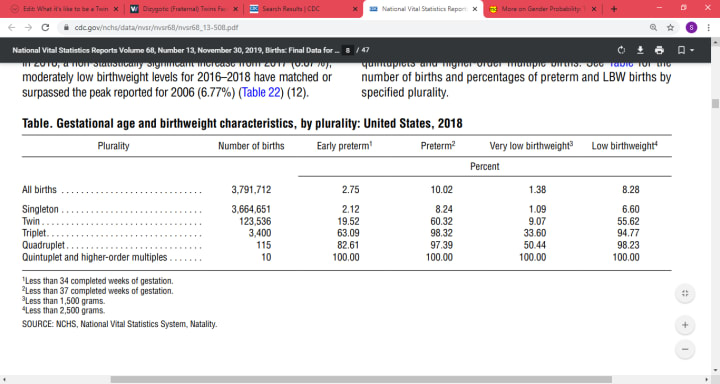
It comes as no surprise that human beings, unlike most mammals, normally only give birth to one child at a time. However, the possibility to become pregnant with more than one child at any one given time is possible. Some have claimed that it skips a generation while others are the first to ever have been reported in their families.
There are two different types of twins; fraternal and identical and their differences are not just in their appearance and the gender of the children. Fraternal twins, occur when the eggs that have been fertilized, grow in separate embryotic sacs. Identical twins share the same sac through the duration of the pregnancy. The probability of having a boy-boy, girl-girl, or boy-girl set of twins is 50%, 25%, and 25%, mathematically speaking. Family history does affect these numbers, doctors can predict the gender of the child or children before birth, however, it's important to note that this prediction is not a guarantee.
Women have two choices when giving birth and sometimes it's a choice made when it comes to increasing the safety and survivability rate of both the mother and/or the child/children being born. Natural birth is pretty self explanatory in that the body chooses when it is time to go into labor, roughly 9 months after conception. C-section is another term for a cesarean birth. Although less common, a C-section birth can be either planned or done in case of an emergency; for example, if the cord is wrapped around the babies neck. "North America and Western Europe are well above this optimal rate, with 32 percent and 27 percent of babies in 2015 delivered by C-section, respectively."
Both methods of child birth require a time for healing. You're body just went through the process of creating an entire other being and bringing it into the world.
What to expect
From a young age, your parents teach you how to respond to the questions that adults and peers would ask. Questions like; Who was born first or who's older? Do you like being a twin? Do you read each others mind or have telepathy, do you know what the other is thinking? Do you feel each others pain? Do you always say the same thing at the same time?
The answers to the questions above, change over time, as you and your sibling grow apart; because at the end of the day, I imagine it's the same as having any other sibling, you learn different lessons from your parents, you experience different life events, you're simply not the same person. If you're an only child or you and your twin are the only children in your family, it is difficult to honestly know. As you grow up you learn about and hear comments on incest and people love to watch you argue and fight with one another. I imagine the appeal comes from watching someone fight themselves which is entertainment for some. You'll hear perversions on how "hot" it is that your a twin and people do look at you differently after seeing you together.
Financially, your parents are doubling everything. If you're the first children to be born in the family, hand-me-downs from older siblings are not really a thing, however, thrift shops are a good alternative for cheaper clothing. You can obviously share clothing (what siblings don't at some point) and you'll gift each other clothing that no longer fits or you don't wear anymore and know they loved. You'll argue over wearing each others stuff or taking each others belongings.
It's okay not to agree all the time or to share the same opinions on important issues. You're two different people and no matter how much people want to believe you share the same mind and thoughts, it simply isn't true. I've met twins who are the best of friends and then on the other hand can't stand one another and have to be separate from one another and love one another from a distance, the best way you know how to.
About the Creator
Keep reading
More stories from Shasta Scott and writers in Families and other communities.
Growing up, Getting out, Creating your new Family
Family, the foundation for the next generation of adults. Some people have large families, while others have small families, and some people have no family at all, or feel isolated from them over time. Friends and teachers are the outside forces that also influence much of our dreams and aspirations. Traditions change with the passing of grandparents and great grandparents, family reunions become less and less, so we try our best to create our own traditions.
By Shasta Scott5 years ago in Families
Wise~Guys
— Look Behind what's in Front of You ~ Make Good Choices — Hey, So how you Doin'..! Made~Men — Mobster Movies romanticise a distinctive, elegant appearance, impeccable attire style, along with the 'Families' expressive lingo. Making their 'Bones' gave them Panache — with vintage fedoras, tailored pin-striped suits, mirror-polished wing-tip shoes adorned with tassels; with their 'Gun Moll' gorgeous dates on their arms.
By Jay Kantor18 days ago in Families
The quiet sound of families breaking
There is a kind of silence that is louder than any noise. It is the silence of a child waking in the night and realizing their parent is gone. It is the silence of a kitchen table with one chair suddenly empty. It is the silence of a home that still looks the same, but no longer feels the same. Across the United States, thousands of families live inside that silence. Not because of war. Not because of disaster. Not because of death. But because of policy.
By Kaylee Souther6 days ago in Families



Comments
There are no comments for this story
Be the first to respond and start the conversation.