

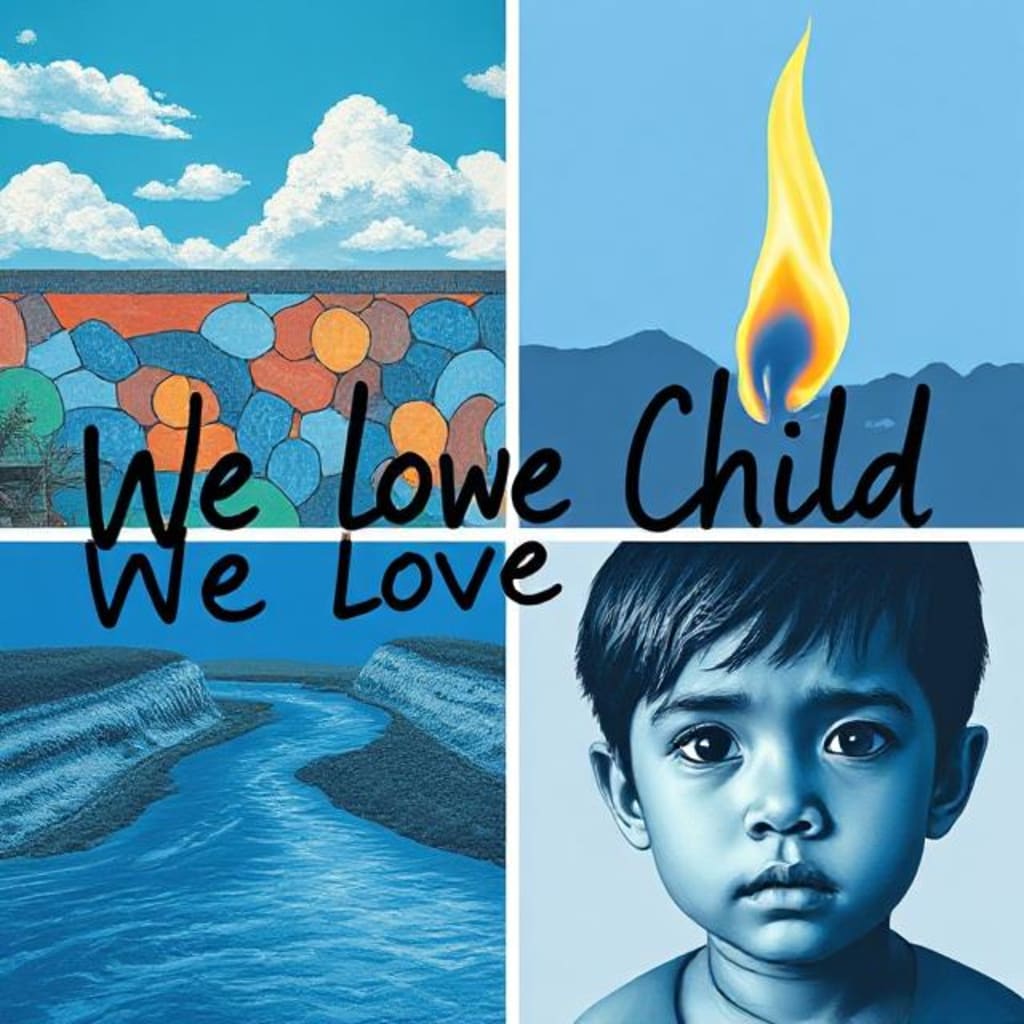
They met where the river bends — not by accident, but as if the world, for one brief moment, had paused to let something impossible bloom.
Jamil was a traveler, a soul with too many dreams and no place to store them. He painted murals in forgotten towns, played the oud beneath moonlit windows, and moved like wind — seen but never captured. Zara was rooted — daughter of a village elder, engaged to a man with a powerful name, her life already carved in stone before she’d ever spoken her own dream aloud.
Their first conversation was about color.
“Why do you use so much blue?” she had asked, watching him paint a great sky across the crumbling wall of her village school.
“Because blue is the color of longing,” Jamil had replied without looking up.
She returned the next day. And the next.
He painted. She brought him chai. He told her stories. She laughed like the sound of water.
By the time the mural was finished — a child holding a flame beneath a sky full of stars — they had fallen into something they didn’t have the courage to name.
But villages are not kind to unnamed things.
When the whispers began, they spread fast — through cracked doors and sharp eyes. Zara was confined. Jamil was told to leave, beaten, and left with one last bruise beneath his ribs that pulsed in rhythm with his heartbreak.
They separated, not with goodbyes, but with promises.
“If you ever find yourself alone,” he told her, “remember: you carry love. No matter what they say.”
Months later, she was no longer alone.
Her father’s rage was cold. Her mother’s tears were silent. The wedding was canceled, the shame declared.
They offered her choices: a distant relative in another town, or silence and erasure.
Zara chose neither.
She left.
With nothing but a bag of clothes and the sound of Jamil’s voice echoing in her memory: You carry love.
In a coastal town where no one knew her name, she began again. She worked in a bookshop by day and stitched dreams together by night. And when her child was born — a girl with eyes the color of dusk and fingers that curled around hope — she named her Aya, meaning miracle.
They said she would regret it. That she’d be alone. That a child like that — a love child — would only remind her of shame.
But Zara knew better.
Aya was not born of mistake. She was born of poetry, of rebellion, of sky-colored longing. She was the mural they never finished.
And so, every night, before sleep, Zara would whisper to her child, “You are loved. You are not alone. We love, child.”
It became their phrase. Their shield. A song they sang on hard days.
Aya grew up knowing her story. Not as something hidden, but something sacred. Her mother never lied to her. “You were born from love that wasn’t allowed, but that doesn’t mean it wasn’t real.”
At ten, she asked, “Was he a good man?”
Zara smiled. “He was a dreamer. And he gave me you.”
When Aya was twelve, she found the mural — hidden in the folds of an old photo her mother kept beneath her pillow. She asked where it was.
And so, for her thirteenth birthday, they returned.
The village had changed. Strangers lived where once neighbors judged. The mural was faded, the blues pale and forgotten. But it was there.
Aya stood before it in silence.
“Did he know?” she asked.
Zara shook her head. “I never found him.”
Then, Aya did something unexpected. She dipped her fingers in the blue paint they brought with them, and began tracing the stars back to life.
Zara joined her. Side by side, mother and daughter painted — not to restore the past, but to reclaim it.
And when they finished, Aya looked at the child in the mural, holding the flame.
“That’s me,” she said.
Zara nodded. “Yes. That’s always been you.”
From that day, whenever anyone asked about her family, Aya would smile and answer with pride, “We love, child.”
It was never a mistake in grammar. It was a declaration.
We — my mother, my father, even in his absence —
Love — not in halves or secrets, but whole and loud —
Child — the one born from that love. Me.
“We Love Child.”
Not a statement.
A legacy.
About the Creator
Sadiq Muhammad
storeys
Keep reading
More stories from Sadiq Muhammad and writers in Families and other communities.
Salahuddin Ayyubi: The Noble Warrior King of Islam
In the rich tapestry of Islamic history, few names shine as brightly as Salahuddin Ayyubi, known in the West as Saladin. Revered by both Muslims and non-Muslims alike, he was a powerful Muslim king, a skilled military commander, and a man of deep faith and exceptional character. His legacy is not only remembered for his victories, but also for his sense of honor, justice, and compassion—even in times of war.
By Sadiq Muhammad9 months ago in Art
Wise~Guys
— Look Behind what's in Front of You ~ Make Good Choices — Hey, So how you Doin'..! Made~Men — Mobster Movies romanticise a distinctive, elegant appearance, impeccable attire style, along with the 'Families' expressive lingo. Making their 'Bones' gave them Panache — with vintage fedoras, tailored pin-striped suits, mirror-polished wing-tip shoes adorned with tassels; with their 'Gun Moll' gorgeous dates on their arms.
By Jay Kantor19 days ago in Families
Bettijo Hirschi
Introduction Bettijo Hirschi is a multi‑talented creative professional from the United States. She works as a designer, art director, photographer, writer, and event planner. Bettijo has built a long career in creative work and media. People know her for her artistic skills, her work in magazines and television, and her lifestyle blog. She is also known in recent news because of changes in her personal life.
By Farhan Sayed5 days ago in Families




Comments
There are no comments for this story
Be the first to respond and start the conversation.