
Was my Dad the real Indiana Jones?
Discovering my Dad's extraordinary life after his death...

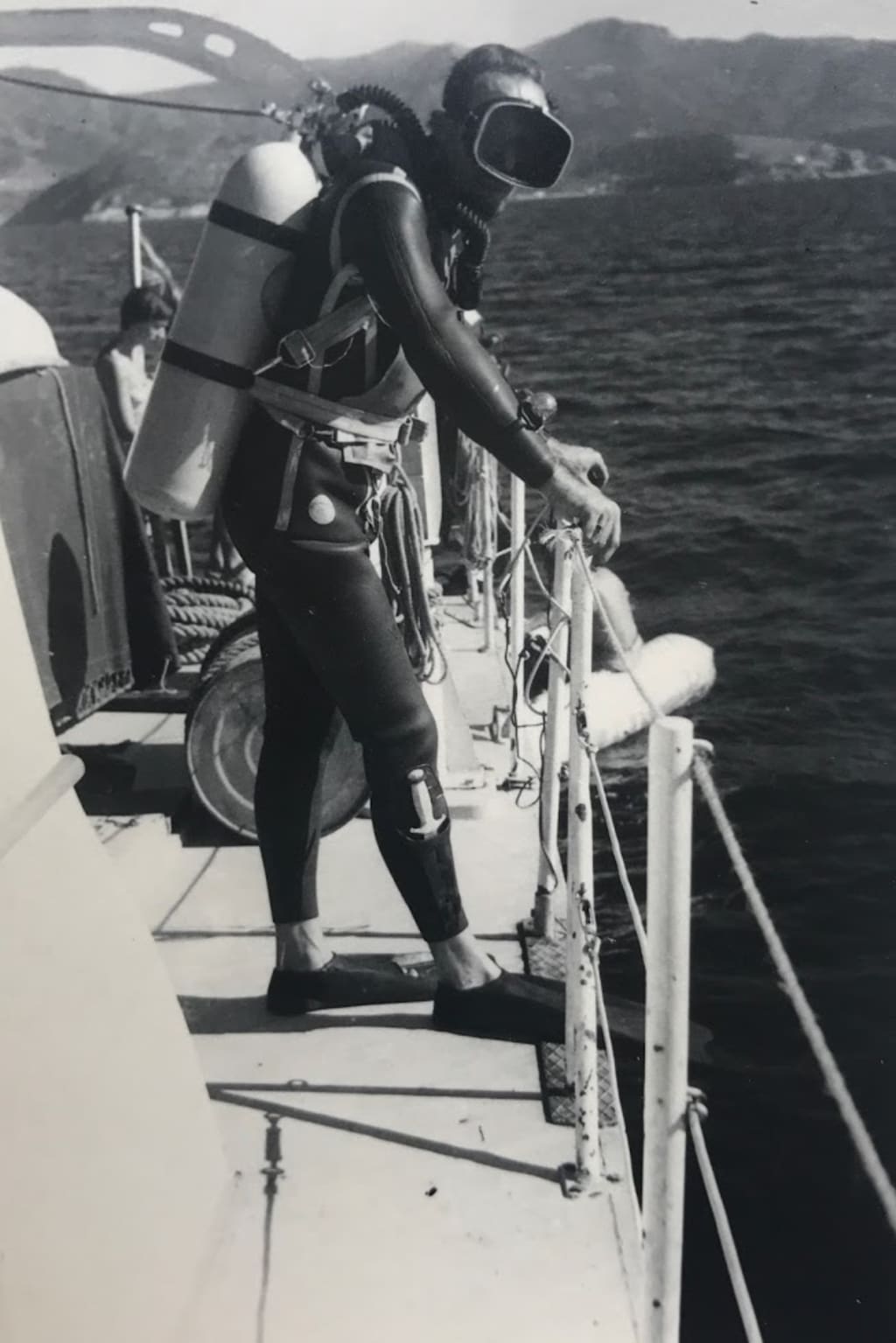
When I was at school I always struggled when someone asked "What does your Dad do?" as it was a little hard to explain. If I gave them the truth they'd say I was making it up. I think my favourite example of this was when I was on the first date with my future wife. Sue asked me the question and I answered her truthfully.
"He's a mercenary, treasure hunting arms dealer." I told her. That's all true.
When I first met Sue, my Dad was still alive. She was so fascinated by his stories that she sat him down and interviewed him on camera. Despite his amazing stories of danger, fortunes and thrilling missions into the unknown; to me, he was just my Dad.
I grew up hearing all his amazing tales. Sunken treasure, warfare, plane crashes and jungle expeditions. His telling of them was rich and textured. He was a great storyteller. When I think about it, his stories are the reason I got into making television programmes. I grew up understanding that stories are a vital part of the being human, and telling them well is a great skill. I became obsessed with them. Movies and documentaries, and set my sights on working in the media. I succeeded and have been working as an editor for 21 years in the UK.
By the time Sue and I had our first child in 2002 my Dad was in his 70's. William Sutton (Bill to his friends) was born in 1928 and when our son was 2 he died of throat cancer. He was 76 years old. He died pretty much penniless, but before he passed away he had been busy. He had written 2 novels and a book of short stories.
I knew he had been writing them for 15 years. It was the only thing he could do since he broke his back in plane crash. He was able to walk but due to crushing a vertebra he was an inch shorter and was in constant pain. After a lifetime of being the strongest person in the room, writing became his escape. That and the occasional whiskey and painkiller cocktail.
A year or so after he died, I was digging through some of his stuff and I found an old CD ROM that contained word processor files. It was his book and short stories. I saved them all to my cloud storage and got on with life.
I loved my Dad like most sons do. He was the person I could ask for advice from. He had done a lot with his life, and solved problems with a logic and clarity I related to. To him, life was an adventure full of opportunities. The books and short stories are filled with moments from that incredible life. I found them very hard to read as it was a reminder to me that I'd never be able to speak to him again.
Today is the first time I've read his short stories all the way through and I need to share them.
The first short story I am sharing really sums up what Dad got up to before I was around. There are so many more to come and it's been one hell of a journey to read through them all - and making some shocking discoveries too.
"The Crew" by BILL SUTTON
Alex, a young Corsican entrepreneur, was very helpful when we arrived at Calvi on the north coast of Corsica. He pointed out the best anchorage for the yacht 'Nyata' and acting as interpreter. He was a eighteen years old free diver who earned his living spear fishing. His boat was sixty years old if it was a day, clinker built, with a small cuddy cabin at the bow for shelter and powered by an antiquated 5 horse power Seagull motor. He fished with an old rubber powered spear gun, a damaged mask and a pair of odd coloured fins and sold his catch to visiting yachtsmen.
Our dive equipment on the 'Nyata' caught his attention. A tank of air would allow him to go deeper and for longer. We agreed to buy fresh fish from him, although we could easily have speared our own and late that afternoon he delivered enough for an evening meal.
My two crew on the 'Nyata' were Anne and Maggie, both open water divers and on this trip we had two visitors from London, Richard and his girl friend Jennifer.
Doctor Bonetti of Italy's Milan Museum provided the cash to locate an Etruscan wreck after the neck and handles of an amphora were recovered in a fisherman's net. We dived all the next day in the area where the net was fouled, without success.
Alex turned up again that evening with more fish and as I counted out the money in the deck saloon he handed a piece of paper with a sketch of a sunken submarine to me. The sub was wedged between two huge rocks. The stern, propellers and rudder, tilted upwards toward the surface, gave the impression that she had dived into her last resting place at some speed.
Alex saw my interest and smiled as I studied the sketch.
"Is it real?" I asked him.
He nodded emphatically. "Real, yes. You want to see it? It is forty meters, maybe more. I show you where it is, you give me a tank?"
"And a regulator and gauges," I said.
The others came up from below and I told them about the submarine. Alex explained that he had been unable to get down to the wreck because it was too deep for him to free dive, but he was sure it had not been worked. We decided the Etruscan wreck could wait a few days and we would look at the submarine the following morning.
Alex arrived the next day an hour earlier than we agreed and waited impatiently while we ate breakfast. We up anchored and he piloted us to the wreck site anchorage, and pointed out the two sets of visual transits on the shore which marked the position. He said he would free dive to show us the way.
Richard and I planned to dive together and get vital measurements to identify the sub. The depth was one hundred and thirty feet. We could spend up to thirty minutes on the bottom and would need twenty one minutes for decompression on the way up. Three minutes at twenty feet and eighteen minutes at ten feet. I lowered two extra tanks twenty feet beneath the boat for additional air reserves during decompression and we were ready to go.
Visibility was better than average and at sixty feet we could make out the bottom some fifty feet below us. Alex came down on his second free dive, tapped me on the shoulder and pointed into the deeper blue water where the first drop-off began. At first it was only a vague rock formation in the distance and I signalled a 'thank you' to him and headed in the direction he pointed. Richard, fairly new to open water diving, tagged along behind.
At one hundred feet we swam with the current thirty feet above a jungle of swaying weed with the domes of huge boulders breaking through the dense undulating mass. I finned toward the irregular looking rock formation and suddenly the sleek sinister shape was there, its bow jammed between two large rocks. It was bow down with rudder fin and propellers sticking up as if it had dived into its present position at speed. I turned and saw Richard's eyes behind his mask, wide open in amazement. He nodded excitedly and gave the thumbs up.
We descended through a waving blanket of kelp and explored the outside of the sub. The conning tower and hull were covered in short dark weed moving with the current. At first we could find no obvious damage so we took measurements and scratched around in the conning tower for numbers or identification marks to compare later with my copy of Janes Fighting Ships. After fifteen minutes trying to open the hatch without success we were about to leave when Richard discovered the reason she was there. On the starboard side, just below and forward of the conning tower was a large dent, covered by thick weed, with a jagged hole nearly two feet across.
I scraped weed from around the hole and peered inside with a flashlight which shone on pipe work, once white, which was now green with slime and algae. The hole seemed big enough to get through if I took off my tank, but we had been on the bottom for twenty minutes and our air was down to seven hundred PSI. We could do a second dive that afternoon without too much decompression if we surfaced now.
I signalled 'up' and we did a four minute stop at ten feet to be on the safe side. Alex had returned to the Nyata to tell the girls and they were all on 'Nyata's dive platform, waiting to hear about the sub.
After lunch we compared our measurements with the details of submarines in Jane's Warships, a book dedicated to the fighting ships of the two wars. I decided we had a World War 2 German Type V11 Sub, an early class, developed from those used in World War One. This one, still in use in the earlier part of the second World War, had been a part of Hitler's U Boat packs operating in the Med against Allied shipping.
I was more excited by our find because this class of submarine had a simple solution to the problem of ballast. It was probable that our sub was fitted with trim tanks which would contain a fortune in mercury. This was a dangerous but very lucrative salvage proposition and the prospect of treasure brought a whole new dimension to our adventure.
We hung the weighted rope from the dive platform to suspend two tanks at thirty feet, two at twenty feet and two at ten. With no hyperbaric decompression chamber on board, this would supply an air reserve for longer decompression necessary after a repetitive dive at this depth. We would have thirty minutes for me to explore the inside of the sub and confirm its type, plus a reserve in case we over-ran the time. Richard would remain outside the sub as back-up. I knew I would not get through the hole with tanks on so his main job was to help me remove my gear and to get me in and out of the jagged hole.
We tanked up and dropped of the dive platform at the stern of Nyata. At the lower decompression tanks I tied off a yellow guide rope from the weighted line and paid it out as we descended.
At seventy feet depth we could see the sub plainly, now that we knew what to look for and were quickly down to the hole on the starboard side of the hull. We both wore hard hats with lights attached and each carried heavy duty flash lights. As I peered through the jagged hole my head light picked out the flat steel plating and the masses of pipes all covered with a pale green slime and I had the first nagging doubts. The grim interior produced a violent shudder down my back, but there was no going back now and Richard wedged himself behind me as I shrugged off my tank and B.C. (Buoyancy Compensator). He held the tank close to the jagged hole and I kept the second stage mouthpiece in my mouth to breathe as I manoeuvred through, feet first. It was a tight fit. The steel, inches thick, had jagged edges, which snagged and grabbed at my wet suit.
Inside the hole it was pitch black and I squeezed through the maze of pipes which ran down the hull. The beams of both my lights cut through the blackness outlined by a haze of floating silt that I had disturbed with my entry. I squeezed between two pipes and was in a low narrow passage with checker plate on the deck and very little head room. Further along I could see that the corridor had crew lockers on one side and an array of dials and switches on the other. Small fish flashed silver in my lights as Richard passed my gear through and I put it on. I was breathing faster than normal and consciously slowed down as I warned myself of the consequences of hyper ventilation.
The passage opened into the nerve centre of the submarine, the space below the conning tower, where I could see the periscope and voice pipes. I tied off the yellow guide line to a pipe, signalled 'see you later' to Richard, peering in at me through the hole. I swam slowly toward the control area and was surprised by a sudden clamour in the sub as a million crustaceans, silenced by our arrival, began clacking away on the outside of the hull. A chilling two tone groaning sound, like a distant fog horn, vibrated through the hull and added to my uncertainty. Green slime covered everything and my bubbles rose, sparkling and noisy, to create new air spaces in the recesses on the deck head.
I saw the first skeleton just inside the control area. I had been expecting it so it didn't come as too much of a shock. It appeared to be held together by the one-piece uniform overalls used by German submariners and the skull, lying a little apart, grinned at me from behind a steel grating. Further into the control area there were several of them, lying huddled where they died as the submarine filled with water.
I struggled with the drawers of the navigation chart table, under the conning tower. It was jammed and tilted at an angle and I succeeded only in pulling off the handles. Two stiff backed books fell to pieces as I tried to decipher the titles. Wedged behind a massive electrical switch on a generator board I found the peaked cap of a German U-boat Officer. Electrical fittings, dials and pressure gauges had German navy markings
I moved on through the control area , swimming upwards toward the stern and entered the living quarters with packed four tier bunks crowded together. The signal line attached to my B.C. jerked as Richard signalled: 'Are you O.K.?'
I signalled back: 'O.K.'
My exhaust air bubbles now reached larger pockets of what I knew would be deadly fouled surface air, carbon dioxide and battery gas, trapped under the deck-head when she sank. It was all my present companions had to breathe in the last desperate fight for survival, until finally all the oxygen was gone. A movement above me took my head back and the beam from my hard hat light picked out figures in uniform overalls apparently hanging from the surface of the water beneath the deck head. They wore old style grey canvas covered cork life jackets and queued in a disciplined line ready and hoping for a chance to escape the hell that was to come. They hung motionless, suspended from the life jackets and I swam up to the surface, careful not to touch the hanging figures. Wherever I looked skeletons hung in the full length overalls, some with skulls still attached, balanced and held in place by the cradling straps of the life jackets. The skulls had a green slimy sheen which produced an evil looking phosphorescence in the reflection from my lights.
As I watched they began to move, slowly at first, in unison, swaying and jiggling. Skulls nodded and arms and legs moved in time with each other moving jerkily, like puppets under one control. My imagination fought for the upper hand.
In the bright light from my flashlights, against the still blackness, one of the suspended figures bodies began to revolve and I held the shaking beam of my flashlight on the grinning green skull as it slowly turned to face me. The light from my helmet shone clearly through the open eye sockets and illuminated the smooth inside of the skull. I turned my head to the right, to catch a movement, where other skulls, partly submerged, wobbled slowly from side to side, and back to front, grinning as they watched me. Some, with the jaw bone detached, but balanced on the floating life jacket, moving independently under the water, singing as they danced. Arms and legs swayed and jogged in a timeless dance, as if life was still there. The eternity waltz.
I watched one figure whose skull was just beneath the surface, fascinated by the moving jaw. A larger fish swam out of the gaping eye socket and stopped my breathing for a moment. Now there was movement everywhere and I swung my head left and right, determined to see everything at once. My helmet light swung and shone starkly on three more suspended figures, bobbing and swaying, shoulder to shoulder like some obscene chorus, nodding as they slowly advanced toward me. Another group faced each other, in earnest animated conversation. It was impossible to hang on to reality. I looked back along the way I had come and saw that my escape was blocked.
I told myself over and over they couldn't hurt me and they were not talking to each other. They were dead. I searched for a reason for what was happening. Then, as I snatched at some semblance of logic, in the full beam of my two powerful flashlights one of the mocking, grinning figures slowly disintegrated. Held together for years by the uniform overalls in the stillness of the unmoving water the skeleton finally shook free. Bones slid down slowly out of the overall and the skull rolled forward off the supporting life jacket to cascade into a heap on the deck, close to me.
I heard a loud wailing noise over the intermittent clattering of the mussels on the hull and realised it was me. A suppressed howl came through my mouthpiece and deadly panic was very close. The light from my helmet moved across grinning skulls, closer now. Closing in. The thought that panic would almost certainly kill me was just enough to keep it at bay. I forced myself to watch the bobbing swaying figures and finally the reason came to me. My panic stricken imagination rejected it, but I struggled and it came back. It had to be the slow movement of my fins. Just enough to set up a circular movement of the confined water. For the first time since the sinking it caused the suspended corpses to drift about. Air trapped beneath the deck head, calm and still since she sank, had been increased and disturbed by my exhaust air bubbles and my movement. The surface ripples caused the floating life jackets and the overalls to jiggle about and move the suspended bodies into their unearthly dance.
I felt fear and relief at the same time, then something touched my back and as I spun round I collided with a grinning skull that toppled off the floating life-jacket and fell slowly to the deck.
I heard myself howling through my mouthpiece again and dived low, close to the steel deck, underneath the guardians of this pathetic tomb. I followed the yellow guideline hand over hand, quickly, not bothering to reel it in, back to the jagged entrance hole. I tried to get through the pipes with my tank and B.C. still attached, then with hands trembling uncontrollably struggled to remove the cumbersome B.C. I stuffed my gear through the jagged hole to Richard. Panic closed in again.
He saw my shaking hands and wild eyes and knew I was in trouble. I got stuck as I attempted to get through the wrong gap in the pipes and couldn't turn my head. For a moment I could neither go forward nor back and I knew they were following me. I backed out from the pipes and tried another gap. My tank was already outside so I had to remove my mouth piece, pass it round the pipe and put it back in my mouth, only automatically clearing the mouth piece of water because of long years of familiarity. A mistake here would certainly result in death. I squeezed between the pipes, certain that I was, once again, in the wrong place. Claustrophobia and panic screamed at me that I was trapped. Richard carefully eased my head through the jagged hole, then my wet suit, ripping and pulling it off the snagging edges. Outside, shaking uncontrollably, I just hung there recovering from hyper-ventilation while Richard struggled to replace my tank and B.C.
We swam away from the black tomb and he held my arm to reduce the speed of our ascent. He steered me toward the waiting 'Nyata' and I looked back, expecting to be followed. I swam automatically toward the tanks of the lower decompression stage, but Richard shook his head and pointed to his watch as he led me slowly upwards past the twenty foot tanks. My watch meant nothing at all to me. I allowed myself to be guided up to the ten foot mark, where we did a ten minute stop, hanging there, looking down. What had seemed like hours inside the sub turned out to be less than ten minutes.
The three girls at the rail watched as we climbed onto the dive platform and I sat there while the shaking slowly subsided. They stared at me with worried expressions. This reaction was new to them. "My God, Bill," Dianne said at last. "What on earth happened ?"
"I think he met the Crew," Richard said quietly.
END
About the Creator
Andrew Sutton
I work in TV but recently discovered something that has inspired me to tell my own story. My Dad might have been the real Indiana Jones... but slightly more real.
Keep reading
More stories from writers in Families and other communities.
Wise~Guys
— Look Behind what's in Front of You ~ Make Good Choices — Hey, So how you Doin'..! Made~Men — Mobster Movies romanticise a distinctive, elegant appearance, impeccable attire style, along with the 'Families' expressive lingo. Making their 'Bones' gave them Panache — with vintage fedoras, tailored pin-striped suits, mirror-polished wing-tip shoes adorned with tassels; with their 'Gun Moll' gorgeous dates on their arms.
By Jay Kantor21 days ago in Families



Comments
There are no comments for this story
Be the first to respond and start the conversation.