

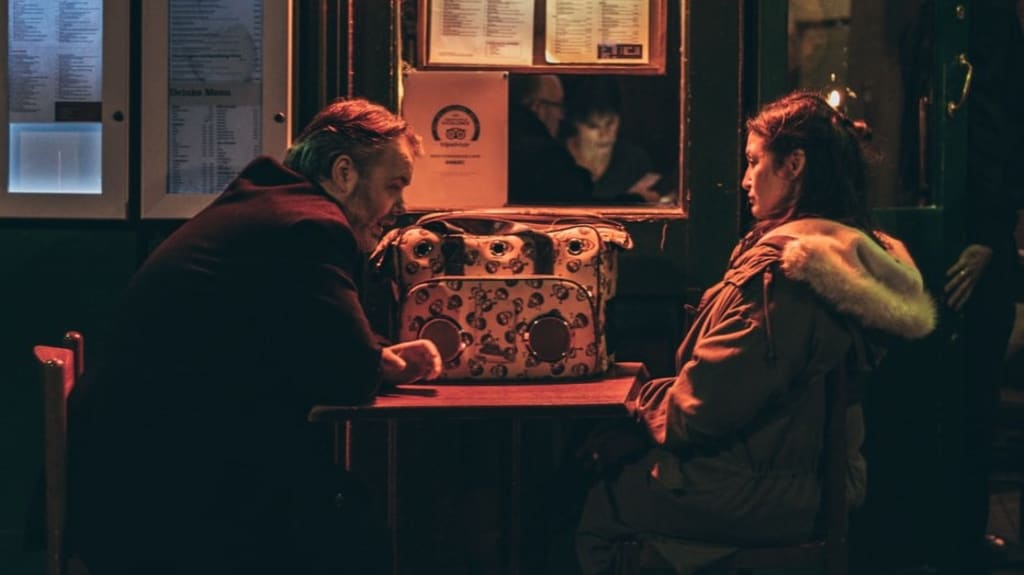
The café was much busier than normal. Cigarette smoke covered the ceiling and shrouded the room in a fog, and every table was occupied. Chairs screeched against the hardwood floors, and the smell of coffee permeated the air more heavily than usual. As the man and the woman walked in and ordered their drinks, they heard a radio playing in the background:
“. . . occupied the south of France. Soldiers have driven out opposing forces. Casualties are amounting upwards of only three thousand, but bodies are still being found. A great victory for us all, paralleled only by our occupation of Germany back in 2095. In other news, the War has taken a darker turn for us in Russia. American casualties there have amounted to . . .”
The two of them turned to fit in-between chairs as they made their way to the last open table at the far corner of the room. As they sat down, the woman saw a small TV at the far end of the barista’s counter. It was playing a recent war film that had come out, and was currently showing a scene of four soldiers, many of which had not yet reached their teens, storming up a hill under a storm of bullets, fighting and dying to take some enemy base. The music was swelling, and it was clear that the children were heroes.
The woman watched the scene with an even, stern expression. “I wish they wouldn’t show this one as often as they do,” she said bitterly.
The man glanced at the television. “This one’s good for morale.” He watched the film silently for another few seconds, then turned back to the woman. “Well, so—how’s your arm doing?” he said, gesturing to her cast.
“It itches.”
“That’s the worst part of those things. I hope it never happens to me. I can take the pain, but I don’t think I could take the itching.” He laughed to himself, but the woman’s cold expression did not change, and after some time he fell silent, then cleared his throat. “There’s really not much to it, you know. I just need a signature, and you get your check. It’s a simple exchange.”
“Simple,” the woman echoed somberly.
He nodded, then reached into his pocket and pulled out a pack of cigarettes and a lighter. But just as he went to light the cigarette, he stopped and asked, “Is it all right if I smoke?”
She looked at him. “I don’t care.”
“You didn’t like it last time.”
“It’s fine.”
“If it bothers you, I’m have no problem with—”
“I said it’s fine.”
The man looked at her motionlessly. Then he pulled out another cigarette and held it out to her. “Here, take one.”
She shook her head. “I don’t want it.”
“You seem like you could use it.”
“It’s never appealed to me.”
The man waited a few more moments, then finally yielded and pocketed the pack. “Well, they’re not for everyone. But you ought to try it sometime. They really do help. They’re a good way to forget about bad things. I heard on the radio yesterday that some civilians over in Nagoya tried rebelling against our soldiers. So we rounded them all up and killed them. ‘The Miracle in Nagoya,’ they called it. Does it bother me? Sure, if I think about it too hard. But whenever that happens, I just take a cigarette and—” He exhaled a perfect circle of smoke into the air, and when it faded, waved his hands like a magician. “Forgotten. That’s all it takes. All you have to do is find a way to put it out of your mind, and if you do it enough times, then you don’t ever think about it again.”
The woman frowned and said nothing. It unnerved her just how young this man was sitting across from her. He couldn’t have been more than in his mid-thirties, and he, like all young government employees, had not yet mastered the art of pretending to care for the general population. He could act as though he did, but no matter how reassuringly he spoke, the woman noticed the impatience in his voice and watched as he kept taking off his glasses and cleaning them with his shirt, as though he couldn’t think of how else to pass the time. Meanwhile, she could see the wrinkles in her hands, and she wondered how it was that such a young man could be looking down on her as though she was a child.
“Twelve, right?” the man said.
She nodded.
“That’s perfect. That’s the highest we pay. Twelve is the best balance of everything we look for, which means you get—”
“Have you ever done this before?” she asked suddenly, cutting him off.
The man paused a moment, then nodded. “Of course. It’s my job.”
“I don’t mean have you done this with other people. I mean have you done it yourself? Have you ever had to give up yours?”
The man blinked. “No. But I don’t have one.”
“So you don’t understand, then. There’s more to it than you think.”
“I know everything there is to it. It’s a simple exchange.”
“I don’t mean the process,” the woman said hotly. “I mean the feeling. You’ve never felt it.”
The man looked confused. “What is there to feel? I wish I had this chance. You’re getting a great price for it all. Do you know how many hours I have to work to get twenty-thousand dollars? And you can get it now, all at once, just for signing—and then another twenty once it’s all gone through. If anything, I’m jealous of you.” Seeing that she was still not convinced, he added, “Don’t you have any friends that have done this?”
At length, she said, “Yes.”
“How did they feel about it?”
She thought back. About a year ago one of her coworkers had done it, and she was able to move into a much better apartment, which was a major feat, considering that almost every apartment in the A5 district was taken. A nice apartment was one of the only marks of status anyone had anymore. The entirety of the country’s industrial power was geared solely and completely toward providing for World War VII. And after the government created the program several years ago that allowed for these kinds of exchanges, several of her friends who had sworn they would never marry began to earnestly seek out a husband. Everyone she knew—not just close friends, but the whole of her district, the whole of her society—had responded to this program with overwhelming joy. Not only did it provide a quick and effective solution to the problem the country was facing of losing most of its soldiers to the war, but it provided everyone else with a healthy financial bonus. She had watched as everyone around her took advantage of the program as quickly as possible, and she had listened to the questions and criticisms of those around her as she held off, refusing to take part. But after breaking her arm in an accident some weeks ago, she did not know where else to turn. She couldn’t work in her district’s factories anymore until her arm healed, but that would be several months. She still had bills to pay, and outside of this, she had no way to pay them.
“They felt very good,” she finally said, answering the man’s question.
“Well, there you go. If there’s anything to feel, that’s it.”
The woman clenched her jaw and looked away. The man still did not understand. No one, it seemed, understood. Even those who had already gone through it—what could they say to her? Could they look upon her, in all her trembling and weakness, and wrap their minds around why the very thought of doing this ruined her? They all seemed so proud of their decision. What she wouldn’t give to feel like them! She thought for a moment that maybe there was something wrong with her. Was it some kind of error to care as much as she did? Was it, at some point in history, normal to feel these kinds of things? Or was she some kind of fluke? Maybe she was making too much out of it. Perhaps it wasn’t such a bad thing. And who knew? Maybe the man was right. Maybe, if she kept putting it out of her mind, then the pain would eventually go away, and she would never think about it again. Yes . . . yes . . . that had to be true. It was true for everyone else around her. Why would it not be for her? A moment of pain, and then an eternity of forgetting. It would all be over soon.
“Twenty-thousand?” she asked.
The man nodded. “And another twenty-thousand once it all goes through.”
“Okay,” she said. “I’ll sign.”
The man, with a look of relief, pulled from his pocket a small black book. He opened it to a specific page and handed it to the woman. “Sign here.”
The woman took the pen and signed.
“Thank you,” the man said. He pulled from his coat pocket a checkbook and immediately began to write on it.
As he was writing out the check, however, the woman stared at her own signature, watching as the ink dried, and the full realization of what he had just done struck her in an instant, with its full weight, and all at once she began to quiver, and a moment later she fell to tears.
The man looked at her, startled to see her in such a state. His face flushed heavily, and, not knowing what else to do, he reached over to her and, as genuinely as he could manage, patted her on the shoulder.
“It’s okay,” he said. In an effort to cheer her up, he added, “It’s not like this is the only one you get. You can always have another son.” He took the black book from her and stuffed it back in his pocket. With his business now finished, he stood up and left the café. But the woman stayed, her body shaking and her head buried in her hands, while the radio continued to play in the background:
“. . . incoming reports tell that the projected body count in southern France will amount to a total of only five thousand. Truly, a great victory for America. Never before have we had such a successful occupation with such few casualties. In Russia, however, our men are reporting casualties reaching the twenty-thousands, with more soon to come. It would seem Russia is becoming one of the primary enemies of America . . .”
In time, the woman came to. She lifted her head and bit her lip to keep herself from crying, then pressed her hands between her legs to keep them from shaking. She stayed like this, staring at the lights on the ceiling until she got control of herself, upon which time she grabbed her coffee and took several long, slow sips. Then she saw the check the man had left on the table for her, and she took it and pocketed it. But after some time she grew anxious, and she felt a physical pain, as though the paper was burning her skin, so she got up and went to leave the café.
But just as she got to the door, she suddenly spotted a man smoking a cigarette at a table across the room, and she watched him earnestly for some time. And after thinking to herself, she closed the door, walked over to the man, and asked if she could have a cigarette.
About the Creator
Keep reading
More stories from writers in Families and other communities.
Wise~Guys
— Look Behind what's in Front of You ~ Make Good Choices — Hey, So how you Doin'..! Made~Men — Mobster Movies romanticise a distinctive, elegant appearance, impeccable attire style, along with the 'Families' expressive lingo. Making their 'Bones' gave them Panache — with vintage fedoras, tailored pin-striped suits, mirror-polished wing-tip shoes adorned with tassels; with their 'Gun Moll' gorgeous dates on their arms.
By Jay Kantor24 days ago in Families
The Kind-Hearted Friend
In a lush forest, there lived a troop of monkeys. Among this troop were two young monkeys who were notorious for their mischievous behavior. Their constant pranks and antics had even exhausted their parents, who often scolded them for their wildness. In the same forest, there was a young giraffe, a gentle and innocent creature, known for his simplicity and good nature. One day, while grazing on the green grass, the young giraffe wandered into a part of the forest where the mischievous monkey duo was busy plucking leaves and fruits from the trees to eat.
By Sudais Zakwan3 days ago in Families
Five—One Grounding
Five—Locked in a perpetual battle against my failing senses and reason, I fight to survive, to get through; I am afraid of... nothingandeverythingallatonce—...—my mouth is dry, and my muscles seize up... what can I see? I can see the birdcage and birds; I can see the watercolour my beautiful wife painted many years ago and unlocked her journey into art; I can see the empty mug of tea as it sits perilously on the arm of the sofa; how many is that now? Three down, two to go; I can also see a jackdaw on the roof of our neighbour's house across the road and a bookcase of potential—Five things you can see.
By Paul Stewart7 days ago in Poets



Comments
There are no comments for this story
Be the first to respond and start the conversation.