
The Year My Father Became a Stranger
Grief didn’t break us all at once—it happened in slow, invisible ways.


The Year My Father Became a Stranger
I used to know my father like I knew my own heartbeat.
There was a rhythm to us, once. In the way he’d toss me a soccer ball on Sunday mornings, or how we’d listen to Motown in the car without saying much, both of us humming along. We weren’t talkers—we were doers. Our love was built on shared silence, gentle nods, and the kind of quiet comfort you only find when you truly belong somewhere.
But then my mother died, and everything changed.
That was the year my father became a stranger
I was seventeen. Old enough to know what grief looked like, but not old enough to understand how it rewired a person. My mom’s illness was short and brutal, like a storm that rolls in out of nowhere, flipping the world upside down before anyone has time to run for cover. One week we were arguing about me skipping school to hang out with Maya and Josh, the next week we were standing in a cold hospital room, watching machines do the breathing for her.
She was the glue. The translator between my father and me. Without her, our home became a museum. Same furniture, same pictures on the wall—but none of it alive anymore.
Dad didn’t cry. Not at the funeral. Not at the kitchen table where she used to sit with her chipped coffee mug and crossword puzzles. Not even when I found him sitting on the edge of their bed, staring into a closet still full of her clothes. He just… folded in on himself.
And I didn’t know how to reach him.
At first, I tried. I’d come downstairs in the mornings and say things like “Want eggs?” or “I’ve got a math test today.” He’d grunt or nod or offer a half-hearted “Good luck,” but his eyes were always somewhere else. Glazed over. Like he was still listening for her voice in another room.
Then one day I came home late from school—deliberately—and he didn’t ask where I’d been.
That should’ve been freedom, right? But it felt like abandonment.
I started staying out more. Coming home to a dark house. I’d hear the creak of the floorboards upstairs as he paced at night, but we never talked about it. We were ghosts to each other. Coexisting. Breathing in the same space, but on different timelines.
There was this one moment, around Christmas, when I thought I could crack the silence.
I found an old photo of the three of us—me on my dad’s shoulders, Mom beside him laughing, her scarf flying in the wind. I left it on the kitchen counter with a sticky note that said: “Do you remember this day?”
He never mentioned it.
I found the photo the next morning tucked into the junk drawer, under expired coupons and broken rubber bands.
That stung more than yelling would have.
When someone dies, everyone tells you that grief brings families together. But they never talk about the kind of grief that splits people apart—how the quiet kind kills relationships in a way you don’t even notice until it’s already done.
It wasn’t a big blowout or a betrayal.
It was dinners eaten separately.
It was unanswered texts from the upstairs bedroom.
It was missed birthdays and unopened report cards.
It was sitting across from someone who once knew all your fears and favorite songs—and realizing they hadn’t looked you in the eyes for six months.
In the spring, I almost failed history.
My teacher called the house, and for the first time in months, Dad said more than a sentence to me. But it wasn’t what I expected.
He didn’t ask why.
He didn’t ask how I was.
He just said, “You need to fix this,” and walked away
That night, I screamed into a pillow so loud I gave myself a sore throat. Not because I was failing—but because it felt like I had already failed at the only thing that mattered: keeping what was left of my family intact.
Graduation came and went. He showed up, sat in the back row, and left before I could find him in the crowd. My friends congratulated me. Maya cried. Josh handed me a stupid balloon that said “You did it!”
And all I could think about was that my father hadn’t clapped.
Not once.
It took me years to understand that my dad wasn’t trying to hurt me.
He was drowning.
Just like I was.
But he didn’t know how to ask for help, and I didn’t know how to offer it. We were two people stuck in our own separate pain, waiting for the other to reach across the gap—but neither of us could move.
We still talk now—briefly. On birthdays. Holidays. I visit once or twice a year. We exchange stiff hugs and comment on the weather. Sometimes we look at old photos and smile like strangers pretending to remember something deeply. And maybe that’s all we’ll ever have.
Some people lose their fathers in sudden ways—a heart attack, a car crash, a war.
I lost mine slowly.
Over coffee left untouched.
Over rooms gone quiet.
Over words that were never spoken.
And while part of me still hopes he’ll look me in the eyes one day and say “I’m sorry I disappeared,” I’ve made peace with the idea that maybe he won’t. Maybe he can’t.
But I remember him.
The version before the grief.
And I carry that version with me wherever I go.
Because even if my father became a stranger to me, I will never forget the man who once hummed Motown in the car, and made the world feel like it would always be okay.
About the Creator
Keep reading
More stories from waseem khan and writers in Families and other communities.
The Door My Father Never Closed
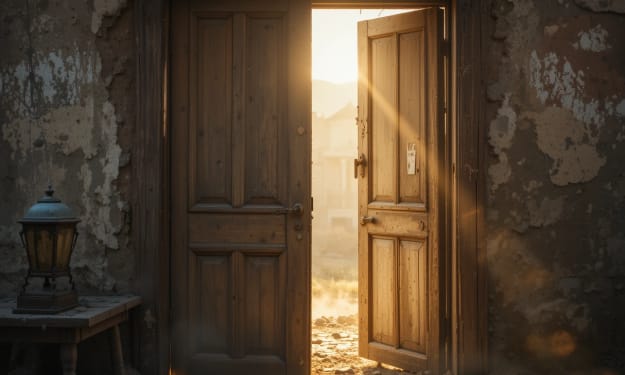
The door to my father’s study was never fully closed. It creaked, quietly, leaning into the frame like it too was unsure of whether it should commit. It stayed ajar through thunderstorms, during birthdays, through dinners left uneaten after angry words. A door that whispered of invitation even in moments we mistook for abandonment.
By waseem khan6 months ago in Families
Wise~Guys
— Look Behind what's in Front of You ~ Make Good Choices — Hey, So how you Doin'..! Made~Men — Mobster Movies romanticise a distinctive, elegant appearance, impeccable attire style, along with the 'Families' expressive lingo. Making their 'Bones' gave them Panache — with vintage fedoras, tailored pin-striped suits, mirror-polished wing-tip shoes adorned with tassels; with their 'Gun Moll' gorgeous dates on their arms.
By Jay Kantor17 days ago in Families
The quiet sound of families breaking
There is a kind of silence that is louder than any noise. It is the silence of a child waking in the night and realizing their parent is gone. It is the silence of a kitchen table with one chair suddenly empty. It is the silence of a home that still looks the same, but no longer feels the same. Across the United States, thousands of families live inside that silence. Not because of war. Not because of disaster. Not because of death. But because of policy.
By Kaylee Souther6 days ago in Families



Comments
There are no comments for this story
Be the first to respond and start the conversation.