
The Door My Father Never Closed
A Story of Unspoken Love and the Echoes Left Behind

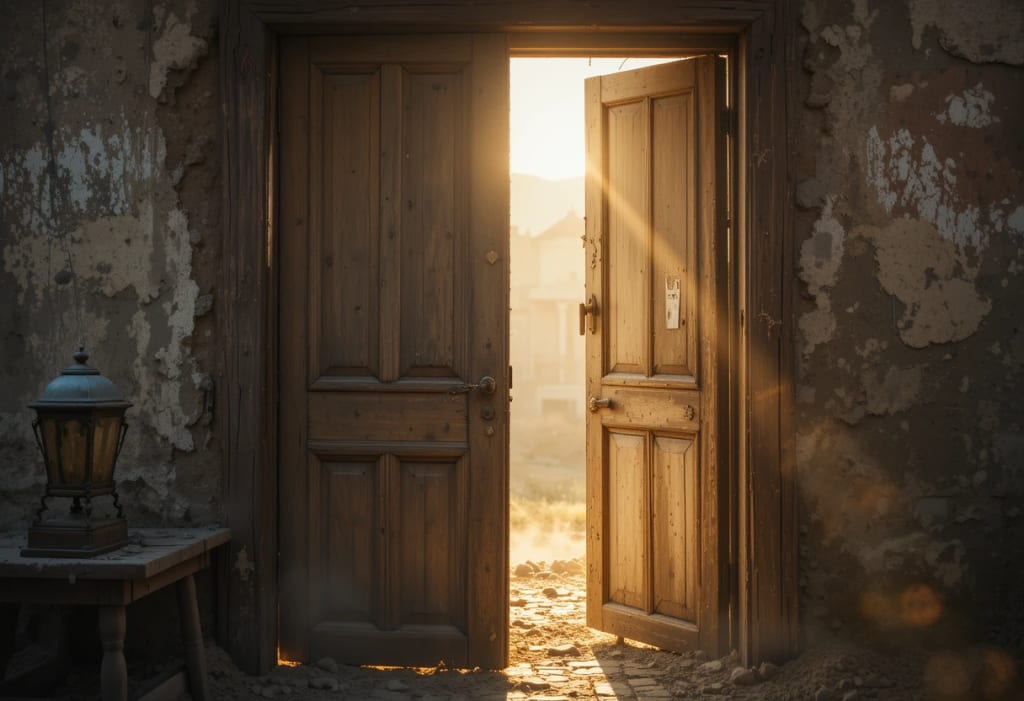
The door to my father’s study was never fully closed.
It creaked, quietly, leaning into the frame like it too was unsure of whether it should commit. It stayed ajar through thunderstorms, during birthdays, through dinners left uneaten after angry words. A door that whispered of invitation even in moments we mistook for abandonment.
I used to resent it—this half-opened thing. I thought it meant indecision. I mistook the gap for a barrier. As a child, you want clarity: open or closed, yes or no, love or not-love. But my father was a man of ellipses, not periods.
He never said “I love you” in the easy ways I heard from other fathers on television, or in the voices of my friends’ dads who scooped their kids into arms like it cost them nothing. My father loved with silence, with weathered hands fixing broken toys on the kitchen table, with old jazz records that he insisted on playing on rainy Sundays, with a coat handed to me without words when the wind bit too hard.
And with that door—always, always left slightly open.
I remember one night in particular, during one of those pointless teenage storms when I thought he didn’t understand anything about me. I had thrown words at him like knives—about control, about not listening, about dreams I thought he was crushing with his quiet disapproval. He didn’t raise his voice. He never did. He just looked at me with those sad, knowing eyes and said, “You’ll understand one day.”
I slammed the door to my room so hard the whole house shook.
But sometime in the middle of the night, I heard the hinge moan faintly. I pretended to be asleep. He didn’t step in. He didn’t say a word. But the light from the hallway pooled softly into my room through the crack he left. A thread of gold in the dark. The door was open, just slightly. Just enough.
It infuriated me.
It comforted me.
I forgot about that moment for years.
When my father died, the silence was the loudest part. No radio drifting down the hallway. No sudden chuckle while reading the paper. No low hum as he watered the plants. Just stillness.
The house became a museum of his unspoken affections. His coffee mug still on the drying rack. A bookmark in the middle of the gardening section in one of his almanacs. And, of course, the door to his study—half-open, waiting, like it always was.
I didn't walk into that room for a long time. I was afraid. Not of dust or memories, but of grief pressing down too hard in the place where he used to sit and write his weather journals, noting the patterns of wind and clouds like they were old friends.
When I finally stepped in, it was morning.
Light spilled across his desk, warming the leather armchair. His notepad lay open, a pen placed neatly beside it. There was a list, of course—he always made lists. This one said:
Check roses (aphids?)
Fix gate latch
Call Sam about the canoe
Leave the door open
That last one stopped me cold. The handwriting wavered slightly, like his hand had been shaking. It was the last entry.
I stood in that doorway for a long time, unable to move.
He had known.
He always knew something I didn't yet. That love wasn’t in the grand gestures but in the discipline of small, consistent acts. In patience. In leaving the door open, even when you’re tired, even when you're hurting. Because one day, someone might need to walk through it.
I think about that door a lot now, especially with my own children. When they’re angry. When they don’t understand me. When they slam their own doors like I used to.
And when they sleep, I walk down the hall. I open their doors—not wide, just enough. Just like he did. It’s not about watching or control. It’s a gesture. A soft signal that says, “I’m still here. When you’re ready.”
Sometimes I talk to him now in that room. I sit in his chair. I imagine what he might say, though I already know.
He’d smile a little, that half-grin that meant he saw right through you but wouldn’t say it aloud.
He’d point to the door.
“Don’t close it,” I imagine him saying. “Not all the way. Not even when it hurts.”
And I don’t.
There is something sacred about a door that’s not quite closed. It says: You are welcome, even now. Especially now. It says: We may not always speak, but the path between us remains.
My father was not a man of many words.
But he gave me one gesture I will carry for the rest of my life.
An open door.
And everything it meant.
About the Creator
Keep reading
More stories from waseem khan and writers in Families and other communities.




Comments
There are no comments for this story
Be the first to respond and start the conversation.