
. The Sparrow and the Clock
A whimsical allegory about time, illusion, and learning to live in the moment.
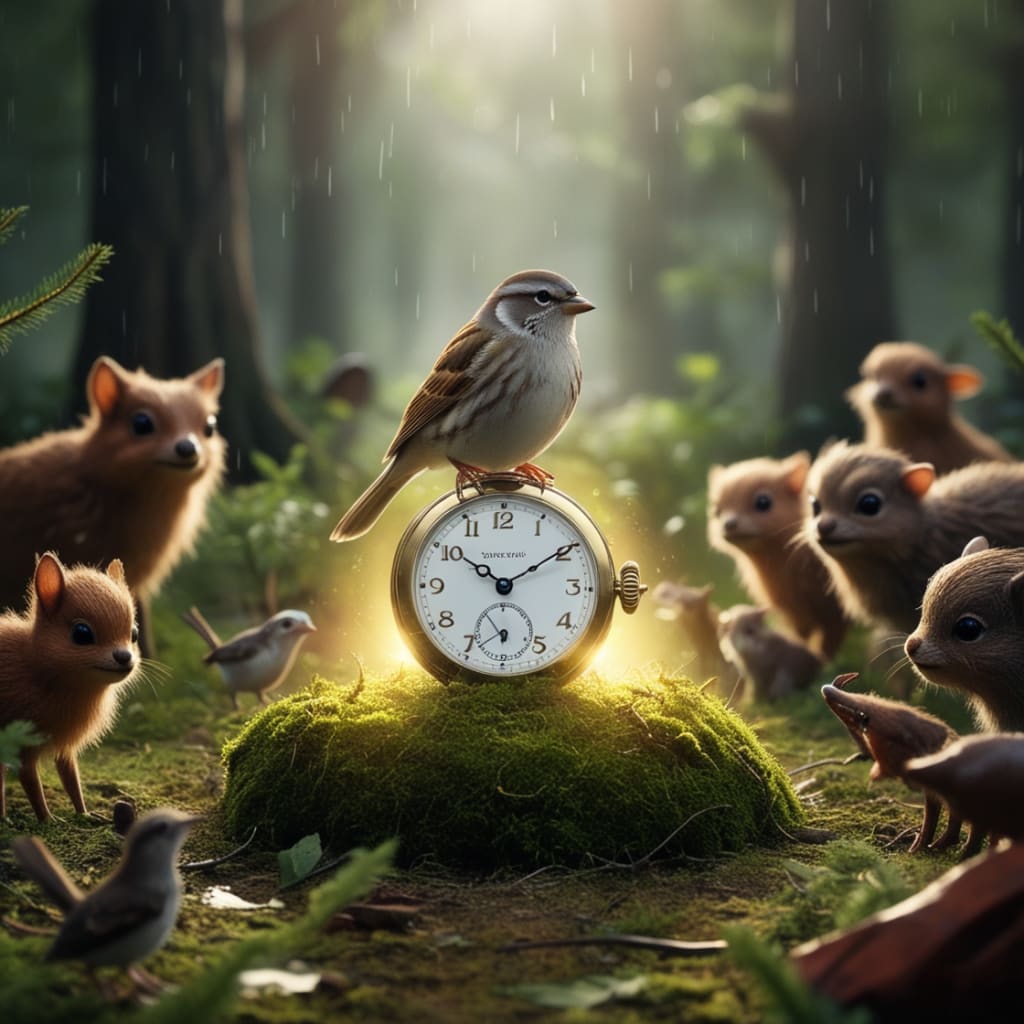
In a clearing where the sunlight dropped in dappled patterns, and the wind whispered in lazy curls through pine and birch, there lived a sparrow with more curiosity than sense. Her name was Pica, and she had a terrible obsession: shiny things.
Nuts, pins, lost earrings, bottle caps—Pica collected them all, tucking her treasures into a hollow knot in the oldest oak tree on the hill. But one day, she found something that shimmered beyond comparison. It was buried half in mud and half in moss: a pocket watch, cracked and cold, its hands frozen forever at ten past three.
“Oh, what is this golden moon?” she chirped, hopping around it. She pecked at its surface, flipped it over, and danced on its face. When the wind moved the hands slightly and they ticked once, Pica gasped.
“It speaks!” she cried. “This is no ordinary trinket. This is a time-maker. A ruler of the day!”
The other birds snickered from the branches above. “It’s just a broken thing,” grumbled Jay. “Humans drop them all the time.”
But Pica puffed up her chest. “You don’t understand. This clock has chosen me. I am now the Keeper of Time!”
The next morning, before the sun had even fully risen, Pica flew across the clearing, landing on branches and shouting her declarations:
“It is now three minutes past dawn! All squirrels report to nut patrol! Chipmunks, begin tunnel checks! Bluebirds, warming songs on my cue!”
Everyone ignored her at first, assuming it was just Pica being dramatic again. But the next day, she added a tiny crown—made of wire and beetle shells—and stood on a stump to issue the “daily time decrees.”
She even built a tower of sticks and mushroom caps, placing the watch at the very top and announcing:
“This is the Clockstone. When it ticks, the day turns. When it pauses, time obeys. You may ask it nothing. Only I interpret its will.”
Now, some of the younger animals were impressed, not knowing any better. They began listening to her announcements. If Pica said it was lunchtime, they chewed grass or seeds, even if they weren't hungry. If she declared nap hour, they yawned and curled up.
The forest, once ruled by instinct and rhythm, began to grow stiff. Ants started marching in odd square patterns. Frogs croaked at awkward hours. Even the sunflowers began turning early, confused by the sudden shift in order.
But the sky did not care.
One morning, when Pica proudly rang a bell made of snail shells to declare “Moonrise Rehearsal,” clouds gathered—thick and dark. A storm rolled in, grumbling and wet.
“Wait!” Pica squawked. “It’s not time for rain yet!”
Lightning ignored her. Thunder mocked her with deep-bellied laughter.
Her watch glinted dully, stuck still at ten past three.
Panicked, Pica grabbed the watch and fluttered into the clearing, raising it above her head.
“Work! I command you! You’re the Clockstone! You control the day!”
But no tick came. Just the crack of thunder and the slap of cold rain. The watch slipped from her talon and smashed against a stone.
It broke open with a soft crunch.
Out spilled tiny gears and a tangled spring, and nothing else. No magic. No whisper of time.
Pica stood stunned in the downpour, crown soggy, feathers clinging to her chest.
From beneath a mushroom, Old Toad blinked at her. “Time’s never been something you keep,” he croaked. “Only something you notice.”
Pica didn’t answer. She flew back to the oak hollow and sat alone for a long while. The watch pieces stayed in the clearing, half-buried, slowly rusting.
That night, for the first time in weeks, the forest fell into its own rhythm again.
The moon rose when it wanted. The owls sang not on schedule but from their hearts. Crickets chirped in uneven patterns, beautiful in their imperfection.
Pica listened to it all, her wings folded tight.
In the morning, she returned to the stump—no crown, no announcements.
She cleared her throat.
“Dear forest,” she said, “I would like to return to being just a sparrow. I don’t wish to keep time anymore. I want to feel it again.”
Jay cocked his head. “Does that mean no more mandatory sunrise speeches?”
Pica chuckled softly. “No more speeches.”
“Not even Timekeeper Tuesdays?” said Squirrel.
“Especially not those.”
There was a beat of silence, then a cheer, awkward and feathered, but warm.
From then on, Pica sang with the robins at dawn—not to mark the hour, but because she felt like singing. She flew not according to a schedule, but wherever the wind pulled her.
The hollow knot in the oak became less cluttered. She gave away most of her shinies to those who needed them: a button to a mouse for her nest, a bead to a wren for her collection, a shard of mirror to Toad so he could see if the flies were stuck in his teeth.
And the watch? She kept one piece—a single broken gear—hanging from a string on the branch beside her perch. Not as a relic of power, but as a reminder.
Time is not a thing to master.
It is a river that runs whether you fight it or float.
And sparrows, Pica learned, were made to float.
About the Creator
Keep reading
More stories from Abuzar khan and writers in Families and other communities.
The Forgotten Song of My Father
When I was a child, my father’s presence filled the house like smoke—always there, lingering, yet impossible to hold. He wasn’t cruel, and he wasn’t kind. He was quiet. A man of few words, fewer expressions, and a kind of stillness that made even the walls hesitate. He simply existed, floating in and out of rooms, his footsteps muffled by worn carpets and quiet regret.
By Abuzar khan6 months ago in Families
Christmas Abroad: Celebrating the Holidays Without Family
I moved to South Korea in 2017. I was twenty-two years old and excited to start my career as an English Second Language Teacher. With a Bachelor's degree and six hundred dollars in my bank account, I set off for Busan.
By Kera Hollow29 days ago in Families
A Heartfelt Family Gathering: Celebrating Dad’s Birthday with Those Who Truly Matter
Celebrations come in many forms — some grand and elaborate, others quiet and deeply meaningful. For Dad’s birthday this year, we chose the latter: a heartfelt family gathering filled with love, memories, and the simple joy of being together. It wasn’t a huge affair like some big birthday parties you see on social media. Instead, it was a celebration rooted in connection — a true family gathering that reminded us what matters mostMost of Dad’s coworkers couldn’t attend. Many of them live overseas or in different states, so they had planned their own smaller gatherings for him in their local areas. This was their way of honoring a loved one from afar, sending birthday wishes and thoughtful messages from miles away. Another bittersweet reality we faced was that so many of Dad’s older relatives and cherished family members could only participate in spirit — attending the celebration in our hearts rather than in person. It’s always a little sad to acknowledge that some loved ones are now celebrating with us from Heaven, watching over us instead of singing “Happy Birthday” beside us.
By Yassine Loufti7 days ago in Families


Comments
There are no comments for this story
Be the first to respond and start the conversation.