
The Forgotten Song of My Father
How an old vinyl and a broken silence brought me closer to a man I never understood
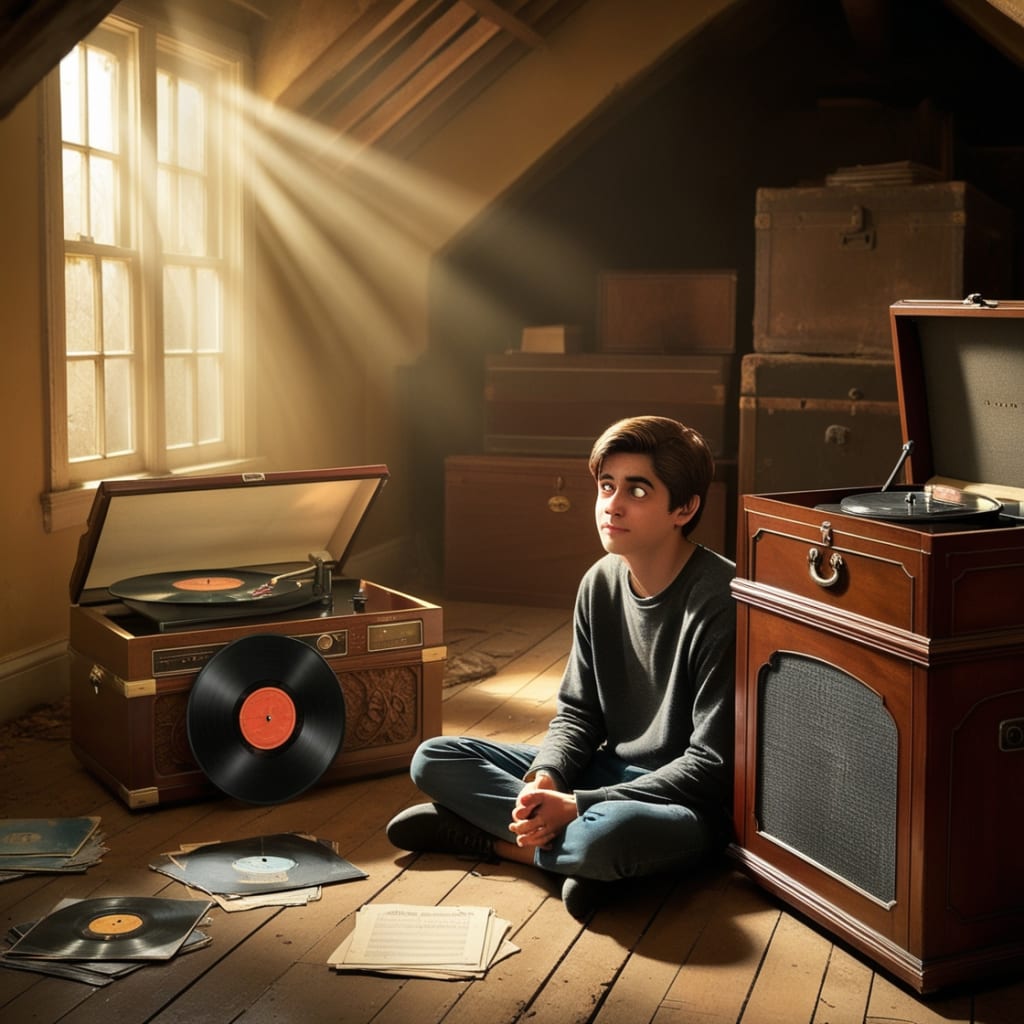
When I was a child, my father’s presence filled the house like smoke—always there, lingering, yet impossible to hold. He wasn’t cruel, and he wasn’t kind. He was quiet. A man of few words, fewer expressions, and a kind of stillness that made even the walls hesitate. He simply existed, floating in and out of rooms, his footsteps muffled by worn carpets and quiet regret.
He was the kind of man who kept his feelings sealed tight—like folded letters no one was ever meant to open. I don’t remember long conversations or deep talks about life. I remember him reading the paper in the morning, watching the news at night, and sighing just a little too long between the two.
It wasn’t until years after he passed away that I discovered the record.
I was cleaning out the attic on a rainy Sunday, the kind of day when memories seem to echo louder. Dust clung to everything like old grief, and the light bulb above flickered as though it, too, had grown tired of remembering. I was sorting through boxes of tax papers and yellowing photographs when I found it—an old cardboard sleeve tucked between forgotten Christmas lights and a rusted toolbox.
There was no label on the vinyl, no case. Just a scribbled note on the back of the sleeve in his handwriting: “For J, always.”
J was my mother’s initial. But she had never mentioned this album, nor did I know my father ever touched music, let alone created it.
Curiosity tugged at me with hands too gentle to resist.
I carried the record downstairs and dusted off the old turntable we hadn’t used in years. The machine groaned as it started up, the needle hesitant, like it too had lost its place in the world. And then, like a ghost stepping into the room, a voice emerged—low, shaky, a little rough around the edges. But unmistakably his.
It was my father. Singing.
The song was simple. Just a guitar and his voice. No grand arrangements. No background harmony. Just him, raw and honest. But the lyrics—God, the lyrics. They were more than a song. They were a love letter. A confession. A promise. A goodbye wrapped inside a melody.
I sat there cross-legged on the living room floor, frozen. The tears came silently, as if they knew they didn’t need to ask permission. I listened to this side of my father I’d never met before. A man who had once loved deeply, fiercely, like the world was something to be conquered with open arms. And then—something had broken him.
Growing up, I always thought of him as a man-shaped mystery. His silences said more than his words ever did. He worked long hours. Came home tired. Ate dinner without looking up. He rarely smiled. He never told stories.
I remember asking him once, when I was twelve, “Dad, were you ever in love before Mom?”
He looked at me—almost startled—and after a long pause, he answered, “Music. That’s who I loved.”
It didn’t make sense then. I thought he was being poetic or strange. But now, the record made everything clear. He had loved her—my mother—through melodies. Through lyrics he never dared to speak aloud. Through a vinyl album that never saw the light of day.
A week later, my mother came over for tea. We sat in the kitchen, the kettle steaming between us, wrapped in our usual dance of long pauses and half-finished sentences.
“I found one of Dad’s records,” I said.
She froze, her hand halfway to her cup. “Which one?”
“The one that says, ‘For J, always.’”
She exhaled, slowly, like she was letting go of something heavy. “I didn’t think he’d kept that.”
“He never told me he could sing.”
“He never told anyone,” she said, and a soft smile tugged at the edge of her mouth. “He was afraid of being ordinary.”
I asked her about the song. When he wrote it. Why he never played it. She told me it was from the early years—when they were still dreaming together, living in a tiny apartment above a bakery. When they’d stay up until 2 a.m. making plans they couldn’t afford but loved imagining anyway.
“He was a different man then,” she said, her voice trembling. “He believed he could make something beautiful.”
He did, I thought. He just didn’t realize it.
That night, I played the record again. The sound crackled, soft and broken, like his voice was fighting its way through the years to reach me. I sat in the same spot, but this time I didn’t cry. This time, I sang along.
Maybe my father wasn’t a man of bedtime stories or big emotions. Maybe he didn’t know how to hold love in his hands. But in his own way, he left me something. A map. A song. A fragile piece of the man he once was—and perhaps still wanted to be.
And maybe that’s all any of us can hope for.
To be remembered not by the silence we left behind,
But by the one song we dared to write
Before it was too late.
About the Creator
Keep reading
More stories from Abuzar khan and writers in Families and other communities.
Rural and Suburban Loneliness
It wasn’t the quiet that bothered Edith. It was how loud it could get. She lived in a small white house on the last street before the cornfields began. Not quite farmland, not quite neighborhood—just the space in between. The kind of town where people wave but never stop. Where every dog knows its way home, and every secret stays in the soil.
By Abuzar khan6 months ago in Families
Wise~Guys
— Look Behind what's in Front of You ~ Make Good Choices — Hey, So how you Doin'..! Made~Men — Mobster Movies romanticise a distinctive, elegant appearance, impeccable attire style, along with the 'Families' expressive lingo. Making their 'Bones' gave them Panache — with vintage fedoras, tailored pin-striped suits, mirror-polished wing-tip shoes adorned with tassels; with their 'Gun Moll' gorgeous dates on their arms.
By Jay Kantor17 days ago in Families




Comments
There are no comments for this story
Be the first to respond and start the conversation.