
The Photograph That Bridged Nine Decades: A Heartwarming Tale of Twin Brothers and Their Mother's Legacy
How One 1936 Family Portrait Became a Symbol of Enduring Love and the Unbreakable Bonds of Family

The late afternoon sun cast long shadows across the emerald hills of County Cork as Margaret O'Sullivan adjusted her checkered headscarf and smoothed down her worn but clean dress. It was autumn 1936, and at just twenty-two years old, she carried the weight of the world on her slender shoulders. In her arms, she held her greatest treasures – twin boys, barely eight months old, their cherubic faces peering out at a world that seemed both promising and uncertain.
"Hold still now, lads," she whispered softly to Thomas and Patrick, though they were far too young to understand. The traveling photographer had arrived in their small village that morning, offering to capture family portraits for those who could afford the modest fee. Margaret had saved every penny for months, knowing instinctively that this moment – this fleeting glimpse of their life together – needed to be preserved.
The wooden fence behind her had weathered countless seasons, much like the rolling hills that stretched endlessly toward the horizon. Trees dotted the landscape like ancient sentinels, their leaves beginning to turn the golden hues of autumn. Margaret positioned herself carefully, one baby nestled in each arm, and smiled with a mixture of exhaustion and profound love that only a mother could understand.
*Click.*
The shutter captured more than just an image that day. It froze a moment of pure maternal devotion, the kind that would echo through generations yet to come.
The Weight of Dreams
Life in rural Ireland during the 1930s was far from easy. Margaret's husband, Seamus, worked the fields from dawn until dusk, his hands permanently stained with soil and his back bent from years of hard labor. The twins had arrived during one of the harshest winters on record, and Margaret often found herself wondering how they would manage to feed two growing boys when one seemed challenging enough.
But as she looked down at Thomas and Patrick that day, she made a silent promise. Whatever hardships lay ahead, these boys would know love. They would understand the importance of family, of staying connected to their roots, and of never forgetting where they came from. The photograph would serve as a reminder of that promise – a tangible piece of their beginning that would travel with them wherever life might lead.
The photographer, a kind man named Edmund who made his living traveling from village to village, carefully packed away his equipment. "Beautiful family, Mrs. O'Sullivan," he said, tipping his hat. "These boys will grow up to be fine men, mark my words."
Margaret nodded, clutching the receipt for the photograph that would be ready for collection in two weeks' time. She had no way of knowing that this simple piece of paper represented one of the most important investments she would ever make.
Growing Up O'Sullivan
The years that followed were a tapestry of joy and struggle, woven together with the threads of family love and determination. Thomas and Patrick grew up inseparable, two halves of the same whole. Thomas, born twelve minutes before his brother, took on the role of protector from an early age. He was thoughtful and careful, always looking out for Patrick's more adventurous spirit.
Patrick, with his mischievous grin and fearless nature, seemed to find trouble wherever he went. But it was never malicious – just the natural curiosity of a boy who saw the world as one grand adventure waiting to be explored. Whether they were climbing trees, chasing sheep through the fields, or helping their father with the harvest, the twins were rarely seen apart.
Margaret kept the framed photograph on the mantelpiece, where it watched over their small but happy home. On quiet evenings, when the work was done and the boys were finally asleep, she would sit by the fire and study that image. Sometimes she could hardly believe that the young woman in the photograph was really her – life had a way of aging you beyond your years when survival required constant vigilance.
As the boys grew older, they would often catch their mother staring at the photograph with a wistful expression. "Tell us about that day, Mam," Thomas would ask, settling beside her on the worn wooden chair that Seamus had made with his own hands.
And Margaret would tell them about the traveling photographer, about how she had saved every penny, about her dreams for their future. "You were just babies then," she would say, "but I knew that someday, when you were old men, this photograph would remind you of how much you were loved."
The Call of the New World
The 1940s brought changes that no one could have anticipated. World War II raged across Europe, and even in their remote corner of Ireland, the effects were felt. Food became scarcer, opportunities even more limited, and young men began looking across the Atlantic toward America, where stories of prosperity and possibility filtered back through letters from relatives who had made the journey years before.
When Thomas and Patrick turned eighteen, they made the decision that would define the rest of their lives. Like so many Irish boys before them, they would seek their fortune in America. Margaret's heart broke the day they told her, but she also felt a fierce pride. These were her sons, raised to be brave and strong, and she would not stand in the way of their dreams.
The night before they left, Margaret carefully wrapped the framed photograph in soft cloth and handed it to Thomas. "Take this with you," she said, her voice steady despite the tears in her eyes. "Whatever happens, wherever you go, remember that you began here. Remember that you were loved from your very first breath."
Thomas tucked the photograph safely into his satchel, and the next morning, the twins began their journey to a new life across the ocean. Margaret stood at that same wooden fence where the photograph had been taken, watching until they disappeared over the hill. She would never see her sons again, but the love they carried with them would prove stronger than any distance.
Building Lives Across the Ocean
New York City in 1950 was a maze of opportunity and challenge. Thomas and Patrick arrived with little more than the clothes on their backs, a few dollars in their pockets, and that precious photograph wrapped carefully in Thomas's belongings. They found work in construction, their strong backs and willing attitudes earning them steady employment in a city that seemed to grow taller by the day.
For the first few years, they shared a tiny apartment in Queens, the photograph displayed prominently on the small table that served as both dining room and desk. Letters from home became increasingly rare as the years passed, and eventually, word came that both Margaret and Seamus had passed away within months of each other, their hearts finally worn out by decades of hard work and worry.
The twins grieved deeply, but they also felt grateful for the foundation their parents had given them. They had instilled values that served the brothers well in their new country: the importance of hard work, the value of family, and the understanding that success was measured not just in dollars earned, but in lives well-lived.
As they established themselves in America, both Thomas and Patrick married wonderful women and raised families of their own. Thomas became a master carpenter, his skilled hands creating beautiful furniture that would be treasured for generations. Patrick opened a small grocery store that became a gathering place for other Irish immigrants, a little piece of home in their adopted country.
Through all the changes – marriages, children, grandchildren, career successes and setbacks – the photograph remained a constant. It moved with Thomas from apartment to apartment, house to house, always finding a place of honor wherever he lived. Patrick would visit regularly, and they would often find themselves standing before that image, remembering their mother's words about love and family.
The Circle of Time
Decades passed with the relentless march of time. The twins watched their children grow up American, with opportunities they could never have imagined in rural Ireland. They became grandfathers, and eventually great-grandfathers, their family tree spreading wide branches across their adopted homeland.
But as they entered their eighties, both men felt an increasing pull toward their roots. Patrick's wife had passed away two years earlier, and Thomas had been a widower for nearly a decade. Their children were grown and successful, scattered across the country with lives and responsibilities of their own.
"I want to go home," Patrick said one evening as they sat in Thomas's living room, the old photograph between them on the coffee table. "I want to see the place where this picture was taken."
Thomas nodded slowly. At eighty-nine years old, he had been thinking the same thing. "One last trip," he agreed. "To see where we began."
The journey back to Ireland was both exciting and overwhelming. The country they remembered from their youth had changed dramatically – modern roads where there had once been dirt paths, new houses where they remembered empty fields. But when they finally found their way back to the family farm, their hearts nearly stopped.
The land had been sold decades ago, but the new owners had preserved much of the original character. And there, still standing after all these years, was the wooden fence where their mother had posed with them for that precious photograph.
The Moment of Return
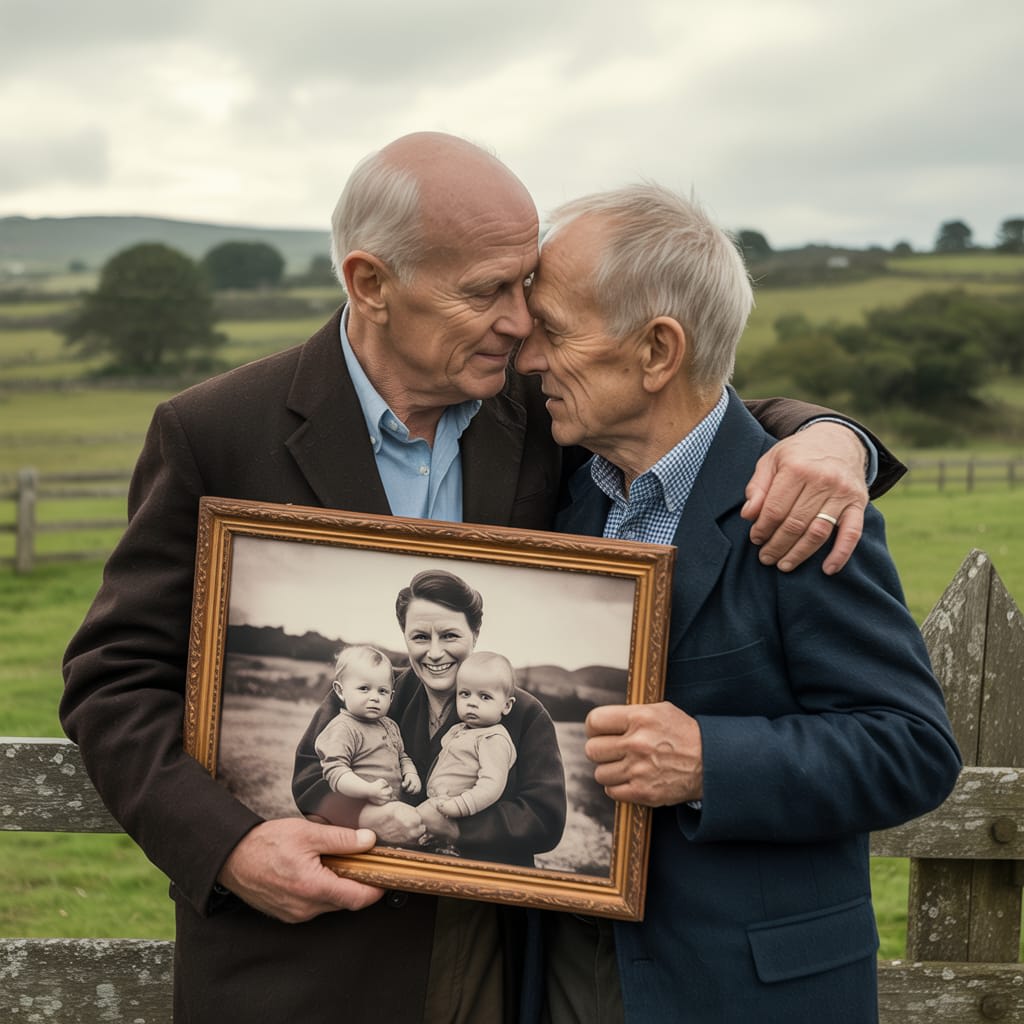
Standing there in 2025, two elderly men facing the fence where their story had begun, Thomas and Patrick felt the weight of nearly nine decades of life. The rolling hills still stretched toward the horizon, though modern houses now dotted the landscape. The trees were different – some of the old ones had fallen, new ones had grown – but the essence of the place remained unchanged.
Patrick, now wearing the cap that had become his trademark in recent years, stood beside his brother. Thomas, in his favorite dark sweater, carefully held the original framed photograph – the same one their mother had given them all those years ago.
As they posed for a new photograph, recreating that moment from 1936, both men felt their mother's presence as surely as if she were standing beside them. They could almost hear her voice on the wind, reminding them of her promise that the photograph would one day serve as a reminder of how much they were loved.
The modern photographer – a young woman with digital equipment that would have seemed like magic to Edmund from 1936 – captured the moment with the same care and attention that had been given to the original. In her viewfinder, she saw not just two elderly men, but the completion of a circle that had taken nearly a century to close.
Legacy of Love
As Thomas and Patrick prepared to return to America for what they both knew would likely be their final time, they reflected on the journey that had brought them full circle. The photograph that had traveled with them across an ocean, through decades of joy and sorrow, triumph and loss, had finally brought them home.
"Mam was right," Thomas said quietly as they stood together by the fence one last time. "This photograph did remind us of how much we were loved."
Patrick nodded, his eyes bright with unshed tears. "And now our children and grandchildren will have both pictures. They'll know where they came from, and they'll understand what it means to be family."
The two photographs – one from 1936 and one from 2025 – would hang side by side in Thomas's home, a visual testament to the enduring power of family love. They told a story that transcended time and distance, a story of a mother's love that had guided her sons across decades and continents, bringing them safely home at last.
In an age of digital images and social media, where photographs are taken by the thousands and forgotten just as quickly, the story of Margaret O'Sullivan and her twin sons serves as a powerful reminder of what truly matters. Sometimes, the most important photograph you'll ever take is the one that captures not just a moment in time, but the love that binds families together across all the years that follow.
The wooden fence still stands, weathered but strong, a silent witness to the power of love and the importance of remembering where we came from. And somewhere in the Irish countryside, the wind still carries the whispered promise of a young mother to her sons: "Remember that you were loved from your very first breath."
About the Creator
Muhammad Sabeel
I write not for silence, but for the echo—where mystery lingers, hearts awaken, and every story dares to leave a mark
Keep reading
More stories from Muhammad Sabeel and writers in Families and other communities.
Growing Up with a Parent in Prison
When I was seven, my dad stopped coming home. There was no explanation that made sense at the time. One day he was there, sitting on the worn couch with his usual cup of tea and half-smile, and the next, he was just... gone.
By Muhammad Sabeel7 months ago in Families
Wise~Guys
— Look Behind what's in Front of You ~ Make Good Choices — Hey, So how you Doin'..! Made~Men — Mobster Movies romanticise a distinctive, elegant appearance, impeccable attire style, along with the 'Families' expressive lingo. Making their 'Bones' gave them Panache — with vintage fedoras, tailored pin-striped suits, mirror-polished wing-tip shoes adorned with tassels; with their 'Gun Moll' gorgeous dates on their arms.
By Jay Kantor19 days ago in Families



Comments
There are no comments for this story
Be the first to respond and start the conversation.