
The Dynamics of Family Relationships
An Analytical Exploration

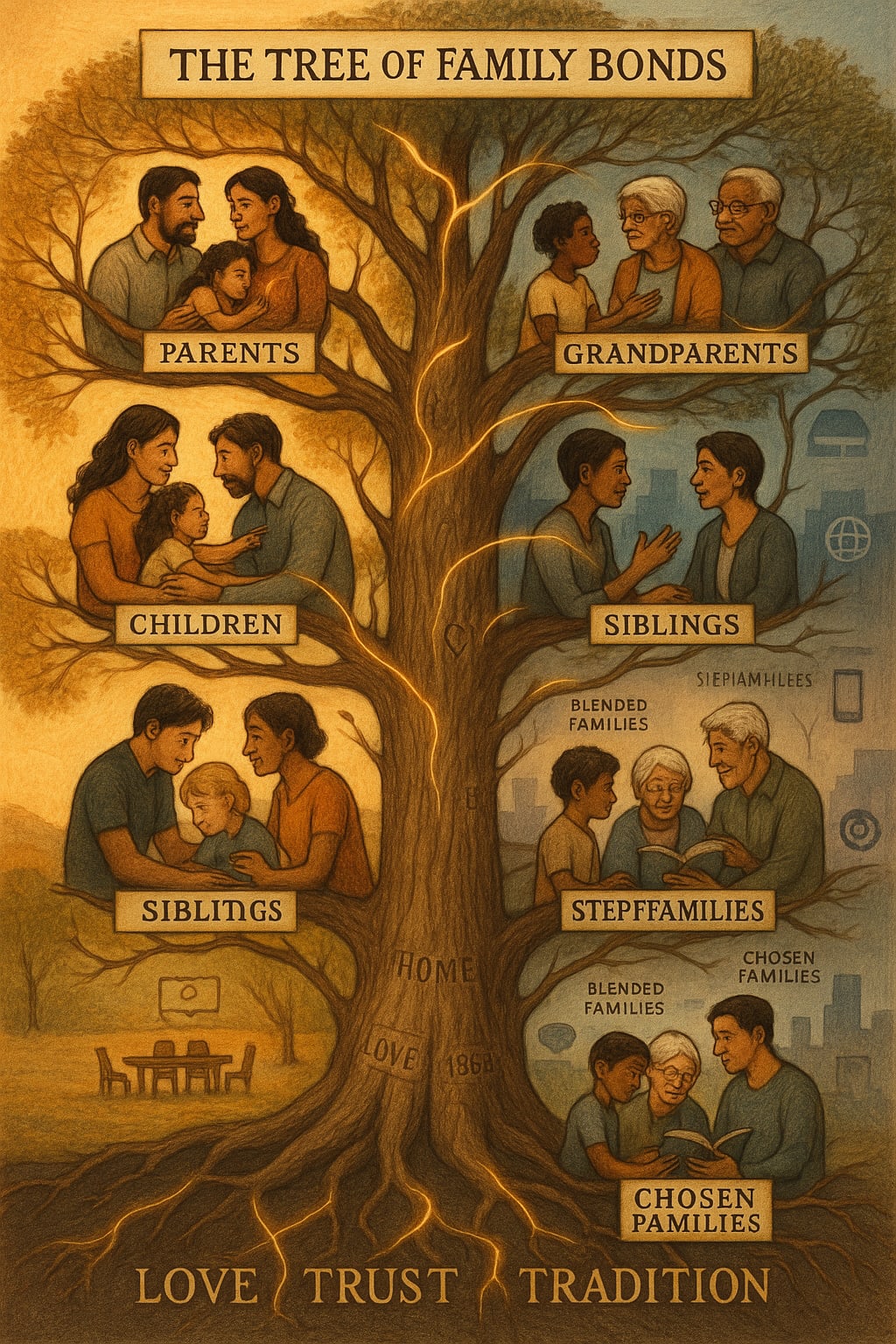
Introduction
Family is often considered the fundamental unit of society, serving as the primary source of emotional support, socialization, and identity formation. Yet, family relationships are far from monolithic. They are intricate, evolving structures influenced by culture, economics, psychology, and interpersonal dynamics. Understanding the nature of family relationships requires an analytical lens that dissects their various components—from parental roles and sibling dynamics to the effects of societal changes and technological advancements.
This article delves into the anatomy of family relationships, exploring their functions, psychological underpinnings, challenges, and the impact of modernization on familial bonds. By understanding the complexities of these relationships, we can appreciate their significance and work toward nurturing healthier family environments.
1. The Structural Foundation of Families
Families can be structured in numerous ways, including nuclear families, extended families, single-parent households, stepfamilies, and chosen families. Each structure comes with its own set of relational dynamics.
Nuclear Families consist of parents and their children. They offer simplicity and clarity in roles but may lack the extended support system present in broader family units.
Extended Families, including grandparents, aunts, uncles, and cousins, often provide a stronger support network but may lead to conflicts due to overlapping roles and generational differences.
Single-Parent and Blended Families introduce complexities such as role ambiguity, loyalty conflicts, and transitional instability, yet they can also foster resilience and adaptability.
These structural foundations set the stage for how emotional bonds and relational roles develop within families.
2. Psychological Theories of Family Dynamics
Understanding family relationships involves examining psychological theories that explain behavior, attachment, and communication patterns within the family.
Attachment Theory, introduced by John Bowlby, highlights the importance of secure attachment between children and caregivers. Secure attachments foster trust, self-esteem, and effective coping mechanisms, while insecure attachments may lead to anxiety, avoidance, or disorganized behavior in later relationships.
Family Systems Theory views the family as an emotional unit where individuals cannot be understood in isolation. Instead, behaviors are best understood as part of an interdependent system. Changes in one member affect the entire system, often leading to a process of rebalancing.
Social Learning Theory posits that children learn behaviors through observation and imitation of family members, reinforcing the idea that the family serves as a primary agent of socialization.
These theories collectively underscore that the quality of family relationships significantly influences psychological well-being.
3. Parent-Child Relationships: Foundations of Development
The parent-child relationship is often the most formative in a person’s life, impacting emotional regulation, academic achievement, and interpersonal skills.
Authoritative Parenting, which balances warmth and discipline, is associated with positive outcomes such as high self-esteem, academic success, and social competence.
Authoritarian and Permissive Parenting, on the other hand, may lead to behavioral problems, emotional instability, or lack of discipline.
Parental Involvement is critical, but so is the type of involvement. Overparenting or "helicopter parenting" can stifle independence, while neglect leads to insecurity and attachment issues.
The evolving nature of parent-child relationships, particularly during adolescence, often brings tension as children seek autonomy. However, maintaining open communication and mutual respect can ease this transition.
4. Sibling Relationships: Rivalry and Solidarity
Siblings share a unique relationship, marked by both companionship and competition. They are often the longest-lasting relationships individuals experience and play crucial roles in social development.
Sibling Rivalry is common, especially when children compete for parental attention or resources. Such rivalry can lead to conflict but also teaches conflict resolution and negotiation skills.
Birth Order Theory suggests that firstborns, middle children, and youngest siblings adopt different roles and personalities based on their family position, influencing their future relationships and career paths.
Support Systems: In adulthood, sibling relationships often become sources of emotional and practical support, especially in times of crisis, such as the illness or death of a parent.
While sibling relationships may fluctuate over time, their endurance makes them a central pillar of family life.
5. Spousal Relationships: Partnership and Conflict
Marital and spousal relationships are central to family stability. Healthy partnerships model intimacy, cooperation, and conflict resolution for children and other family members.
Communication is the cornerstone of successful marriages. Research shows that couples who practice active listening, express appreciation, and resolve conflicts constructively tend to have more satisfying relationships.
Conflict Patterns: According to John Gottman’s research, the presence of criticism, contempt, defensiveness, and stonewalling can predict marital breakdown.
Changing Roles: With increasing gender equality and dual-income households, traditional marital roles are being renegotiated. This shift can cause tension but also foster equality and shared responsibility.
Marriage counseling and therapy have become valuable tools in addressing issues before they escalate, emphasizing the need for proactive relationship management.
6. Intergenerational Relationships and Aging
The relationship between younger and older generations is vital for cultural continuity, emotional support, and identity preservation.
Grandparenting has become more prominent as grandparents often take active roles in caregiving. This can strengthen intergenerational bonds but also lead to role confusion.
Caregiving Challenges: As parents age, adult children may assume caregiving roles, which can be emotionally and financially taxing. This shift often changes power dynamics and requires renegotiation of boundaries.
Generational Gaps in values, technology use, and worldviews can cause friction, but also present opportunities for mutual learning and empathy.
Respect and understanding across generations are crucial to maintaining harmonious family systems.
7. Cultural and Societal Influences on Family Relationships
Family relationships do not exist in a vacuum; they are shaped by cultural norms, economic conditions, and societal expectations.
Cultural Variability: Collectivist cultures often emphasize family loyalty, obedience, and interdependence, while individualist cultures prioritize autonomy and personal achievement. These values influence parenting styles, marriage expectations, and elder care practices.
Socioeconomic Factors: Financial stress can strain family relationships, increasing the likelihood of conflict, divorce, and emotional neglect. Conversely, economic stability often fosters positive family interactions.
Legal and Policy Influences: Family law, social welfare programs, and healthcare policies significantly affect family structures and the resources available to support familial roles.
Society plays a pivotal role in either reinforcing or challenging traditional family dynamics.
8. The Impact of Technology on Family Relationships
Technology has revolutionized how families communicate and connect, with both positive and negative consequences.
Digital Connectivity allows for frequent communication among family members across distances, enhancing emotional closeness.
Screen Time and Disconnection: Excessive use of digital devices can lead to emotional detachment, reduced face-to-face interaction, and increased family conflict, especially among adolescents.
Digital Parenting involves monitoring children’s online activities, which can either foster trust or trigger surveillance-related tensions, depending on how it's managed.
Striking a balance between technological convenience and emotional presence is essential for nurturing strong family ties.
9. Challenges to Family Relationships
Family relationships are not immune to stress, and various factors can destabilize them.
Divorce and Separation often lead to emotional turmoil for all members, particularly children. While co-parenting can mitigate negative effects, inconsistent parenting and ongoing conflict can exacerbate problems.
Addiction and Mental Health Issues create instability, codependency, and emotional distance within families. Support systems, including therapy and rehabilitation, are critical in addressing these issues.
Abuse and Neglect undermine the very foundation of trust and safety in family relationships. Such situations require immediate intervention and long-term psychological healing.
Recognizing and addressing these challenges early is key to preserving and rebuilding healthy family dynamics.
10. Evolving Concepts of Family
As society evolves, so does the definition of family. Modern families encompass same-sex parents, cohabiting couples, childfree families, and chosen families built on emotional rather than biological ties.
Inclusivity: The broadening of the family concept allows for more diverse and inclusive relationships, accommodating people who may not fit into traditional roles.
Emotional Foundations: What defines a family today is less about structure and more about emotional commitment, shared values, and mutual support.
Legal Recognition of non-traditional families is crucial to ensuring their rights and responsibilities are protected, especially in areas such as healthcare, inheritance, and adoption.
These developments signal a shift toward more flexible and emotionally intelligent understandings of familial love and responsibility.
Conclusion
Family relationships are the bedrock of human development and societal cohesion. While their forms and functions may vary across time and cultures, the core principles of love, respect, support, and communication remain constant. An analytical examination of family relationships reveals their multifaceted nature—encompassing psychological theories, cultural norms, structural patterns, and evolving societal influences.
Understanding these dynamics enables individuals to navigate their own familial roles more consciously and compassionately. As modern challenges continue to reshape the family landscape, fostering strong, resilient, and adaptable relationships becomes ever more essential—not only for personal well-being but for the health of society at large.
About the Creator
Foysal Ahmed Meheros
I’m an article writer with a deep-rooted passion for science and a curiosity that never quits. My writing focuses on uncovering the fascinating patterns and truths that lie beneath the surface of the world around us.
Keep reading
More stories from Foysal Ahmed Meheros and writers in Families and other communities.
Bangladesh in 2025
Bangladesh’s political landscape in 2025 is undergoing a dramatic and historic transformation. For decades, the country has been dominated by two powerful forces—the secular-nationalist Awami League (AL) and the centre-right Bangladesh Nationalist Party (BNP). These two parties have alternated in power since the fall of military rule in the 1990s, often with fierce rivalry and mutual accusations of corruption and vote rigging. However, a massive student-led uprising in 2024 has disrupted this duopoly, ushering in an interim administration led by Nobel Peace Prize laureate Dr. Muhammad Yunus. This article explores the political history leading up to 2025, the collapse of the Awami League government, the emergence of a new caretaker regime, and the ongoing debates shaping the future of democracy in Bangladesh.
By Foysal Ahmed Meheros8 months ago in Journal
Wise~Guys
— Look Behind what's in Front of You ~ Make Good Choices — Hey, So how you Doin'..! Made~Men — Mobster Movies romanticise a distinctive, elegant appearance, impeccable attire style, along with the 'Families' expressive lingo. Making their 'Bones' gave them Panache — with vintage fedoras, tailored pin-striped suits, mirror-polished wing-tip shoes adorned with tassels; with their 'Gun Moll' gorgeous dates on their arms.
By Jay Kantor20 days ago in Families
The Portal of Creation:
Across ages and civilizations, the feminine principle has been revered not merely as a companion to creation, but as its very portal. The phrase “portal of creation” captures a truth whispered through myth, mysticism, and sacred geometry alike — that the universe expresses itself through a generative matrix, a womb of becoming. In this cosmology, creation is not a passive event but an eternal pulse flowing through the living body of the feminine.
By Living the Greatest CONSPIRACY Theory. By RG.a day ago in Families
Smart phones, Humans and Aliens.
WARNING. I will be tapping into one of your favorite creative tensions: The absurdity of humans worshipping their glowing rectangles as if they were tiny oracles. There’s something deliciously poetic about that contradiction, and it lends itself beautifully to an instructive proviso.
By Novel Allen5 days ago in Poets




Comments
There are no comments for this story
Be the first to respond and start the conversation.