
The Chair at the End of the Table
A family’s unspoken grief and love live on in the empty seat no one dares to move.
The Chair at the End of the Table
By: Abdullah Khan
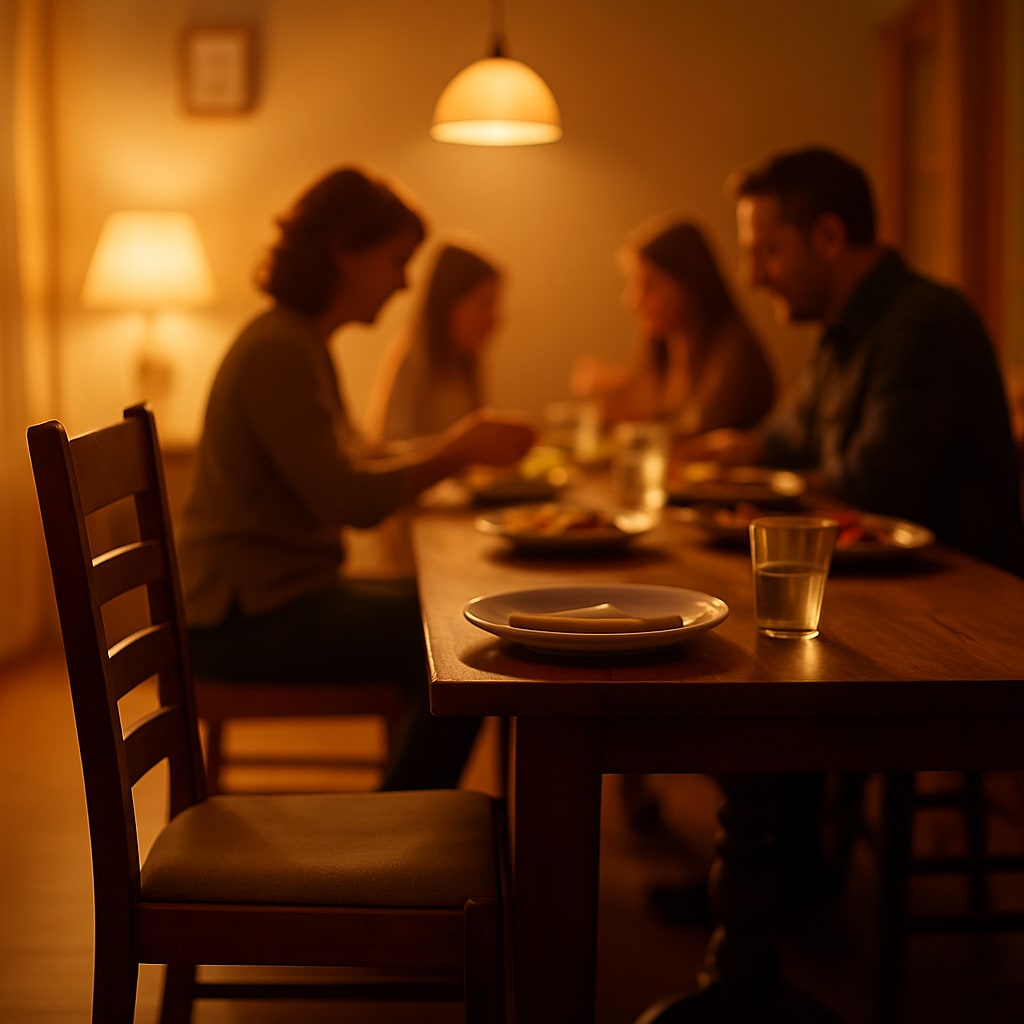
The chair at the end of the table was never just a chair.
It was his chair.
It had been his place for as long as I could remember the spot where Dad would sit every evening, one arm resting lazily on the table’s edge, the other cradling his cup of tea. The head of the table wasn’t about authority in our home. It was about presence. His presence.
The chair faced the kitchen, angled just so that he could watch Mom fuss over the final touches of dinner. He never offered to help not because he didn’t want to, but because he knew Mom’s kitchen was her domain. Instead, he’d keep her company, telling her about his day, asking about hers, or teasing her about how much salt she put in the stew.
Even after we grew up and left home, whenever we visited, there he was. Same chair. Same smile. Same steady warmth, as dependable as the old grandfather clock ticking in the corner.
And then, one winter evening, he was gone.
It wasn’t sudden we’d known he was sick for months but knowing doesn’t soften the blow. We buried him on a Wednesday. By Saturday, the family gathered for dinner as we always did. It was the first meal without him, and the air was heavy with the absence.
No one mentioned the chair. No one asked who should sit there. It just stayed empty.
I thought it would be temporary. Maybe we’d avoid it for a week or two, and then life, stubborn as ever, would shift things back into place. But weeks turned into months, and still, no one sat there. We filled the other seats easily, laughter and chatter spilling across the table, but that end stayed untouched.
It wasn’t a rule anyone spoke aloud. It didn’t need to be. We all understood.
Every so often, my eyes would wander to it during dinner. The wood was scratched from years of his restless fingers drumming on the edge. The cushion sagged where he’d sat for hours at a time. Sometimes I swore I could still see the shape of his shoulders in the way the fabric folded.
Holidays were the hardest. Thanksgiving, Christmas, birthdays each one came with the same quiet ache. We’d decorate, cook too much food, and try to carry on with the same traditions, but there was always that one gap in the circle.
I remember one Christmas Eve, my niece she was six at the time — climbed up into the chair. She didn’t know. She just wanted to be near the cookies. But the moment she sat down, the room went still. Mom’s eyes flicked up from the roast, and my brother stopped mid-sentence.
“You can’t sit there, sweetheart,” my sister-in-law said gently, lifting her out of the seat. My niece looked confused but didn’t argue. The chair was pushed back in, its space restored.
It became almost sacred not in a religious sense, but in the way certain objects hold the weight of memory. Sitting in it felt like breaking a spell.
Years passed. Mom eventually moved to a smaller house, and the dining table went with her. But when it came time to arrange the chairs in the new place, the end seat stayed empty.
One evening, while helping Mom set the table, I asked her why we still kept it that way.
She paused, holding a stack of plates, and said, “Because when we leave it open, it feels like he’s still here. Like he’s just late, and he’ll walk in any minute, complaining about traffic.”
I didn’t say anything, but I understood. The chair wasn’t a void — it was a placeholder for love. A reminder that absence can be felt as strongly as presence.
Last month, we gathered again, this time for Mom’s birthday. She’s eighty now, but still insists on cooking herself. The table was set as always, the chair untouched at the end.
But after dinner, when the plates were cleared and the cake crumbs were all that remained, Mom did something she’d never done before. She pulled the chair out, sat down in it, and sighed.
“I think,” she said, looking around at all of us, “it’s time someone sat here again.”
No one moved at first. It felt wrong, like crossing an invisible line we’d all agreed not to touch. But then my brother slid into the seat, resting his arms on the table just as Dad used to. He didn’t say anything, but I noticed the way his shoulders softened, as if the chair had passed something invisible to him.
The conversation slowly resumed. The laughter came back. And in that moment, I realized the chair had done its job.
It had held the space for him until we were ready to carry it ourselves.
Now, when I visit, someone always sits there. Not every time, and not in the same way he did but the emptiness is gone. And still, when I glance at it, I feel him. Not as a ghost, not as a loss, but as a quiet thread running through our family, holding us together.
Some chairs are just furniture.
This one will always be a place where love learned how to stay.
About the Creator
Keep reading
More stories from Abdullah Khan and writers in Families and other communities.
The Bench That Watched Me Grow Up
The Bench That Watched Me Grow Up By: Abdullah The first time I sat on that bench, I was seven years old. My mother had packed a picnic basket full of peanut butter sandwiches, a bottle of orange juice, and a blanket that smelled faintly of laundry soap. She spread it out on the grass near the pond while I chased pigeons and pretended I could outrun the wind.
By Abdullah Khan 5 months ago in Families
Wise~Guys
— Look Behind what's in Front of You ~ Make Good Choices — Hey, So how you Doin'..! Made~Men — Mobster Movies romanticise a distinctive, elegant appearance, impeccable attire style, along with the 'Families' expressive lingo. Making their 'Bones' gave them Panache — with vintage fedoras, tailored pin-striped suits, mirror-polished wing-tip shoes adorned with tassels; with their 'Gun Moll' gorgeous dates on their arms.
By Jay Kantor18 days ago in Families




Comments
There are no comments for this story
Be the first to respond and start the conversation.