
The Car My Family Escaped In
A gripping true or creative nonfiction story involving migration, escape, or road journeys with emotional depth.

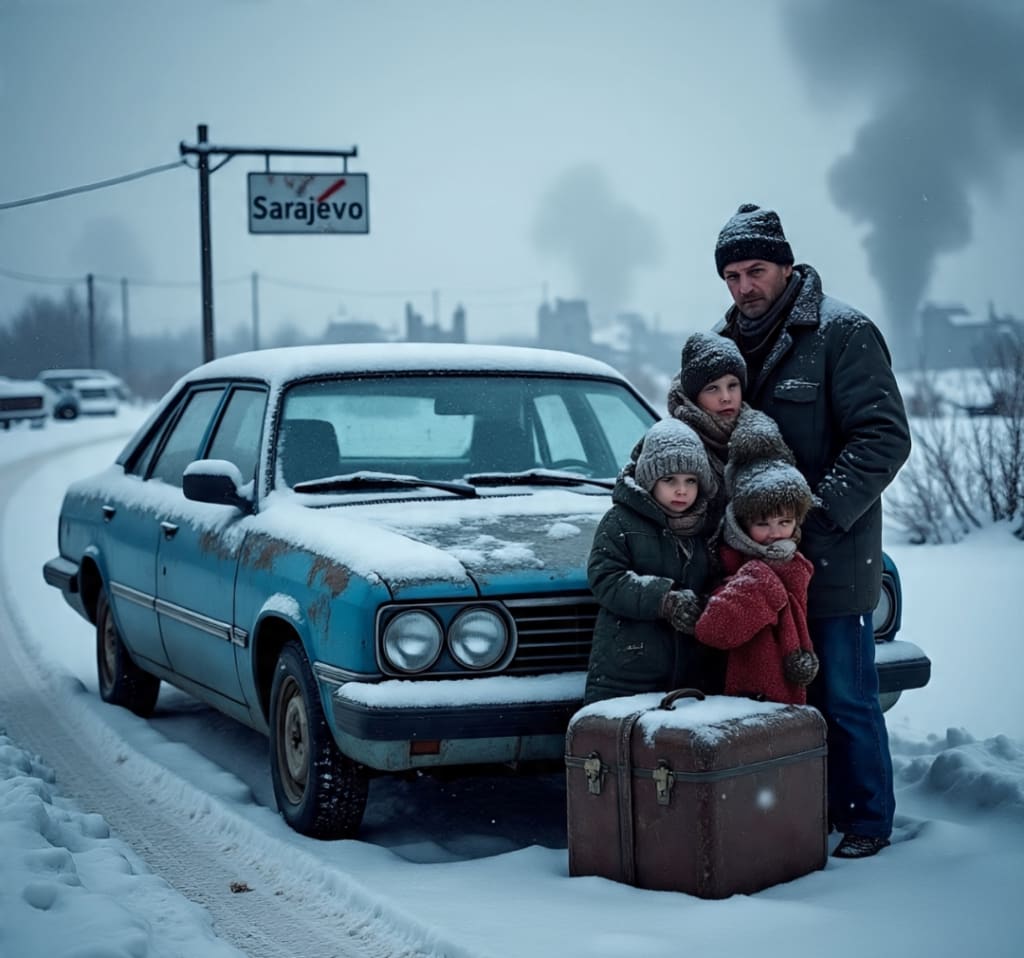
The car was a 1982 Datsun 510—two-tone blue, rust crawling up its wheel wells, and a cracked rear window patched with duct tape. It wasn’t supposed to be a vehicle for escape. It was just the only thing we had left that still ran.
We left Sarajevo at dawn, January 1993. Snow covered everything except the fear in our hearts. My mother told me we were going on a trip. She packed my school backpack with bread, two apples, a photo of my grandparents, and my favorite red sweater. My father filled the trunk with a single suitcase, a can of motor oil, and a plastic jug of water.
My sister, just six, clutched her stuffed rabbit the entire time. She didn’t speak much after the mortar shell hit our neighbor’s house two weeks before. My parents hadn't said it out loud, but we knew—we were fleeing.
The war had unraveled everything. One day, I was learning English in school, dreaming of visiting America; the next, I was running to a basement every time the sirens wailed. My father was an engineer, once proud of his work on the city bridges. Now, the bridges were blown apart, and he barely spoke. His silence scared me more than the shelling.
The Datsun was our lifeline.
We drove west, avoiding the main roads where checkpoints turned deadly. We took the mountain backroads, the kind usually reserved for smugglers and shepherds. The car wheezed and groaned on every incline, but my father coaxed it forward with whispered prayers.
On the third day, near Mostar, we were stopped by armed men. Not soldiers—just men with rifles and anger. They demanded to see our papers. My mother, trembling, handed them the family documents and some German marks she had sewn into her coat lining. They rifled through our suitcase, took half our food, and kicked in the left headlight just for sport. Then they waved us on.
That night, we slept in the car. My father kept the engine running just enough to keep us warm. I remember waking up to the sound of my mother crying softly, her face turned to the window. I pretended to sleep. I was eleven, but I knew I would never feel like a child again.
On the border with Croatia, we met other families. A convoy of weary cars, old Peugeots, battered Volkswagens, all pointed west like we were following a star only we could see. There was a man who said he could bribe the guards. He collected cash from everyone, then vanished into the woods. Some people cried. My father just started the Datsun again, as if betrayal was now routine.
When we finally crossed into Croatia, it felt anticlimactic. No one cheered. No one spoke. It was just a breath—one we hadn’t taken in weeks. I remember looking back at the snow-covered hills and wondering if I’d ever see home again. I never have.
We made it to a refugee camp near Split. The Datsun broke down at the entrance. It never started again. My father left it where it stopped. He didn’t even look back. To him, it had done its job—like an old soldier who'd given all it had.
In that camp, we were given clean clothes, soup, and blankets that smelled like mothballs. My sister started speaking again. My mother smiled for the first time in months. My father stared at the sea.
Two years later, we got asylum in Canada. The journey from Sarajevo to Toronto was long in other ways—new language, new customs, new griefs—but it was safer. War didn’t follow us there. Only memories did.
I’m 42 now. I live in Vancouver, with kids of my own. They’ve never known war, and I pray they never will. They know parts of the story. I show them a photo sometimes—four people huddled in front of a blue Datsun, surrounded by snow and silence. They laugh at the old car, ask me if it even worked.
I tell them it did more than work.
It carried a family out of a burning city.
It carried hope on a half-tank of gas.
It carried us home, even when we didn’t know where home would be.
About the Creator
Masih Ullah
I’m Masih Ullah—a bold voice in storytelling. I write to inspire, challenge, and spark thought. No filters, no fluff—just real stories with purpose. Follow me for powerful words that provoke emotion and leave a lasting impact.
Keep reading
More stories from Masih Ullah and writers in Families and other communities.
The Bird That Waited 17 Years
Every morning she sang the same song — until the one who left finally returned. The first time the bird sang, Mara was seventeen. She had just watched her brother board a train bound for a far-off city. He had dreams she couldn’t hold, and she had roots he couldn’t wear.
By Masih Ullah7 months ago in Families
Wise~Guys
— Look Behind what's in Front of You ~ Make Good Choices — Hey, So how you Doin'..! Made~Men — Mobster Movies romanticise a distinctive, elegant appearance, impeccable attire style, along with the 'Families' expressive lingo. Making their 'Bones' gave them Panache — with vintage fedoras, tailored pin-striped suits, mirror-polished wing-tip shoes adorned with tassels; with their 'Gun Moll' gorgeous dates on their arms.
By Jay Kantor19 days ago in Families
The quiet sound of families breaking
There is a kind of silence that is louder than any noise. It is the silence of a child waking in the night and realizing their parent is gone. It is the silence of a kitchen table with one chair suddenly empty. It is the silence of a home that still looks the same, but no longer feels the same. Across the United States, thousands of families live inside that silence. Not because of war. Not because of disaster. Not because of death. But because of policy.
By Kaylee Souther7 days ago in Families
The Devil's Cut
“Comrade, finally you’re awake.” The voice was smooth, sensual. A flickering incandescent bar was all that lit the white, sterile room. All Vladimir remembered was everything going black. He tried to move his arms and found them strapped to the gurney.
By Matthew J. Fromm5 days ago in Fiction



Comments
There are no comments for this story
Be the first to respond and start the conversation.