
The Angel of Death: A Love That Killed
How a Nurse’s Obsessive Love Turned into a Deadly Obsession

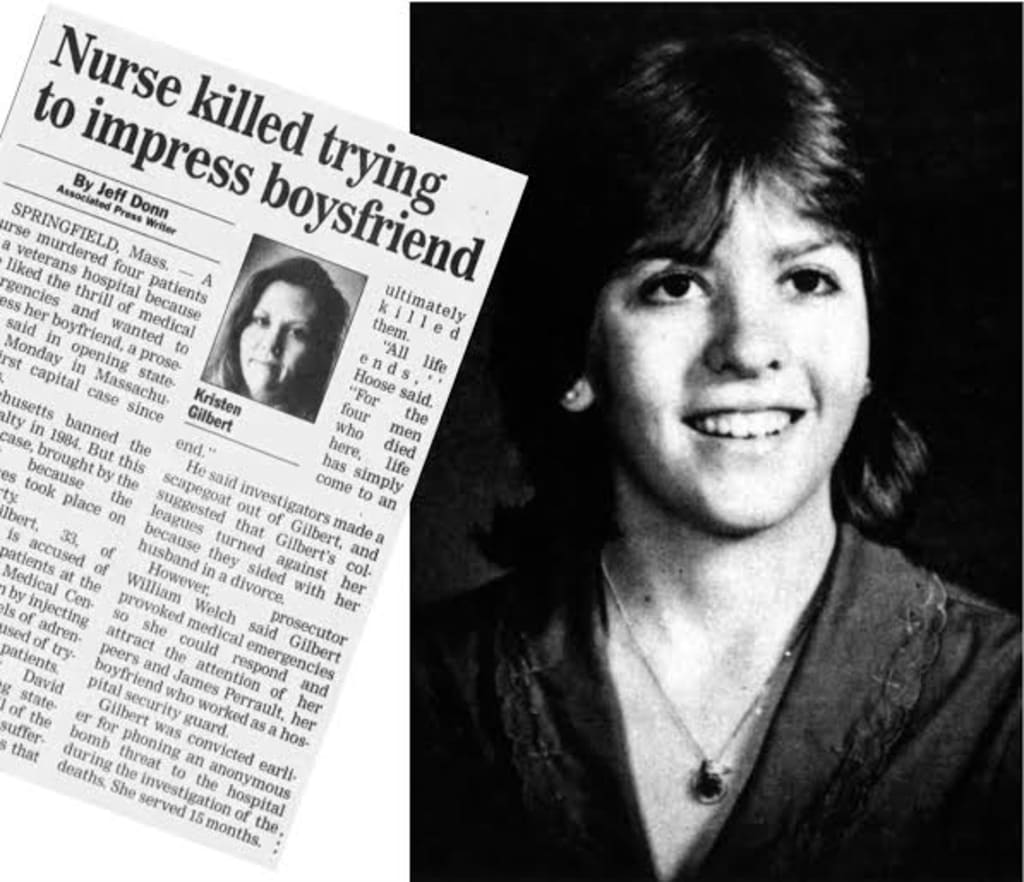
In the quiet corridors of a hospital in Massachusetts during the late 1980s and early 1990s, patients checked in for care and healing—but some never made it out. Behind their tragic endings was not negligence, nor natural decline, but a woman with a soft voice, calm demeanor, and a heart consumed by a deadly passion.
Her name was Kristen Gilbert, a nurse whose dedication to her patients once earned her praise. But hidden behind that sterile mask and white uniform was a story of twisted love—one that would make her infamous as "The Angel of Death." This is not a legend, nor a dramatized tale of fiction. This is the true story of a woman who killed—not for money, revenge, or thrill—but for love.
---
A Nurse Like No Other
Kristen Gilbert (born Kristen Strickland in 1967) seemed like the ideal nurse. Intelligent, charming, and composed, she worked at the Veterans Affairs Medical Center in Northampton, Massachusetts. At first, her colleagues viewed her as competent and capable. She formed close bonds with her co-workers and patients, especially those in critical care.
But soon, a strange pattern began to emerge. Whenever Kristen was on duty, patient deaths increased sharply. While the VA hospital catered to elderly and vulnerable patients, the spike in fatalities was statistically alarming—far too frequent to be mere coincidence.
What no one knew at the time was that Kristen's motives were deeply personal—and heartbreakingly deranged.
---
The Man in the Morgue
Among the hospital staff, Kristen had developed an intense affection for James Perrault, a handsome and soft-spoken Gulf War veteran who worked as a security guard at the facility. He was responsible, among other duties, for responding to emergencies and transporting the deceased to the morgue.
Kristen fell deeply in love with James. But her love wasn’t the ordinary kind that inspires poetry or romance novels. It was obsessive, manipulative, and uncontrollable. She needed him near her constantly. But James worked shifts that didn’t always align with hers. And even when he was on duty, he had no reason to visit her unit—unless there was a death.
That’s when her dark plan began to take shape.
To see him, to have a reason for his presence, Kristen manufactured emergencies. She began injecting patients with epinephrine, a powerful drug that can induce cardiac arrest when given in high doses. After the patient collapsed or died, James would be called to respond—sometimes for a Code Blue, sometimes to transport a body.
In her twisted mind, this became a ritual of longing and reunion. The lifeless bodies left in her wake were merely steps toward a fleeting glimpse of her beloved.
---
A Trail of Death
From 1993 to 1996, patient deaths during Kristen’s shifts were estimated to be three times higher than during other nurses' shifts. Despite the hospital’s attempts to maintain a professional and compassionate environment, fear began to grow among the staff. Some nurses even whispered among themselves that Kristen was cursed—or worse.
When confronted, she often brushed it off with medical jargon or pointed to the patients’ underlying health issues. It wasn’t until several co-workers expressed serious suspicions that the hospital launched a formal investigation.
The turning point came when a fellow nurse noticed Kristen preparing a syringe for a patient who had shown signs of recovery. Minutes later, the patient went into sudden cardiac arrest. That incident—along with multiple mysterious deaths—was reported to hospital administrators.
---
Crumbling Facade
Kristen’s once-charming demeanor began to crack. She started manipulating records, faking symptoms in patients, and gaslighting fellow nurses. Eventually, fearing exposure, she resigned in 1996. But it was too late. The federal government had launched an inquiry, and in 1998, Kristen Gilbert was indicted for four counts of murder and two counts of attempted murder.
During the trial, the prosecution laid out a chilling narrative: Kristen murdered patients to create emergency situations that would summon James Perrault. James, now aware of her manipulation and disturbed by her actions, had already cut ties with her.
But to Kristen, it was all for love. Her defense team painted her as mentally unstable, pointing to her diagnosis of borderline personality disorder. They argued that her actions, while tragic, stemmed from psychological breakdown rather than malice.
The jury wasn’t convinced.
---
Justice and Legacy
In 2001, Kristen Gilbert was found guilty on all counts and sentenced to life in prison without the possibility of parole. She currently serves her sentence at the Federal Medical Center in Texas.
Her story sent shockwaves through the American medical community. The very person entrusted to heal and protect had become a predator in scrubs. Hospital protocols were reevaluated nationwide, and more rigorous background checks and mental health screenings for medical staff became standard.
But perhaps the most haunting aspect of this tale is not the number of lives lost, or the betrayal of trust—it’s the reason why. Kristen didn’t kill for gain. She didn’t hate her victims. She didn’t even seek to evade detection with clever tactics. She killed for love—a love that never even fully bloomed, a love that remained one-sided, and ultimately deadly.
---
Love or Madness?
Was it love—or was it delusion? Can longing be so intense that it warps one's very morality? Kristen Gilbert's case has been the subject of books, documentaries, and psychological analyses. Many see her as a cautionary tale of unchecked mental illness. Others view her as a cold-blooded murderer who used love as a justification.
But no matter how one interprets it, one truth remains: she loved someone so much, she was willing to kill just to see him. And in doing so, she lost everything—including the very person she tried so desperately to hold close.
---
Final Note:
While this story may read like fiction, it is tragically real. A dark chapter in medical history, and a painful reminder that even love—when left unbalanced—can turn into the most dangerous of obsessions.
About the Creator
Keep reading
More stories from 🇲 🇮 🇳 🇩 🇺 🇳 🇫 🇴 🇱 🇩 🇪 🇩 and writers in Families and other communities.
When Hate Comes Home: How Families Become Targets in a Polarized World
In a world growing increasingly connected and yet more divided, families—once considered private, sacred spaces of unity and safety—are now becoming unintended targets of hate. Whether due to their race, religion, political affiliation, sexuality, or even their stance on social issues, entire families have found themselves at the center of hostility, threats, and even violence.
By 🇲 🇮 🇳 🇩 🇺 🇳 🇫 🇴 🇱 🇩 🇪 🇩 7 months ago in Families
Wise~Guys
— Look Behind what's in Front of You ~ Make Good Choices — Hey, So how you Doin'..! Made~Men — Mobster Movies romanticise a distinctive, elegant appearance, impeccable attire style, along with the 'Families' expressive lingo. Making their 'Bones' gave them Panache — with vintage fedoras, tailored pin-striped suits, mirror-polished wing-tip shoes adorned with tassels; with their 'Gun Moll' gorgeous dates on their arms.
By Jay Kantor18 days ago in Families
Silver Screen Magic with Mae West
American actress and singer Mae West became a popular film actress during the Great Depression. She started entertaining in vaudeville, then performed on Broadway, and finally went to Hollywood. She signed up with Paramount Pictures and made her debut in the 1932 film “Night After Night.” She also starred in musicals, comedies, and crime dramas. The American Film Institute named her one of the best classic Hollywood actresses.
By Rasma Raisters5 days ago in Geeks



Comments
There are no comments for this story
Be the first to respond and start the conversation.