
The $127 Lesson: What I Learned About International Shopping the Hard Way
How understanding shipping terms can save you from customs surprises

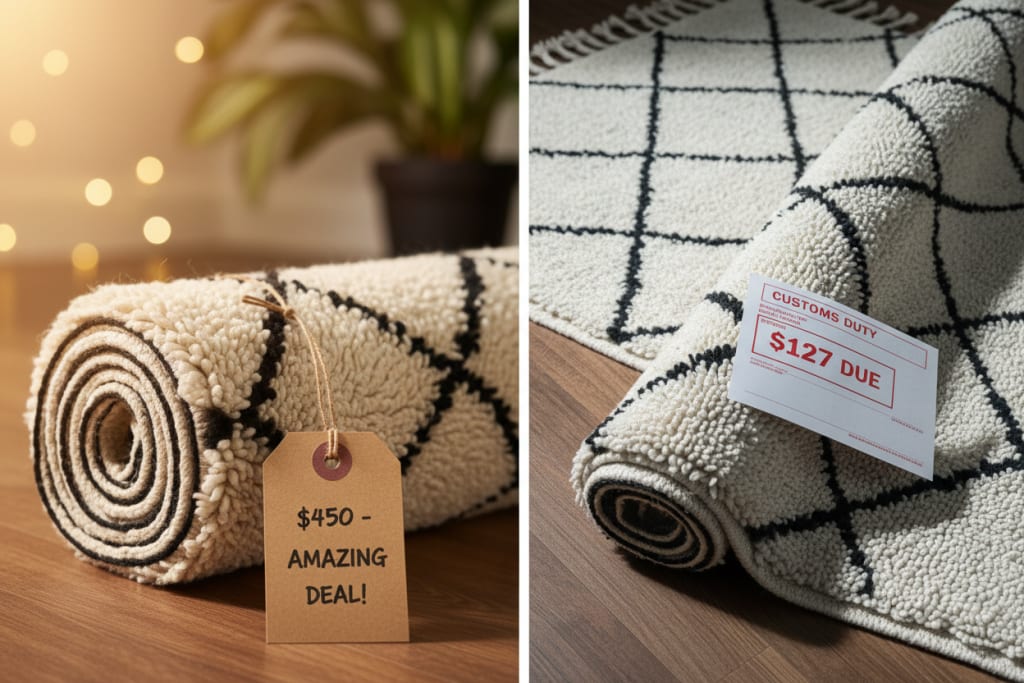
There's a special kind of frustration that comes with thinking you've found the perfect deal, only to discover you've been played by fine print you didn't know existed.
The "Deal" That Wasn't
I'd been hunting for a Beni Ourain rug for months. You know the ones—those gorgeous cream wool rugs with black geometric patterns that interior designers obsess over. High-end retailers sell them for over a thousand dollars. Even the "affordable" versions at big-box stores run $800 or more.
So when I found an authentic one from an overseas seller for $450, I felt like I'd won the lottery.
I clicked "buy" without a second thought.
The rug arrived two weeks later. Well, sort of. What actually arrived was a notice from US Customs informing me that my package was being held until I paid $127 in duties and fees.
My "amazing deal" suddenly cost $577—plus a week of trying to figure out how to pay customs (spoiler: they don't make it easy), deciphering confusing paperwork, and waiting while my rug sat in bureaucratic purgatory.
I felt like an idiot.
The Fine Print I Missed
Turns out, buried in the seller's shipping policy—in that wall of text nobody actually reads—was this line:
"Customer is responsible for any import duties, taxes, or customs fees imposed by their country."
I'd been so focused on the product price and "free shipping" that I completely missed the part where I'd be paying customs fees on arrival.
This is called DDU shipping: Delivered Duty Unpaid.
The seller ships the product. You pay customs when it arrives. Simple for them. Surprise for you.
The Solution I Didn't Know Existed
After my expensive lesson, I did what any frustrated consumer does: I went down a research rabbit hole.
That's when I discovered DDP shipping: Delivered Duty Paid.
With DDP, the seller covers ALL customs duties, import taxes, and clearance fees. The price you see at checkout is your final price. No surprise bills. No customs paperwork. No delays waiting for you to pay fees.
It's how shopping should work—transparent, predictable, hassle-free.
But here's the thing: most international retailers don't offer it.
Why DDP Is Rare
Offering DDP shipping is operationally complex and expensive for sellers:
They need expertise in international tariff codes. There are thousands of product classification codes, and choosing the wrong one can result in incorrect duty calculations or customs problems.
They need relationships with customs brokers. Clearing customs requires specialized knowledge and established broker relationships in destination countries.
They need capital. DDP sellers pay customs duties upfront, before receiving payment from customers. This requires significant working capital.
They need sophisticated systems. Calculating duties accurately for every product and destination requires technology and expertise.
They assume risk. If they calculate duties incorrectly, they absorb the loss.
For most small-to-medium retailers, this investment isn't worth it. It's easier to pass the complexity—and surprise costs—to customers.
But a handful of retailers have made DDP their competitive advantage.
And for customers, they're game-changers.
My Research Journey
After my rug debacle, I became obsessed with understanding international shipping terms and finding sellers that actually offer transparent pricing.
I spent weeks checking shipping policies, reading the fine print, contacting customer service departments, and analyzing customer reviews looking for mentions of customs fees or surprise charges.
What I discovered changed how I approach international shopping entirely.
Understanding the Morocco-US Trade Context
Before diving into specific findings, it helps to understand why customs duties exist and how they're calculated.
The Morocco Free Trade Agreement (MAFTA), effective since 2006, provides duty-free or reduced-tariff access for most Moroccan goods entering the US. Many artisan products—textiles, pottery, leather goods—qualify for preferential treatment.
So why worry about customs at all?
Because "most" isn't "all," and classifications are complex:
A hand-knotted wool rug might enter duty-free under one tariff code
A similar rug with cotton warp threads might face 5-10% duties under a different code
Leather goods vary by construction method and materials
Pottery duties depend on whether items are decorative or functional
Even when duties are low or zero, there are processing fees, customs broker charges, and the administrative hassle of proving MAFTA eligibility.
DDP eliminates all of this uncertainty. The seller handles classifications, paperwork, and payments—you just receive your package.
What I Learned About Shopping Smart
Through my research, I discovered several key principles that now guide my international shopping:
1. Read Shipping Policies Carefully
Don't just look for "free shipping." Look for explicit language about customs duties:
"All customs duties included"
"Delivered duty paid"
"No additional fees upon delivery"
"True landed cost pricing"
If the policy is vague or doesn't mention customs at all, assume you'll be responsible for fees.
2. Understand the True Cost
When comparing international sellers, calculate the complete landed cost:
Seller A: $450 product + $0 shipping + estimated $127 customs = $577 total
Seller B: $550 product with DDP shipping = $550 total
Seller B is actually cheaper, plus you avoid hassle and uncertainty.
3. Ask Direct Questions
If a seller's shipping policy is unclear, contact them before ordering and ask:
"Are US customs duties and import taxes included in the price, or will I be billed separately upon delivery?"
Get their answer in writing (email) so you have documentation.
4. Check Customer Reviews
Look specifically for reviews from customers in your country mentioning:
Surprise customs fees
Delivery delays due to customs
Additional charges upon arrival
Customs paperwork hassles
If multiple reviews mention these issues, the seller likely uses DDU terms.
5. Recognize Red Flags
Certain phrases in shipping policies are warning signs:
❌ "Customer responsible for duties and taxes"
❌ "Import fees may apply"
❌ "Duties and taxes not included"
❌ "Customs charges are the buyer's responsibility"
These all mean you'll be paying customs fees separately.
The Categories of International Sellers
Through my research, I identified three categories of international sellers:
Category 1: Explicit DDP Sellers
These sellers clearly state they cover all customs duties and import taxes. Their shipping policies use explicit language, and they confirm DDP terms at checkout.
Advantages:
Complete price transparency
No surprise fees
Faster delivery (no customs holds)
Zero administrative burden
Predictable timelines
Disadvantages:
Sometimes slightly higher upfront prices (but lower total cost)
Fewer sellers offer this option
Category 2: Unclear or Ambiguous Sellers
These sellers have vague shipping policies that don't clearly address customs duties. They might offer "free shipping" without specifying whether customs are included.
Risks:
Uncertainty about final cost
Potential for surprise fees
May or may not cover customs (varies by product or destination)
Recommendation: Contact them directly before ordering to clarify terms.
Category 3: Explicit DDU Sellers
These sellers clearly state that customers are responsible for customs duties and import taxes.
Characteristics:
Transparent about DDU terms (which is better than being vague)
Lower upfront prices
Customer pays customs upon delivery
Considerations:
You'll need to budget for additional costs (typically 0-15% of order value)
Delivery may be delayed while customs processes payment
You'll handle customs paperwork and payment
My Shopping Checklist Now
Based on my expensive lesson, here's the checklist I use for every international purchase:
Before Adding to Cart:
✓ Read the complete shipping policy
✓ Look for explicit DDP or DDU language
✓ Check customer reviews from my country
✓ Calculate estimated customs fees if DDU
✓ Compare true total costs across sellers
Before Checkout:
✓ Verify customs coverage at checkout
✓ Screenshot or save shipping terms
✓ Check estimated delivery timeline
✓ Confirm return policy for international orders
After Ordering:
✓ Save order confirmation email
✓ Save shipping policy documentation
✓ Track shipment progress
✓ Watch for customs notifications if DDU
If Customs Fees Arrive:
✓ Verify charges match tariff rates
✓ Check if seller's policy was misleading
✓ Pay promptly to avoid storage fees
✓ Leave honest review about total cost
Why This Matters Beyond Money
Yes, understanding DDP vs. DDU saves money. But there are deeper benefits:
Budget Confidence: You can make informed purchasing decisions knowing the exact total cost upfront. No gambling on whether the final price will fit your budget.
Time Savings: No hours spent researching how to pay customs, navigating government websites, or communicating with customs brokers.
Stress Reduction: International shopping becomes as simple as domestic shopping. No anxiety about surprise bills or delivery delays.
Better Planning: When you know exactly when your package will arrive (no customs holds), you can plan accordingly—especially important for gifts or time-sensitive purchases.
Supporting Artisans: When costs are transparent, you can make conscious decisions about supporting traditional crafts and artisan communities without fear of budget-busting surprises.
The Emotional Cost of Surprise Fees
Beyond the financial impact, there's an emotional dimension to customs surprises that's worth acknowledging.
When that $127 customs bill arrived, I didn't just feel frustrated about the money. I felt:
Deceived: Like the seller had hidden important information from me.
Foolish: For not reading the fine print more carefully.
Trapped: The rug was already at customs—I couldn't return it without paying the fees first.
Anxious: About how to navigate an unfamiliar customs payment system.
Disappointed: What should have been an exciting purchase became a source of stress.
These emotional costs are real, even if they're harder to quantify than the $127.
DDP shipping eliminates all of this. The excitement of receiving an international package isn't tainted by dread of surprise fees.
The Bigger Picture: Changing Expectations
My customs nightmare happened because I assumed international shopping would work like domestic shopping—transparent pricing, predictable delivery, no hidden fees.
That assumption was wrong. But it shouldn't be.
As cross-border e-commerce grows, customer expectations are evolving. We're accustomed to the Amazon experience: clear pricing, fast delivery, easy returns. International retailers that can't match that experience will increasingly lose customers to those who can.
The retailers investing in DDP infrastructure are ahead of this curve. They've recognized that operational excellence—transparent pricing, predictable timelines, zero surprises—is becoming as important as product quality.
For customers, this shift means:
More transparency in international shopping
Less risk when buying from overseas
Better overall shopping experiences
Ability to compare true costs across sellers
For artisans and makers, this shift means:
Access to broader international markets
Customers more willing to buy when costs are clear
Economic support that helps preserve traditional crafts
Fair compensation through direct relationships
What I Wish I'd Known
If I could go back and give myself advice before ordering that rug, here's what I'd say:
1. "Free shipping" doesn't mean "no additional costs." Always check if customs duties are included.
2. The lowest price isn't always the best deal. Calculate the complete landed cost including estimated customs fees.
3. Vague shipping policies are red flags. If they don't explicitly address customs, assume you'll pay.
4. DDP exists and it's worth seeking out. The peace of mind is worth paying slightly more upfront.
5. Ask questions before ordering, not after. Once your package is at customs, it's too late to negotiate terms.
6. Save all documentation. Screenshot shipping policies and save confirmation emails in case of disputes.
7. Budget 10-15% extra for DDU orders. If the seller doesn't cover customs, assume you'll pay 10-15% of the order value in duties and fees.
The Silver Lining
That $127 customs bill was expensive, but it taught me something valuable that I'll use for the rest of my life.
Now I approach international shopping with knowledge and confidence. I know what questions to ask, what red flags to watch for, and what terms to look for.
I've since made several international purchases—all with DDP sellers—and every single one has been smooth, predictable, and hassle-free.
The price I see is the price I pay. The delivery date I'm given is when the package arrives. No surprises. No stress. No bureaucratic nightmares.
That's how shopping should work, whether you're buying from across town or across the ocean.
Moving Forward
If you're considering an international purchase—whether it's Moroccan rugs, Italian ceramics, Japanese textiles, or anything else—take the time to understand the shipping terms.
Look for DDP sellers when possible. If you choose a DDU seller, budget accordingly and go in with eyes open.
Read the fine print. Ask questions. Calculate true costs. Save documentation.
And remember: the lowest price isn't always the best deal. Sometimes paying a bit more upfront for transparency and peace of mind is the smartest investment you can make.
Your Turn
Have you been surprised by customs fees when shopping internationally? How did you handle it? What did you learn?
I'd love to hear your stories and experiences in the comments. We can all learn from each other's mistakes and successes.
And if this article helps you avoid a customs surprise on your next international purchase, then that $127 I paid was worth it.
Because now we both know better.
That's exactly what happened when I ordered a Moroccan rug.
About the Creator
Mohamed B
Always fascinated by the skill and creativity of the hands that make the Moroccan product, I devote myself to the work of art. I try to convey on all continents my knowledge, my full knowledge of the Berbers.
Wise~Guys
— Look Behind what's in Front of You ~ Make Good Choices — Hey, So how you Doin'..! Made~Men — Mobster Movies romanticise a distinctive, elegant appearance, impeccable attire style, along with the 'Families' expressive lingo. Making their 'Bones' gave them Panache — with vintage fedoras, tailored pin-striped suits, mirror-polished wing-tip shoes adorned with tassels; with their 'Gun Moll' gorgeous dates on their arms.
By Jay Kantor19 days ago in Families
So You Decided To Become a Nurse Practitioner:
So you decided to become an "Advanced Practice" nurse. Congratulations!... is what I would say if this was a good idea. Grad school? In this economy? What were you thinking? Likely it was something along the lines of either 1) “I've seen these other chucklefucks do it— Why can't I?” or even 2) “I've got a nice career, I should shake it up. I miss feeling like I have no clue what I'm doing.”
By Sandor Szabo3 days ago in Fiction




Comments
There are no comments for this story
Be the first to respond and start the conversation.