
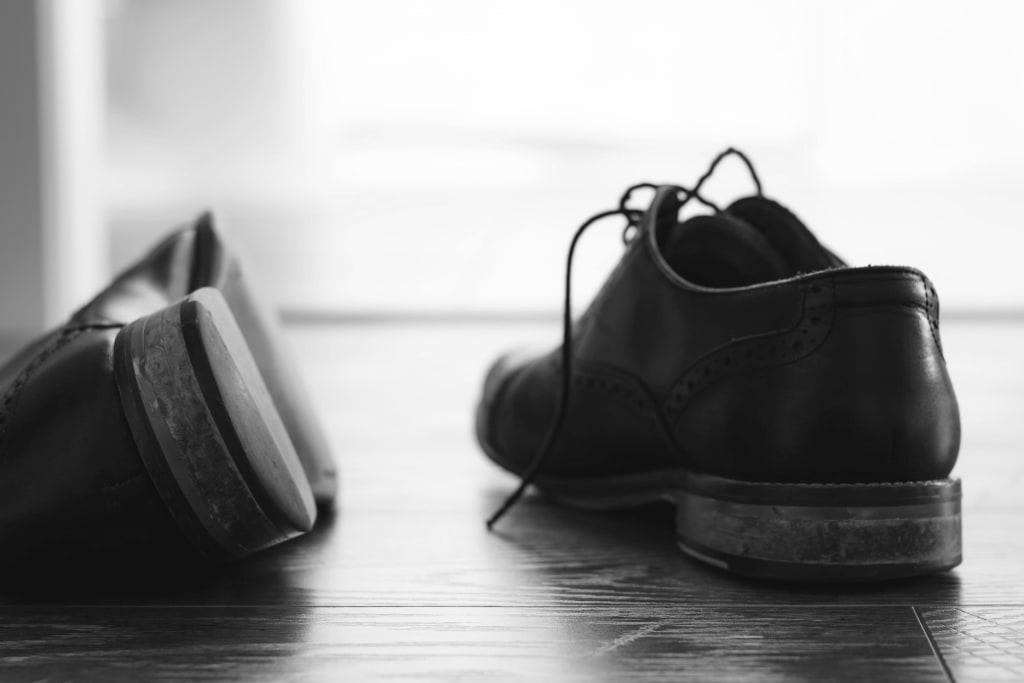
The door swings open into the cellar smelling of cigarettes and shoe polish. Coughing instinctively in anticipation of the smoke that always flooded her lungs here, she steps inside, flips the light switch, and squints her surroundings into focus. Nothing in his workshop has changed – aside from his absence.
The same hammer-weary workbench stained with leather dye and topped with wooden lasts for determining shoe fit. The same neatly arranged line of hammers, awls, scissors, and prying tools hanging from the corkboard wall. The same cherished 1975 turntable, still surrounded by ashtrays and his favorite Paul Simon records. And the same walls lined with rows upon rows of shoes in various stages of repair, their yellow invoice receipts hanging like dog tags from their laces.
She feels, as she did back then, that she doesn’t belong here. She shouldn’t be here. This was his space. The fluorescent lights flicker and the air grows dank as she steadies herself and tries to breathe.
The gentle pressure of a hand on her back coaxes her back to the present.
“It’s alright,” her fiancé whispers, drawing her into his arms. “I’m right here.” She buries her face into his chest.
“I just…I haven’t been here in so long, and I wasn’t expecting it to feel like this. It’s all wrong.”
“I know this a lot to deal with. Let’s just take a quick look around to make sure your dad didn’t leave behind anything important. Soon we’ll be selling this place, and you’ll never have to think about it ever again.”
She pulls away and exhales, wiping away a nascent tear.
“You’re right. Thanks. Let’s get this over with.”
Her fiancé heads over to a rusted file cabinet, while she decides to start with his workbench. How many slips of paper containing bank account numbers, safe combinations, and passwords had her dad shoved into its drawers over the years? She dares not guess.
The first drawer is so stuffed with additional cobbling tools that she can’t yank it open. I’ll come back to that one later, she thinks. The next drawer proves similarly stubborn, though eventually she’s able to pry it open just enough to glimpse stacks of scribbled notes, receipts, and leather scraps inside. Arriving at the third drawer, she’s prepared to wrangle. When it seamlessly slides open, however, her undue force wrenches it out of the workbench and onto the floor.
Her fiancé pops his head out from a file folder. “Everything okay?”
“I’m fine,” she says, dusting herself off. She bends down and peers into the drawer. All it contains is a small black leather notebook, her name written in gold on the cover in his undeniable chicken scratch. ____________________________________________________
She was six years old the first time she heard Paul Simon’s 1986 album partially recorded in South Africa. Her dad had decided that it was finally time. Even if she didn’t fully appreciate it, he figured, she’d finally developed a certain sense of rhythm; at least she could dance to it.
It was a blistering summer day, and they were blasting down the interstate. He had rolled down all the windows in their lopsided jalopy, except the one that insisted on staying shut. She was joyfully slurping the gas station strawberry slushy he had bought her. Every time he turned to check on her in the backseat, he would grin at her slushy-induced glee. With his knockoff aviators, windblown black curls, and thick moustache, he was an off-brand Tom Selleck.
“I have something really important to share with you,” he said, glancing at her in his rearview mirror. “Something special to me. An album I think you’re finally ready to hear. Does that sound good?”
She nodded between slushy slurps. He smiled and pressed “play” on the cassette tape.
It was electric. Joyful saxophone riffs, steady and confident rhythms, playful lyrics, and radiant vocals from iconic South African musicians. She felt the wind swell with each refrain and the sunshine ebb with each coda. Her dad was beaming at her in the rearview mirror, giddier than she knew he could be.
Then came the fifth track. She could tell there was something special about it because her dad paused the tape to turn and look at her emphatically after its first note.
“This is my absolute favorite song,” he lectured, “so I want you to pay close attention. I think you’ll understand once you hear the refrain. It’s about me, and what I want for you some day.”
Mesmerizing vocals from Ladysmith Black Mambazo poured through the stereo. She closed her eyes to take in the Zulu verses. Then came Paul Simon’s voice, and the story of a poor boy and a girl with diamonds on the bottoms of her shoes.
Her dad never had been particularly worldly. He preferred the local paper to national sources, and if he could have gotten all his news from his customers, he would have. As such, he never knew much about the controversy surrounding the album, including the backlash Paul Simon received for breaking the cultural boycott against South Africa’s apartheid regime and the criticism that he had appropriated South African music and culture. Later in life, she wished he had taught her about the complexity of those critiques. But for her dad, the album, particularly its fifth track, was deeply personal, as local as it got. The poor, widowed cobbler was determined to fit his daughter’s shoe soles with diamonds one day.
But as the years passed, his shoe repair workshop barely squeaked by; people preferred buying new shoes to restoring them. Try as he might, he remained the pocket-empty, poor boy, and near-giftless birthdays and holidays were cruel epitaphs to his dashed dream. He grew hard and calloused and sandpaper-rough. He would cloister himself in his cellar workshop for fourteen-hour days, blaring his records and pounding nails into heels and perfuming the cellar with cigarette fumes and sweat. What had been the girl’s favorite joke as a child – her dad was the “old man who lived in a shoe” – became a bitterly apt observation.
His workshop was his sanctuary and his prison, and there was no place for the girl there. It was only natural, then, that she didn’t carve out a place for him in her life. ____________________________________________________
She stares at the little black notebook in her hands. So heavy for something so small.
“What’s this?” her fiancé asks, peeking over her shoulder.
“I have no clue.”
“Some kind of journal, maybe? Or an expense log?”
“I don’t think so. It has my name on it, see?”
He’s quiet for a moment, trying to decipher the chicken scratch.
“Oh.”
“Yeah.”
He begins to speak, perhaps to encourage her to open it, but he thinks better of it. Then he casually returns to digging through the file cabinet.
Her hands quivering, she opens the notebook.
At the top of the first page, he had written the year of her sixth birthday. “First ballet recital,” it reads. “Tore her tutu during the first number but kept dancing. $1,000.”
The second page contains the year of her seventh birthday. “Brought me coffee on a frigid February day. $1,000.”
The third page, her eighth year. “Got in trouble for throwing a pencil at her classmate’s head. She said she was standing up for another student, and that he deserved it. I believe it. $1,000.”
She frantically flips through the pages. Each page marks a successive year. Each page describes a moment in her life. Each page values these moments at $1,000.
As she aged, his descriptions became more eager, more desperate.
Her seventeenth year: “Sang in the chorus at school musical – heard about it from Mrs. Nowak (size 7 loafers). $1,000.” Her twentieth: “Said she got a poem published. Don’t know where – seems shy about it. $1,000.” Her twenty-third: “Engaged. Haven’t met him yet, but he sounded like a decent guy on the phone. $1,000.”
The twentieth page was written this year; the ink is practically wet. Unlike the other pages, this one doesn’t describe a moment. His penmanship is even more erratic, the work of an unsteady hand.
“Probably the last pair. Should’ve quit smoking. I’ve got 20 to give her when she comes by – not enough for my precious girl. $1,000.”
She sets the notebook on the workbench and feverishly fumbles through the drawer of cobbling tools.
“What are we looking for?”
“Pliers. Come on, damnit, Dad, where the hell are your pliers?”
Her fiancé joins the hunt and finds a hanging pair obscured by a hammer and scissors.
“And what’re we using these for?”
She ignores him, or perhaps doesn’t hear him. Clinging to the pliers, she scans the workshop. Finally, she spots it under the stairs beneath a wool blanket and a thick layer of dust: a stack of unassuming shoe boxes. Twenty, to be exact.
She seizes a box from the stack, sets it on the workbench, and tears off the lid. Inside is a pair of children’s shoes. Her shoes. Brown penny loafers with tassels and a penny in the slot, the way she’d insisted on wearing them. Each scuff has been painstakingly buffed out.
She removes the shoes to investigate the box. Nothing else inside. She grabs a loafer, turns it over in her hand, holds it up to the light as if confirming the authenticity of a dollar bill. Then she uses the pliers to begin unceremoniously ripping the sole away from the base.
“What the…” her fiancé starts.
Then they see it. A corner of tattered paper, onion skin-thin in faded chartreuse, peeks out beneath the detached sole. She continues pulling away the sole to expose a stack of five $100 bills. She makes quick work of the other loafer, revealing another $500 tucked underneath the sole.
They grab another box from the stack. Another pair of her shoes, well-loved leather flats from her high school years. Another $1,000 buried under two lonely soles.
Another box, and another, and another. Only a handful contain her shoes – the rest are tattered pairs, likely donated for scraps or deemed beyond restoration – but all hold secret treasures. Twenty years, twenty pages, twenty pairs, $20,000 hidden in the soles of these shoes.
“Right before…” she whispers. “A couple days before…He asked me to come over, said he had something to give me. But I didn’t. And then he was in the hospital, and then…”
She begins to weep, but she catches herself. Wordlessly she walks to the turntable, places the album on the platter, sets the record spinning, counts its track rings like whirling tree circles, aligns the stylus with the proper ring, lowers the tonearm. Track #5.
She grabs her fiancé’s hand and they start to dance.
Her dad had done it. He had given her diamond-soled shoes.
About the Creator
Keep reading
More stories from writers in Families and other communities.
Wise~Guys
— Look Behind what's in Front of You ~ Make Good Choices — Hey, So how you Doin'..! Made~Men — Mobster Movies romanticise a distinctive, elegant appearance, impeccable attire style, along with the 'Families' expressive lingo. Making their 'Bones' gave them Panache — with vintage fedoras, tailored pin-striped suits, mirror-polished wing-tip shoes adorned with tassels; with their 'Gun Moll' gorgeous dates on their arms.
By Jay Kantor22 days ago in Families
The Kind-Hearted Friend
In a lush forest, there lived a troop of monkeys. Among this troop were two young monkeys who were notorious for their mischievous behavior. Their constant pranks and antics had even exhausted their parents, who often scolded them for their wildness. In the same forest, there was a young giraffe, a gentle and innocent creature, known for his simplicity and good nature. One day, while grazing on the green grass, the young giraffe wandered into a part of the forest where the mischievous monkey duo was busy plucking leaves and fruits from the trees to eat.
By Sudais Zakwanabout 13 hours ago in Families



Comments
There are no comments for this story
Be the first to respond and start the conversation.