
Smoke from the Stove
A mother’s silent sacrifices, a son’s long journey, and the love that held them together—despite the distance.
A mother’s silent sacrifices, a son’s long journey, and the love that held them together—despite the distance.
---
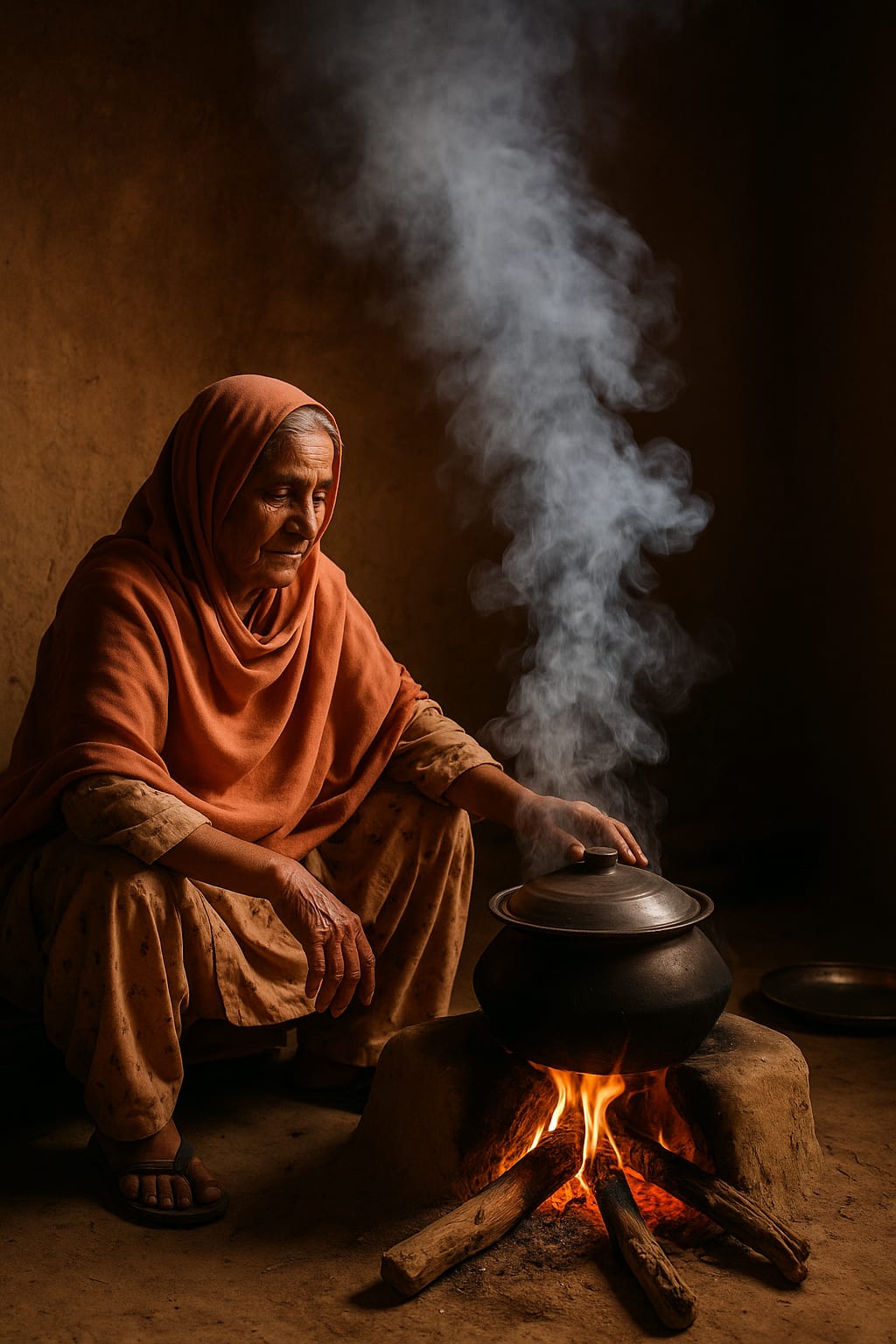
In a small village nestled between fields and silence, there stood a modest mud-brick house with a slanted tin roof and smoke rising gently from its chimney each morning. That smoke, thin and unassuming, was the first sign that life within those walls had begun its day. It came from an old clay stove—handmade, cracked at the corners—where Mumtaz Begum cooked meals, boiled tea, and warmed her aging bones during winter.
Mumtaz Begum lived alone with her son, Ali. Her husband had passed when Ali was just a toddler, leaving her to raise him with calloused hands and a heart that never allowed itself to break. In the quiet simplicity of their home, surrounded by wheat fields and distant mountains, she poured every ounce of her love into Ali’s upbringing.
Ali was everything to her. He had his father’s smile and his mother’s stubbornness, and a spark in his eyes that made her believe he was destined for more than the life of labor she had known. She often sat with him in the evenings beside the glowing stove, telling stories of the past, reciting prayers, and passing down little truths about life. She’d gently stroke his hair and whisper, “Life is hard, beta, but it softens when you love. And know this—no matter where you go, your Ammi’s prayers will always follow you like your shadow.”
Ali listened, wide-eyed, often dreaming of a world far beyond the village’s dusty roads. He wanted more—not out of ingratitude, but because he believed that if he succeeded, he could lift his mother from the weight of her sacrifices. He didn’t just want to earn money; he wanted to rewrite her story.
As he grew, his ambitions expanded beyond the borders of the village. He would study under the dim light of a single lantern, using worn-out books passed down from cousins. His mother couldn’t read, but she sat beside him every night anyway, mending clothes, grinding spices, or just watching him with quiet pride. When he passed his exams and was offered admission to a university in the city, she held his face and said, “Go, my son. Fly. The nest will always be here. But don’t forget the warmth of this stove, the taste of simple food, and the smell of this earth.”
Ali promised. He hugged her tight, almost too tight, afraid to let go. She packed him dry lentils and pickles, folded his clothes with care, and kissed his forehead again and again until the bus pulled away.
In the city, life moved faster than Ali had imagined. The streets buzzed with noise, and buildings stretched toward the sky like dreams refusing to bow. At first, he struggled—missing home, missing his mother’s voice calling him for meals, missing the familiar smoke of their stove. But slowly, he adapted. He studied hard, worked part-time jobs, and earned scholarships. The more he succeeded, the more he felt he owed it to her.
Phone calls became shorter. Visits home were fewer. But every time he called, his mother’s voice was steady and warm. “Khush rehna, beta,” she’d say. “Bas duaon mein yaad rakhna.” Be happy, son. Just remember me in your prayers.
Years passed. Ali finished his studies and started a business. It grew—small at first, then bigger than he had imagined. He wore suits now, attended meetings, shook hands with people whose names echoed in magazines. He moved into a spacious apartment, bought a car, and dined in places his village never dreamed of.
But somewhere between ambition and achievement, time slipped away. Calls to his mother became monthly, then quarterly. She never complained. She always answered with the same joy, the same prayer, the same affection, even when her joints hurt too much to get up from her bed.
Back in the village, Mumtaz Begum’s hair had turned completely white. The stove still burned every morning. She still cooked with the same care, even if it was just for herself. Her neighbors would drop by sometimes, asking if she’d heard from Ali.
“He’s doing well,” she’d say, her eyes gleaming with pride. “He’ll visit soon.”
But the visits never came.
Every festival, every Eid, every birthday, she would prepare as if he might walk through the door. She’d sweep the floor twice, cook his favorite sweet dish, and leave the door slightly open. “He may be late,” she’d whisper to herself. “But he will come.”
Sometimes, she’d sit beside the stove and speak to it, as if it were him. “Ali, remember how you used to help me mix the dough? You were so small then. I used to scold you for eating raw dough, but you always laughed and did it again.”
The smoke from the stove curled toward the ceiling, silent, listening.
Then came the day when she couldn’t get out of bed. The doctor came from the next town and shook his head gently. “She’s tired,” he said. “Her heart is weak. It’s mostly emotional.”
The neighbors called Ali. They told him gently, told him it might be time to come back.
He stared at the phone for a long time after the call ended. The walls of his apartment suddenly felt cold, despite the central heating. He remembered the warmth of that stove, the smell of cardamom in his tea, his mother’s hand patting his back until he fell asleep.
Without hesitation, he booked the earliest ticket and packed a bag.
The village hadn’t changed much, but his mother had. When he entered the house, the air was thick with memory. The stove still sat in its corner, unused for days, but somehow still holding warmth—as if it had waited too.
He rushed to her side, tears in his eyes. Her face had thinned, her skin more fragile than paper, but her eyes lit up the moment she saw him.
“Ali…” she whispered.
“Ammi,” he said, holding her hand, bringing it to his lips. “I’m sorry… I should have come sooner.”
She smiled. “You came. That’s enough. I prayed every day… not for your success… but that I would see your face again.”
He wept at her bedside, apologizing over and over. She stroked his hair, like she used to, her fingers weak but full of love. “You were never alone, beta. My prayers were with you every step. But now… you are here. My heart can rest.”
Ali spent the next few weeks with her, cooking for her, feeding her, helping her walk a few steps every morning. Each evening, he lit the stove again—not for necessity, but for memory. They would sit beside it in silence, hands wrapped around hot cups of tea, time folding into itself like a prayer answered late, but answered still.
When she passed away quietly one morning, she had a smile on her face.
The village came to mourn, but they also came to honor. They spoke of her kindness, her strength, her unshakeable love for her son. And Ali stood beside her grave, not as a successful businessman, but as a son finally returned.
He stayed in the village for months. Restored the house. Rebuilt the stove. Started a small school in her name so other children like him could dare to dream.
Every morning, as smoke rose once again from the chimney, it carried with it more than heat.
It carried memory.
It carried love.
And above all, it carried the story of a mother who waited—not in pain, but in faith—that one day, her son would find his way home.
About the Creator
Keep reading
More stories from Abubakar Khan and writers in Families and other communities.
My Mother’s Hands: Stories Etched in Skin
My mother’s hands were never soft. They were weathered by time, browned by sun, cracked by winters that seemed colder in our little home than outside it. The tips of her fingers had tiny scars—some from kitchen knives, others from sewing needles. She wore no rings. No polish. Only the plainness of duty, the truth of labor, the quiet language of love.
By Abubakar Khan8 months ago in Families
Wise~Guys
— Look Behind what's in Front of You ~ Make Good Choices — Hey, So how you Doin'..! Made~Men — Mobster Movies romanticise a distinctive, elegant appearance, impeccable attire style, along with the 'Families' expressive lingo. Making their 'Bones' gave them Panache — with vintage fedoras, tailored pin-striped suits, mirror-polished wing-tip shoes adorned with tassels; with their 'Gun Moll' gorgeous dates on their arms.
By Jay Kantor20 days ago in Families



Comments
There are no comments for this story
Be the first to respond and start the conversation.