
Polk Elementary
Our experience with a Baton Rouge school

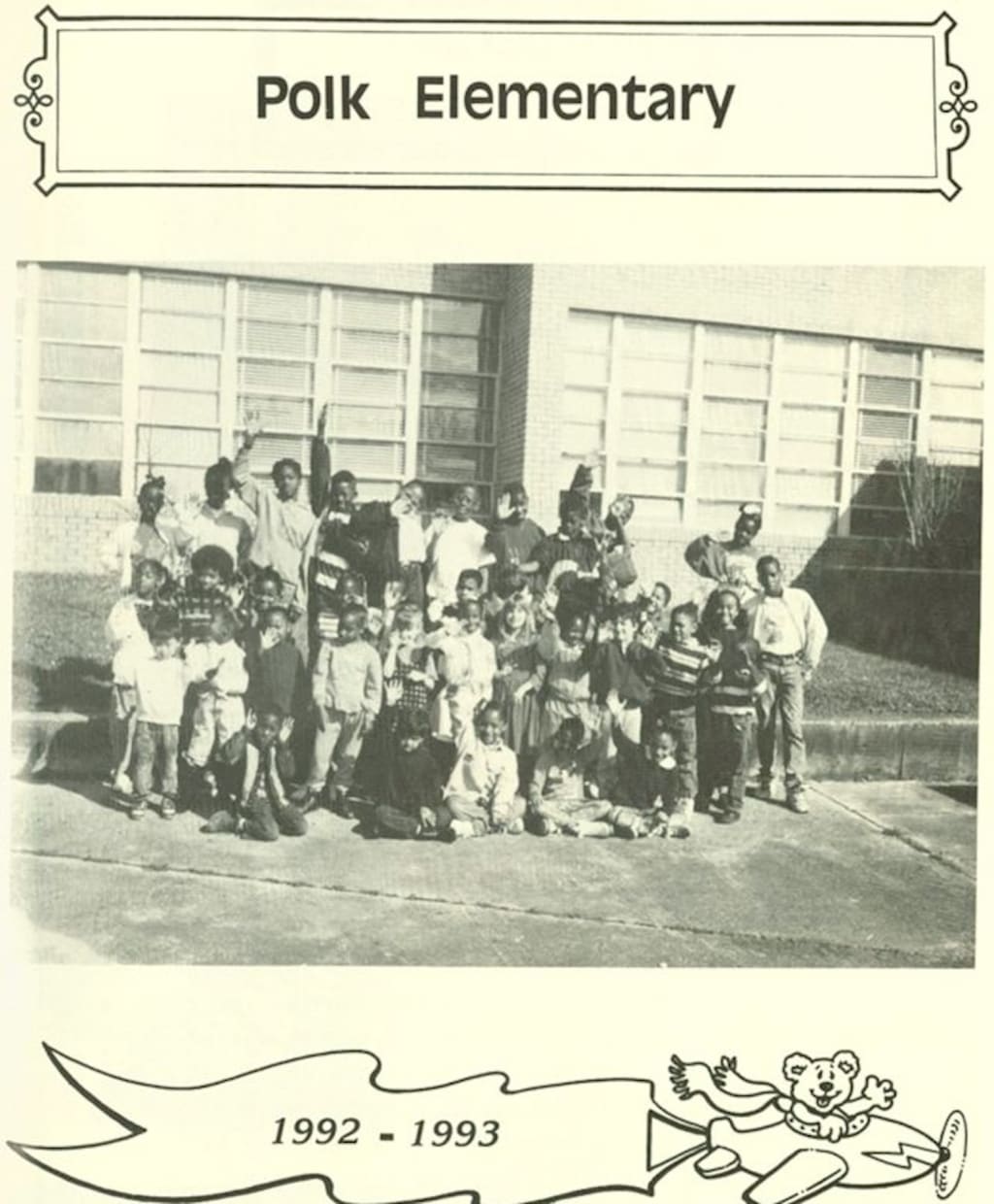
When I was working on my doctoral degree at Louisiana State University, my toddler son started his socialization at the LSU daycare. It was great for his development but also expensive for a single mother: I was paying for it more than for my 1-bedroom apartment rent.
So when my son turned four in the summer of 2006, I decided to sign him up for a pre-K program at a public school. At the time, I didn't know that Louisiana was one of the first states to pioneer a pre-K program. I couldn't even suspect that it was one of the state's policies to alleviate poverty, by allowing working parents to send their four-year-olds to school so that they could go to work without worrying about them.
I called the school district to inquire about the program, and they told me that there was only one spot left in my area, but it wasn’t in the closest school to us, the University Terrace Elementary.
“It’s all right,” I said. “As long as it’s not on the other side of the city.”
“No, it’s not, but because you are outside of their bus routes you’ll have to drop him off and pick him up every day yourself,” the woman said. “It’s just about 10-12 min drive from you.”
“Oh, that’s fine,” I said, “I don’t mind.” I already had my own car for about a year by then.
“It’s Polk Elementary,” the woman said and paused meaningfully as if it was some sort of a coded language.
“Ok, I’ll write it down,” I said, clueless, “could you give me the address?”
She gave me the school address and then asked, hesitantly, “May I ask where you are from?”
The question made me feel a little uneasy. The only reason a school district staff would ask it would be to doubt my legal status.
“Why?” I asked, with a hint of irritation.
“Oh, no, no, I didn’t mean to pry,” she said hurriedly. “You have this beautiful accent I can’t place. Sounds like Eastern European?”
I get that a lot even now, a lot more at that time, so I immediately felt at ease and said, “I’m Russian.”
“Oh, that makes perfect sense then,” she said, seemingly relieved. “I don’t know how to tell you this and if it would make any difference for you, but…” she paused, hesitating.
“Tell me what?”
“Polk Elementary is in the black neighborhood, but there’s a police station right next to it, so it’s safe,” she fired in one quick sentence.
“Why would it make any difference?” I asked.
“There’s high probability that your son will be the only white kid in the class,” she said.
“That will be a great socialization experience for him,” I responded, “besides, do kids really care about the skin color when they are four?”
“Well, great then,” she said, “just fill out the paperwork on the website and send it to me. I’m sure your son will enjoy it, they have great caring teachers there.”
My son did end up being the only white kid in his class of 12. His teacher was the only white teacher there at the time. When I picked him up after classes, it was amusing for me to see them together, two white blond spots in the beautiful sea of blackness wearing red and black school uniforms. And my son did have great experience: by the time he ended his year there, he could read in English and even write some words. It was not in the pre-K curriculum, but his teacher worked with my son and three other kids in the after-school program. As a result, they got ahead.
That after-school program was an accidental result of my encounter with poverty. My son's school day ran from 7:45 am to 3 pm, a big difference from the LSU daycare, where I could pick him up as late as 6 pm. My duties of a doctoral student and graduate teaching and research assistant ran well beyond 3 pm. So, at the beginning of the year I asked my son's teacher if there were any after school programs that I could sign him up for.
“Yes, there is one. He could stay here till 5:30 pm, but unfortunately, it seems we will not be running this program this year,” his teacher said.
“But why? Not enough busy parents to enroll?”
“Oh no, there’s a lot of families that would benefit from it,” she said, “but for it to work we need to run an extra bus to take kids home. The state will not pay for it and it’s just too expensive for some parents.”
“How much is too expensive?” I asked.
“70 dollars, just to cover the gas,” she said.
“Per month?” I asked.
“No, for the entire semester.”
“??? People cannot afford $70 for the entire semester?” I asked in disbelief. For someone who just stopped paying $560/month for daycare, this seemed like peanuts.
“Well, it won’t be even $70 because it’s the cost of the entire bus, so if 7-8 kids participated it would be about $10 per family.”
“Let me get this straight: $10 per semester per family for extra 2.5 hours of school and people cannot afford even that?” I asked, completely shocked.
“You’d be surprised how poor these families are. Most kids are on the free or reduced school meals programs and their parents are happy they only have to buy 2-3 sets of uniforms for the entire year. Many of the kids have hand-me-down uniforms and school supplies from their older siblings.”
“Oh my god, I don’t have the money on me right now,” I said, “but I will bring you the check tomorrow. For the entire bus. Would you please, please, please lobby for the program to run?”
“I’m sure I won’t even have to if we can cover the bus,” the teacher said.
On the same day, still shocked by this conversation, I went to vent to my mentor who'd helped me secure the LSU daycare spot earlier and had a soft spot in her heart for my son. Even before I finished the story, she took a checkbook out of her desk drawer and started writing a check.
“Oh, no, no, you’ve already done so much for us,” I protested. “I’m not telling you this to ask for the money…”
“I know,” she cut me off, “but I always wanted to do something meaningful for you and your son. Let me do this for the entire Polk Elementary.”
I was grateful. My mentor also explained to me why the after school program would not run without that extra bus. In previous years, when the school relied on parents to pick up the kids at 5:30 pm, too often the parents got delayed at work or failed to pick up their kids on time. Many families in that neighborhood did not even have a landline phone so the teachers had to hand the kids off to the police station next to the school. You can imagine how traumatizing it was for the kids to be brought home by a police officer.
I paid for the spring semester's after school bus as well, without telling anyone. To this day, my son remembers that school and his teacher warmly.
He also had his first racial awareness experience at that school. One day, he got off the after school bus crying, and the bus driver said he’d been crying all the way home but wouldn’t tell him why. When I asked what happened, he said, “Lakisha [name changed] called me sour creeeeeeam!”
“Yeah, so what’s so bad about that?” I asked, completely clueless about racial slurs aimed at white people.
“She said it, and other kids laughed at me and pointed fingers,” he continued bawling. “And then they said it again, many, many times.”
“But why sour cream?”
“She said it’s because I’m white!! But I’m not even white!”
“Yeah?” I said, trying not to laugh at this embodiment of righteously indignant cuteness. “What are you then?”
“Look at me!” he said, pointing at his face and hands. “Look! This is not white! This is… this is… (clearly searching for a word) BEIGE!”
I lost it right there, especially because he said “beige” in Russian.
Next day, I asked the teacher what had happened. She said that my son and Lakisha were quite good friends. They were playing together and started arguing about a toy they both wanted. The teacher was with another group of kids at the time. As other kids told her later, my son said Lakisha was greedy. Lakisha called him sour cream in response. When other kids started laughing and chanting “sour cream” at him, the teacher stopped it. “Unfortunately,” she said apologetically, “it runs both ways. Kids hear this stuff at home and then repeat the insults here. We certainly don’t teach them that.”
P.S. I recently looked up Polk Elementary. For a short period of time, it was turned into Eva Lagard learning center. It made me sad to learn that the school founded in 1960 as an African-American school closed permanently in 2021.
About the Creator
Lana V Lynx
Avid reader and occasional writer of satire and short fiction. For my own sanity and security, I write under a pen name. My books: Moscow Calling - 2017 and President & Psychiatrist
@lanalynx.bsky.social
Keep reading
More stories from Lana V Lynx and writers in Families and other communities.
A Birthday Trip to Remember
My earliest childhood memory is from when I just turned 3. It’s patchy and vague, but I remember it because it was such a unique and memorable event: my father took me on a train ride from Bishkek (then Frunze) to Moscow. The Soviet Union was huge, so that trip took three days and three nights one way. I remember the rhythmic and calming sound of the train, which I love even now. I still prefer traveling by train over a plane or car.
By Lana V Lynx2 years ago in Families
My Favorite Slime Recipe
A few years ago, making your own slime was all the rage. People swapped recipes and even swapped slimes. Now, you can buy all the pre-made slime you want, in a variety of colors, textures, and themes. But there is something special about creating your own slime. This activity is great for keeping children busy on a rainy day, or helping them learn to follow step by step directions.
By Angel Mann5 days ago in Families
Punch the Macaque: The Baby Monkey Who Found Comfort in a Plush Friend
Today we look back at one of the most unexpected viral stories of 2025—a tale that began quietly in a zoo in Japan and grew into a global symbol of resilience and tenderness. It is the story of Punch, a Japanese macaque born in July 2025 at Ichikawa City Zoo in Chiba Prefecture. His life began with hardship, but what followed has touched millions across the world.
By Haroon Pasha2 days ago in Families


Comments (4)
I love your writing style, Lana! Thx for sharing this story! It is insightful & inspiring! 🫶🏾🌸
What a vivid snapshot you've given us here. Heart-breaking that so many families had so very little though 😔
This is very informative. I did not know Louisiana was the first state with prek program. I was lucky, too. I went to a school full of diverse culture. I never understood racism or prejudice because of it. I learn to appreciate diversity. Great experience. You are an amazing mother. I had a Russian classmate his mother became my babysitter after school. My mother and her became close friends. These brought back childhood memories. I have been picked on as a child but the way you handle your child’s situation is priceless.♥️
I've never heard of sour cream before. I mean as an insult. It's sad that parents don't realise how much everything they do influences their kids