
My Grandmother's Scissors
The right tool for the job
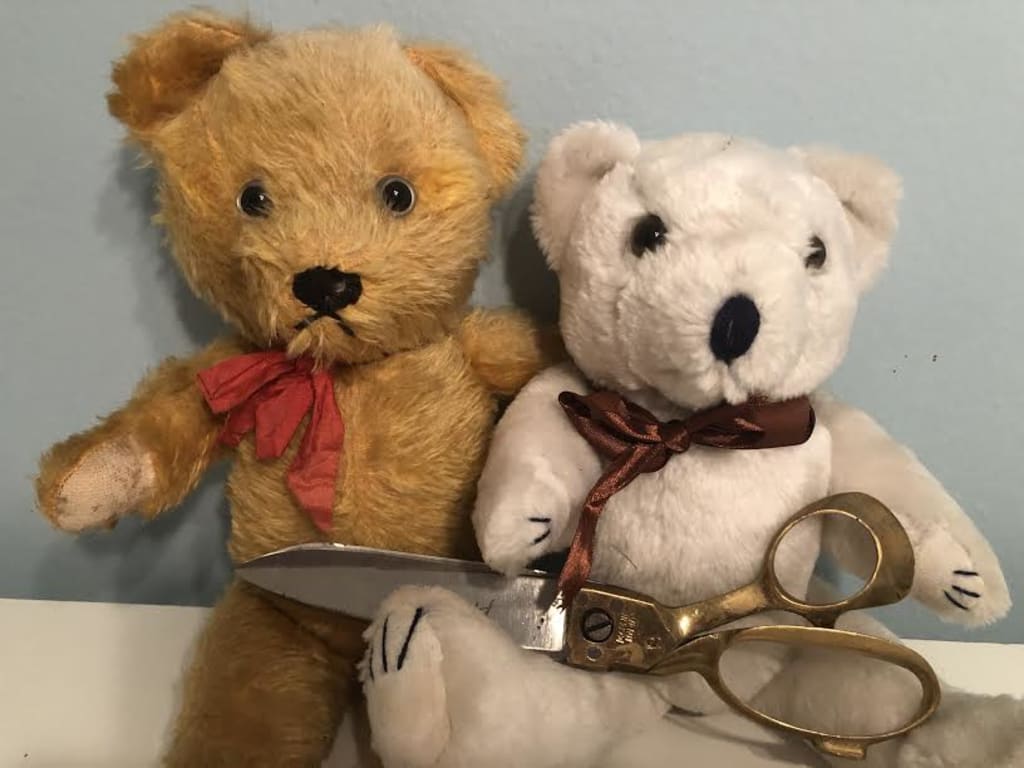
Normally a very obedient child, there were some things that I simply could not resist - like scissors. Long before “scrapbooking” became a thing, I entertained myself as a small child by cutting out pictures from newspapers, magazines, and the Green Shield Stamp catalog, and gluing crazy collages into my big red scrapbook. (It came from Wooly's on the high street, and had large grey construction paper pages and a big pair of scissors printed on the cover). I remember being given a pathetic pair of safety scissors to use; small and dull, with rounded tips. I always rejected them whenever I could in favor of the forbidden, larger, silver pair, which were pointed, and much sharper and more exciting. The sound and feel of shearing into the crisp paper was such a thrill for a five year old. (That must have been before they found their way down the back of the sofa and were lost for several years before their triumphant rediscovery, when we had to deconstruct the sofa to empty the stash of hamster food that had accumulated inside it... but that's another story...)
After being widowed during the Second World War, my grandmother made and sold toys to make a living. She used scraps of fur fabric and straw stuffing, and rode the train from Portsmouth into London to sell them. (Several of her teddy bears became an integral part of my childhood, and I still cherish them today). With little family income coming in, my mother learned to be frugal, resourceful, and to never waste anything. She made all her own clothes, from any fabric that was available, including the gray suit she was married in.
Once she considered me old enough, she passed her knowledge and values on to me, along with the silver scissors. She introduced me to sewing, and taught me the basic skills on her hand-cranked Singer sewing machine. She showed me how to read a paper pattern and cut out each piece carefully along the lines. I learned about selvedges and nap, and how to place and pin each piece so as to waste as little fabric as possible. She showed me when to use pinking shears, and when embroidery scissors were the best choice, snipping loose threads or undoing mistakes in pieces mysteriously sewn together upside down, inside out or the wrong way round. (I have always been spatially challenged.) Then, one day, I was permitted to cut out the precious fabric pieces myself, using grandmother's heavy fabric shears. The right tool for the job. And I never again cut paper with the fabric scissors!
Now that I am all grown up and retired, I have found time to return to sewing and feed my creativity in new ways. I have retained my love for fabric; the colors, textures and patterns excite and motivate me, so I am naturally drawn to piecing as an art form. But still being my mother's daughter, I needed to find a practical excuse for playing with fabric.
Always on the look-out for quality bargains, I see potential where others may only see cast-offs. I like to repurpose and reuse fabrics from thrift stores and up-cycle them in combination with new materials to give them fresh life. And I have a huge scrap box from which I can piece fabrics in coordinating or contrasting colors to create a patchwork large enough to use. I like to sew in straight lines on vibrant cotton fabrics.
My sewing room is my safe place, my happy space, where I can lose myself and spend time doing what I love away from other distractions. It is usually a big mess; I have so many fabrics (well, you can never have too many, can you?), and I like to lay them out across the bed to make selections before starting a new project. After creating the prototype, choosing the right fabrics to use together is the most difficult and time-consuming part. And that's where the fun lies. It is the juxtaposition of colors and patterns that attracts attention and make a project aesthetically pleasing, And it is the texture that gives pleasure to the touch. Add an underlying function and smart design, and what’s not to love?
Having the right tools brings me great joy and makes the creative process so much easier. I inherited some tools from my mother; all cherished and carefully maintained down the years. Others I acquired from thrift stores - provenance unknown. A rare few, I bought new in sales. Cutting shears, pinking shears, embroidery scissors, paper scissors, rotary cutters, quilting rulers, tape measures... Then I have a wall of colored thread, and drawers and cupboards full of hardware and notions: buttons, snaps, rings, tapes, ribbons, zippers, interfacing, batting, pins and needles... My giant cutting mat lives under the bed, and a huge paper roll 36" wide hangs suspended under a wooden bench, like a giant toilet roll; perfect for pattern making. My handy little craft iron sits on the ironing board when folded out from the wall. And of course, in the middle of it all, my trusty sewing machine. No longer a hand-cranked model, I bought it maybe 25 years ago, and it has never let me down. To model my creations, I have Rosy, my new assistant, who stands patiently in the corner of my studio and never flinches when I stick pins in her.
I joined a local craft market and on Saturday mornings, I lug my wares down to the town centre, and set up my tiny 4 x 4 pop-up booth (a modified beach changing tent). Dealing directly with customers and watching them react positively to my creations is very motivating, and their feedback highly educational. My first product was the Swag-Bag, a reversible origami shoulder bag made from six fat-quarters of co-ordinating fabric. I added an internal pocket for a cell phone, and a cute tie at the shoulder. It was quite popular, but I needed to diversify.
As the clock ticked by, I noticed people rushing around the farmers' market trying to juggle all their shopping together with a water bottle and a purse and small children and a dog and a stroller... all with only two hands. And then I understood what I needed to make. I started to design and sew ‘carrying solutions’, as I like to call them: practical ways to carry awkward things in everyday situations, while adding color, whimsy and fun design elements to augment functionality. In short, shoppers needed 'the right tools for the job' too!
Soon new products started flowing like a torrent from my insatiable creativity. I identified a need, devised a solution, designed a pattern, created a prototype, and then modified the product until I was satisfied. Then I gave each new product a catchy name. The Water-Porter (it sounds better with a British accent!), Bouquet-Bag, Tidy-Tote and Play-Sack were born. With small people carrying their own toys and snacks themselves, mum's hand was now free to hold onto theirs. And for my fellow vendors, I made the Market-Pinny (apron) to carry cash, business cards, pen, scissors (!) etc. More products followed to solve other every-day carrying problems e.g. the Flying-Saucer (you know how a serving plate never fits into a brown paper carrier bag?), and the Peg-Pouch (no more losing the peg bag between the sheets on the washing line!).
When market day is over, I pack up and trundle back home to my happy space. As I ponder the day, I like to think there is a fun solution to all the carrying needs one can imagine. My sewing tools in their turn create practical carrying tools for my customers and friends. And my grandmother's teddy bears look on from the shelf and smile as they watch her silver scissors busy in their new purpose.
About the Creator
Keep reading
More stories from writers in Families and other communities.
Wise~Guys
— Look Behind what's in Front of You ~ Make Good Choices — Hey, So how you Doin'..! Made~Men — Mobster Movies romanticise a distinctive, elegant appearance, impeccable attire style, along with the 'Families' expressive lingo. Making their 'Bones' gave them Panache — with vintage fedoras, tailored pin-striped suits, mirror-polished wing-tip shoes adorned with tassels; with their 'Gun Moll' gorgeous dates on their arms.
By Jay Kantor22 days ago in Families
The CEO of Everything
They say "jack of all trades, master of none," but they forgot to mention the part where the jack of all trades is also the camera woman, the makeup artist, and the person currently yelling at a tangled Wii microphone cable in a her own bathroom while recording herself singing and trying to make it look realistic and professional. (As professional as you can make it with nothing but a cell phone camera and a mic that doesn't work)
By Sara Wilson5 days ago in Humans
Rachel Reviews: The Spiral Archive by Pieter Hendrik
It's difficult for me to know where to start with a review of this book as it was, for me, an entirely unique experience and one that I'll probably never have again. I don't want that to be interpreted as unenjoyable but it has left me scratching my head a little and ruminating on its content, its themes and its characters.
By Rachel Deeming5 days ago in BookClub



Comments
There are no comments for this story
Be the first to respond and start the conversation.