

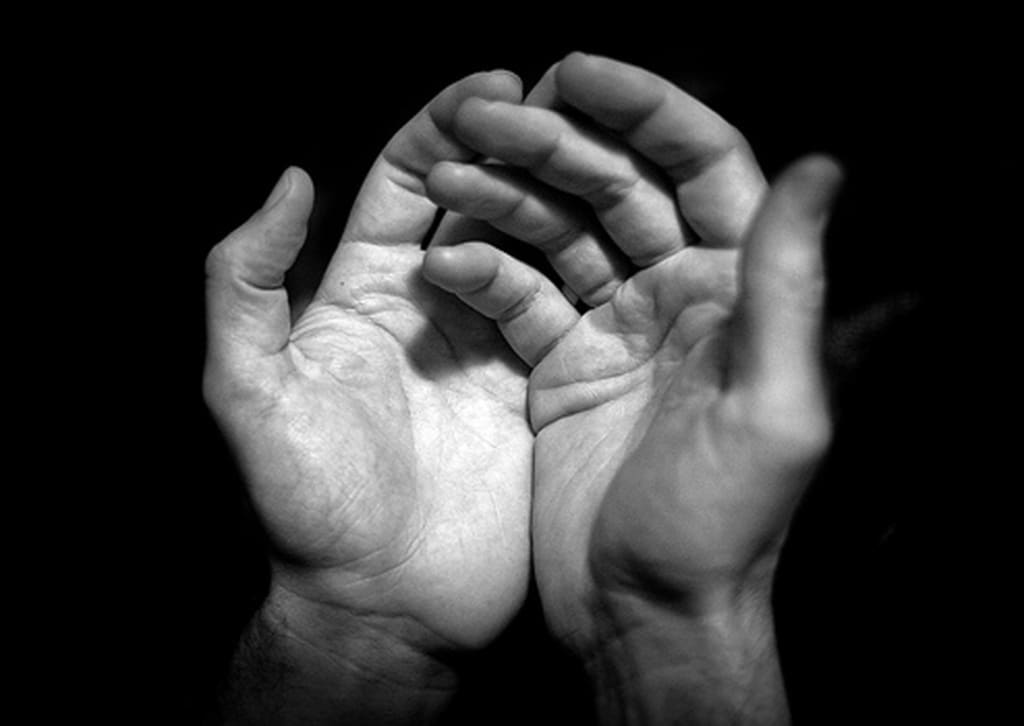
My Father’s Hands
His face is fading in my memory. I try to hold on, but his hands are what is clear to me.
The smooth, straight fingers had clean, short nails. His second finger slanted slightly at the tip, which he had cut off while slicing food for us. The doctor stitched it together at an angle, and it remained that way. The back sides, lightly specked with freckles and sparsely covered with dark hair, had begun to show signs of age. On the underside, the skin was stretched so tight and smooth that the identifying lines seemed barely perceptible.
It is strange to me that they should be what I remember so clearly. I know the caring touch of his stroking my hair – sometimes in consolation, sometimes in adoration of his little girl. His hands portrayed the gentleness of his demeanor.
They were never used for violence like so many men, except perhaps when he was a child or during the war, but masculine in their own way. Those hands cut hair to provide for us. I’m sure there were days when they were tired from the snipping of his scissors, but he could still use them to rub my back as we watched TV together. They ached of love.
His hands were those of an artist, although he didn’t paint, or sculpt, or write. His art was repairing, restoring and cleaning old useless objects, or bringing pieces of materials together to form something useful or practical. There never was an odd-shaped piece of wood or small scrap of material in our garage that didn’t eventually get put to some use.
They loved to create and were very talented. They brought beauty to our world. He reupholstered an old chair for me when I left home. The tiny stitches used to gather the full skirt and the piping around the heart-shaped back must have taken days. He worked in the garage at night until my mother would call him to go to bed. He would get lost in his work. I will always keep that chair by my bedside, a doll from my childhood gracing its linen seat. It is usually the last thing in sight before I am overtaken by sleep. I believe it is this that keeps him coming back to me in my dreams.
Those hands also loved to work with wood. He built a tiny table and chairs for the only grandson he would ever know. He burned the words “Love Grandpa” in the bottom of the table. The child was only one and one-half years old, but he remembers it was Grandpa who used tools and drove a truck.
His fingers poked holes in the soil in our backyard, holes which were filled with seeds. He nurtured the seeds until they blossomed into life, creating beauty and nourishment for his family. There were three flowers, freshly picked from his garden that day, that became the last gift to pass from his hands to my mother’s on the day of his death.
Even though he had three daughters, he would sometimes do the dishes after dinner. He touched our everyday set of plates as though they were the finest china. His hands were never rough with anything. He never broke a dish.
His hands preferred the feel of a recycled cheese jar to that of a crystal wine glass, the crispness of cotton shirts to that of silk ties, and the smoothness of his own tablecloth to that of a restaurant’s. He was happier with the simple things. He was never elaborate.
Salvatore, his name at birth although everyone called him Sam or Sammy, wasn’t particularly vocal. It was often through his hands that he communicated. A playful jab in the arm meant “Welcome home, how was your day?” Placing his hand on my shoulder with a little squeeze translated into, “Things always get better. Keep on going”. His fingers pinching my cheek softly said, “You’ll always be my little girl”.
They were rarely idle, though never fidgety. Their movements always had a purpose and a finished produce: a completed crossword puzzle, a new shelf, a neatly landscaped garden. They always finished what they started.
The plain gold band, which he wore on his wedding finger for over thirty years, now hangs on a chain around my mother’s neck. It was always clean and shiny. That ring was, in a way, my father’s sole purpose for living – to complete the promise he had made to my mother so many years ago.
The rosary beads were intertwined loosely with his fingers the last time I saw them. They were folded gently across his vest, and I waited for them to move. I watched and wept as my brother-in-law placed a fishing jig into his palm, but the hook and bobber would never be cast by those hands again.
The clock on the wall in our living room, which his hands always wound, stopped the hour of his passing. No other hands will wind that clock.
Days after I last saw him, I searched for his face in an envelope filled with old photos. I was familiar with each memory. Except one. Standing in a misty field, he stared back at me. In his right hand, hanging at his side, he held a small, black book. I could not remember ever seeing this picture before, and I was certain I had never seen him hold this book. Where had his hands last placed it? I was now desperate to find this mysterious item.
As my hands rummaged through drawers, I teetered on chairs to see into top closet shelves and lastly, when I thought all hopes of finding it were over, I opened a hope chest stored in a closet in our family room. Buried beneath baby clothes, children’s drawings, school report cards and his Naval Ship’s yearbook, I set excited eyes on and ran my fingers over the black moleskin book. My father’s handwriting told his story from WWII.
Assigned to the engine room aboard the USS Guam, his hands worked on machinery. In his fashion, the room was tidy and organized. Turning to written words, he spoke of the horrors of war. He had seen the unspeakable acts of men. The bombing of enemy warships; life boats filled with soldiers floating aimlessly in the ocean; dead bodies, bloating with decay, following the waters currents. This strong, quiet man had never told me his feelings of true fear as he served our country. He recalled falling to his knees and thanking God as he learned that the war was over, and against dreary odds, he had survived! On page 111, his hands had left the only evidence of something mysterious. A policy number and name of an insurance company.
Perhaps too painful for my mother to have ever read this diary of events, the black book had been hidden away and forgotten. I had no memory of my mother collecting any sum of money after his death. Was it possible this was an unclaimed policy?
Late into the night, I scoured the Internet for information on the insurance company. At last, after following the history of the companies merge and subsequent takeover from a familiar carrier, I located their contact information. The next morning I found myself dialing the number.
I explained to them that I believed my father had purchased a policy in 1939. I did not know the amount of insurance he had purchased. I was told they would research the viability of the policy and get back to me.
Three days later, they returned my call. My father had spent $5 at the Hawaiian port he was sailing out of, for a $100 life insurance policy to help his parents cover final expenses if he didn’t live through the war. With interest, it was now worth over $20,000!
The mailman delivered the check a few weeks later. In my mind’s eye I saw his hands handing me the money. Those hands, once again, showered their unending love on me.
About the Creator
Keep reading
More stories from Marissa Olivier and writers in Families and other communities.
Mommy's Scared
I think about the first time we locked eyes moments after her birth. I saw a familiar soul and a face I somehow already recognized. In that minute I made the connection that every mother makes and never before had I felt so complete. The first few days were so scary - I was completely responsible for everything she needed.
By Marissa Olivier5 years ago in Families
Wise~Guys
— Look Behind what's in Front of You ~ Make Good Choices — Hey, So how you Doin'..! Made~Men — Mobster Movies romanticise a distinctive, elegant appearance, impeccable attire style, along with the 'Families' expressive lingo. Making their 'Bones' gave them Panache — with vintage fedoras, tailored pin-striped suits, mirror-polished wing-tip shoes adorned with tassels; with their 'Gun Moll' gorgeous dates on their arms.
By Jay Kantor24 days ago in Families
Lies Have No Feet
One afternoon, Wahab Sahib went to the school grounds to pick up his son, Abuzar. He saw Abuzar chatting happily with his classmate and friend, Tauseef. Tauseef, speaking casually, asked, “Hey Abuzar! Why didn’t you come to school yesterday? We missed you.”
By Sudais Zakwana day ago in Families



Comments
There are no comments for this story
Be the first to respond and start the conversation.