
I was nine years old when Grandpa decided it was time for me to propagate my very own fern. I chose a silver frond from the Ghost Lady that Grandpa had planted for Grandma behind the house. We tucked the frond with its neat rows of sporangia between two pieces of paper and when the spores fell, they created the shadow of a leaf against the white backdrop.
Grandpa stood over me as I dusted the spores onto a tray of damp soil and helped me cover them with plastic. I was impatient, eager to witness an immediate unfurling of a miniature forest of impeccable ferns. I waited ten whole days and then, to my horror, a translucent green film began to crawl across the soil. Clearly, something had gone very wrong. All that could be done now was to dump the entire contents of the tray into the compost heap behind the greenhouse.
Grandpa sprinted through the ferns and caught my arm. “Nothing has gone wrong, Fiddle,” he said breathlessly as he examined the battered tray for contamination. “It’s called alternation of generations. Fern children look nothing like their parents. The green slime is called a gametophyte and will soon produce little heart shaped leaves. Those leaves will produce your little ferns.” He smiled down at me. “Little grandbaby ferns.”
Grandpa was a pteridologist and ferns were his life. He was gentle and patient, essential qualities for the caretaker of such tender things. I was a raucous child, delivered to Grandpa every summer once my parents had “reached their limit.” Grandpa never yelled. He took my hand and calmly pointed out the consequences of my habitual frenzy, the crushed leaves or spilled peat moss. Gradually, I began to learn what it meant to slow down, to observe and most importantly, to care for things.
“You remind me of myself, Fiddle,” Grandpa would say after one of our conversations. I found that hard to believe. He took to calling me Fiddle after the fiddleheads that emerged from the ground every spring. I, too, was tightly wound, poised to burst. “Don’t be cross,” he would chide gently in response to my scowl. “Even the most glorious fern has its start as a fiddlehead.”
Truth be told, summers spent with Grandpa were a lot of fun. Sunlight shone through ferns, casting fractal patterns that were my playground. I was Grandpa’s vigilant sidekick, ever on alert for unwelcome fungus gnats and shore flies or staking out the strange ooze forming in the germination trays. My favorite days were spent unwrapping the numerous brown paper packages that Grandpa received from various fern societies and collectors. Entranced, I would watch his hands as he carefully uncovered leaves heavy with sori or delicately unfolded paper coated with spores. It was all so meticulous that I nearly fell asleep.
With each delivery, Grandpa would take out his little black book and make careful notes on the parcel’s origin and which species of fern it contained. I loved this so much that Grandpa surprised me with a miniature black book of my own and it lived in my pocket for the rest of the summer.
One day in early August, when the light was changing and my parents’ return was imminent, I made my way from the mailbox with a package smelling faintly of incense.
“Gregorios! It can’t be!” Grandpa exclaimed as I handed him the parcel. Making space on the kitchen table, he hurriedly untied the parcel to reveal a letter neatly written on thick stationary, a small white envelope and a vial of something purple. I balanced on the side rung of his chair, peering over his arm as he read the letter. When he was done, he set the letter down and opened the envelope. I caught a glimpse of several bright pink spore cases. So pretty! I had never seen pink ones before.
I tugged on his sleeve. Grandpa stood up. “I’m going to make a pot of tea, Fiddle,” he announced. “And then I’m going to tell you a story.”
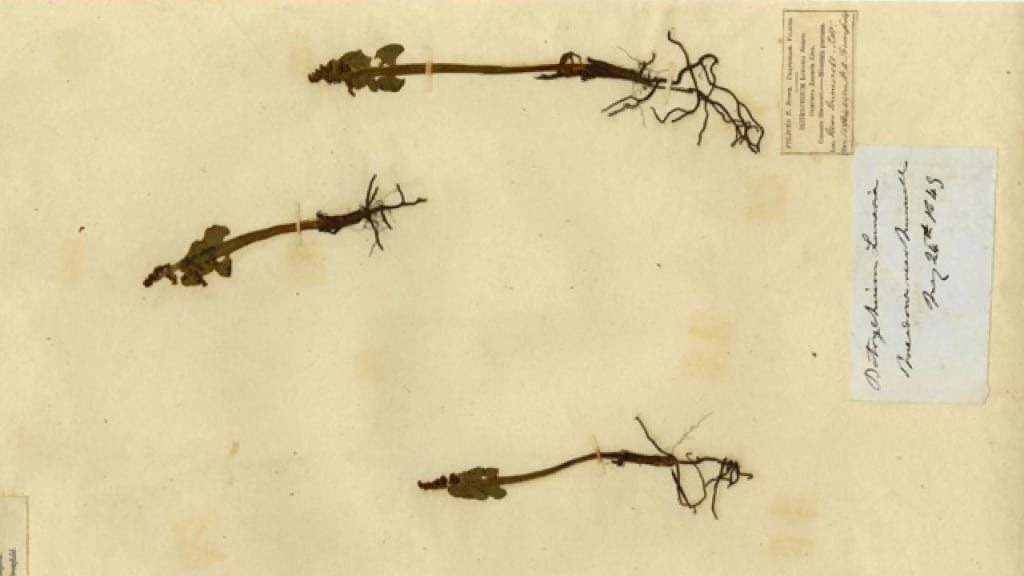
“There’s a strange kind of fern called moonwort,” he began once we were settled, mugs in hand. “Botrychium lunaria. It lives most of its life underground in complete darkness. Occasionally, it will put up two small shoots, one with leaves shaped like tiny half moons and one covered with clusters of sporangia, like little bunches of grapes. Stories tell of it being a magical plant. Witches used to collect it in the light of the full moon for their potions.”
I slurped my tea that was mostly sugar and shivered deliciously.
“It’s a mysterious plant for many reasons,” Grandpa continued. “You see, Fid, one cannot simply collect the spores and sprinkle them on dirt like we do in the greenhouse. Nothing will happen. They need something special. We think that moonwort might form a relationship with the fungus that lives underground. Fungus gives important nutrients to the plant that it can’t get otherwise. But every species of moonwort appears to require a different fungus and we’re simply not sure what the fungus is getting from the plant in return. Honestly, it’s a lot to sort out and I didn’t give it much thought until I read about Little Paper Moonwort and the monks.”
I looked up. “Monks?”
“The monks of Kykkos monastery in Cyprus,” explained Grandpa. “The only place in the world where Little Paper grows. Botrychium chartula. It is a rather beautiful moonwort with pink-edged leaves. You’d love it, Fiddle.” Grandpa smiled. “The monks discovered that Little Paper was really powerful medicine. It could cure anything from heart disease to cancer...” He paused and his voice dropped. “There were even stories of it reversing Alzheimer’s disease.”
“That’s what Grandma had, right Grandpa?”
Grandpa nodded. “Yes, Fiddle. The monks decided to plant more Little Paper so that they could share the medicine with the world. They knew growing it was nearly impossible, but, being monks, they had a secret weapon: prayer. They wrote special prayers on little paper envelopes using the berry ink that they made at the monastery. They chanted and sang as they filled the envelopes with spores and buried them around the grounds. And it worked! The plant was everywhere. Until, suddenly, it wasn’t.”
“What do you mean, Grandpa?”
“The plant stopped growing about fifty years ago. Just like that. No amount of praying could coax it above ground. When your Grandma first got sick, I was so desperate that I visited the monastery to see if I could learn anything. I thought that since I knew a thing or two about ferns I might be able to see something others had missed. Father Gregorios was my tour guide. All he could say was that it seemed like the prayer had just stopped working.” Grandpa shrugged. “God works in mysterious ways, I guess. When Little Paper stopped growing, the monks bought bees and started making honey instead. I had some when I was there. Amazing stuff.”
He stood and drained the rest of his tea. “Father Gregorios promised if he were ever to find a Little Paper shoot, he would send me the spores.” He gestured to the package on the table. “And the good monk kept his word!”
I walked to the table and sat in front of the paper envelope protecting the pink spore cases. They felt like something sacred now.
Grandpa took his little black book from his shirt pocket and I reached for mine. He tucked the white envelope from Father Gregorios between two pages, but not before gingerly removing one pod and tucking it into the pocket at the back of my tiny book. “For your own studies, Fiddle,” he said gently. “Perhaps you’ll have more luck than I did.”
Gathering the tea mugs, Grandpa headed to the kitchen. “Point of interest, Fid,” he called over his shoulder, “If you ever figure out how to germinate this silly plant, you’ll be a very rich lady. I had a guy tell me he would give twenty thousand dollars to anyone who could show him successful germination. ‘Show me the pink, I’ll show you the green,’ he said.” Grandpa laughed. “Better get praying!”
I gathered up the brown parcel wrapping and as I stood, I heard a clink! A plum colored puddle spread on the table before me. The little glass bottle! I thought as I watched the liquid seep into the pages of my black notebook. I grabbed for it, pinching the book between stained fingertips. It was ruined. I started to cry.
“There, there Fid,” comforted Grandpa as we mopped up the mess. “I think your book looks pretty with purple pages.” As I considered this, Grandpa explained that the vial of purple liquid was the special ink made from berries that the monks had used to write the Little Paper prayer. “I asked Father Gregorios if I could have some when I was in Cyprus, but he said the monks had stopped making it. Too much work, he said, especially with the high demand for medicine. He wrote in his letter that he found a dusty crock of it in the cellar and remembered that I had asked about it.”
“I’m sorry I sp-spilled it Grandpa,” I hiccuped.
“Don’t worry Fiddle,” Grandpa consoled. “I can always make my own.”
Grandpa spent the afternoon sterilizing trays and soil. I went to my favorite hiding spot in the greenhouse, tucked under a bench, and tried my best to flatten the wrinkled pages of my book until Grandpa called me for dinner.
My parents arrived that evening. From the back seat of the car, I watched Grandpa wave as we drove away. I felt sad. Instinctively, I reached for the little black book in my shorts pocket. It wasn’t there. I felt my other pocket. Nothing. I looked on the seat, the floor. No book.
“Mom!” I yelled. “I lost my book! I need my book! Go back, Mom!”
My mother glanced at me in the rear view mirror. “Quiet Clara,” she ordered. “We are not going back.” Cheek on the cool glass of the car window, I watched the landscape turn to cityscape and felt oddly homesick.
Back in the city, I scoured my bags for my book and came up empty handed. Luckily, I was young and easily distracted. It wasn’t long before my mind was absorbed with school and friends and mastering a kick flip on my skateboard. Before I knew it, the school year was done and I was packing my suitcase once again.
As soon as I was settled back at Grandpa’s, I ran to my hiding spot in the greenhouse. Crouching, I proudly realized that I was now too big for the space. I patted the dirt floor and felt something hard. It was the corner of a small black book. I pried at it with my thumbnail but it remained stubbornly put. On my hands and knees, I maneuvered to get a better grip and then stopped. There, reaching daintily from the soil, were two tiny shoots. One had leaves shaped like half moons. One was topped with tiny pink clusters that looked like grapes. I stared. Then I yelled.
“GRANDPA!”
Grandpa’s silhouette appeared in the doorway. “Fiddle? You okay?” I could only point at the ground.
We knelt together in the dirt. I heard Grandpa inhale sharply. He reached out and his fingers brushed the half moon leaves.
“It’s my book, Grandpa! With the purple pages. It was here the whole time!”
“Botrychium chartula,” Grandpa whispered. “Little Paper.” A light was building behind his eyes. “There were spores in the pocket, weren’t there Fid? And the spilled ink made from berries. The same ink the monks used...until they stopped making it. Oh Fiddle!”
“Grandpa?”
“It’s the ink! The fungus eats the sugar from the berries in the ink! You did it Fiddle!”
His words danced wildly in my brain, but his joy was unmistakable.
About the Creator
Kara Ginther
I am a designer and a leather artist. I have always used storytelling in my work. It is time for me to hone these storytelling skills using words instead of objects. It is a task I am ready and eager for.
Keep reading
More stories from writers in Families and other communities.
Wise~Guys
— Look Behind what's in Front of You ~ Make Good Choices — Hey, So how you Doin'..! Made~Men — Mobster Movies romanticise a distinctive, elegant appearance, impeccable attire style, along with the 'Families' expressive lingo. Making their 'Bones' gave them Panache — with vintage fedoras, tailored pin-striped suits, mirror-polished wing-tip shoes adorned with tassels; with their 'Gun Moll' gorgeous dates on their arms.
By Jay Kantor20 days ago in Families
Thoughts on Vocal and the way the world is
"Death cannot stop true love, only delay it." – Wesley in The Princess Bride. I decided to come back to Vocal on a very cold and dark night at the end of December. I had been, and still am, convalescing from a horrible staph infection that had gone misdiagnosed for months. This, paired with the increasing challenges of being healthy, making the best choices for my co-parented child, being a wife, and being a director at a new job, was a lot to manage.
By Jazzy 3 days ago in Confessions



Comments
There are no comments for this story
Be the first to respond and start the conversation.