
Joint Family or Legal Graveyard?
The Legal Graveyard We Call Home

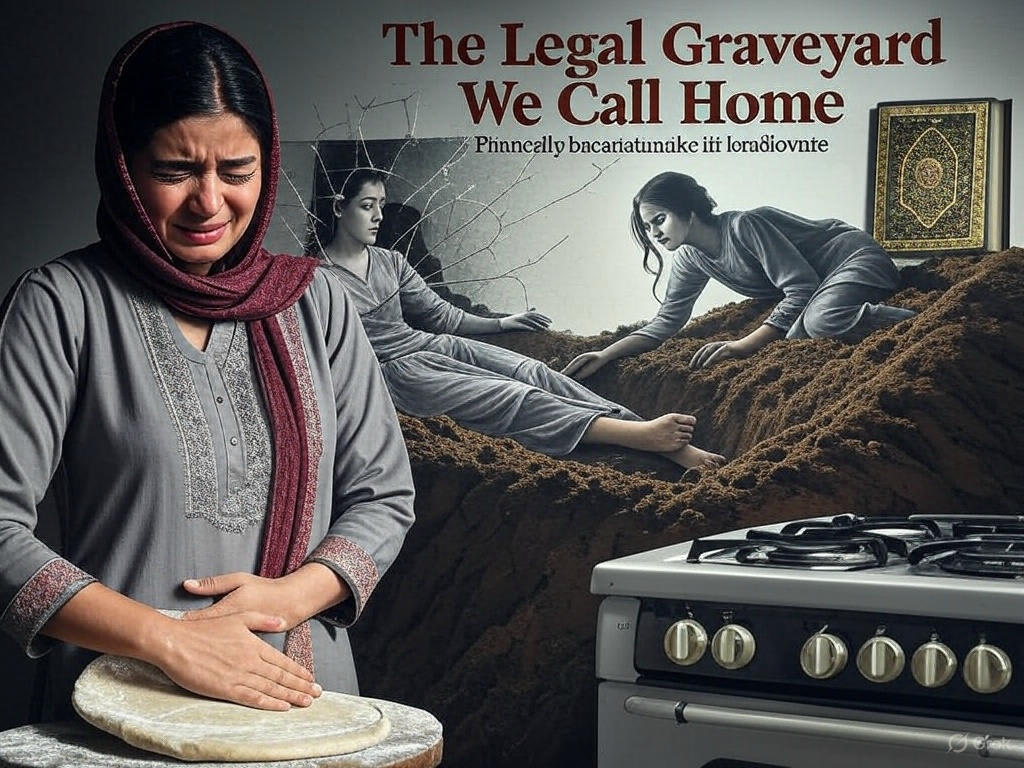
The question isn’t how that woman survived. The real question is—why didn’t she die? But then, an even more haunting question arises: why are we still alive? Because each of us has either witnessed a woman like her, lived her story, or silently watched someone else endure it. And we continue breathing, not out of strength—but because we’ve grown numb enough to keep living.
This isn’t a story written on a woman’s body; it’s carved from within her soul. It speaks for the woman who, despite bowing to her husband’s every command, slaving for her in-laws, swallowing her sisters-in-law’s poison, bearing the hungry stares of her brothers-in-law, and being crucified by society—still somehow manages to “save the family.” But save it for whom? For everyone but herself. She dies a little every day, is buried a little every day, only to rise each morning—rolling out parathas for her mother-in-law—as if nothing ever broke her.
Who is this woman? She is our mother, our wife, our sister. She’s the one whose hands are adorned with henna but whose lips are sealed. Her eyes hold truth, but her world—only lies.
We’re told that marriage gives a woman a new home. What they don’t tell us is that waiting in that home are: suggestive looks from her brother-in-law, taunts from her sister-in-law, and burning glares from her mother-in-law. It’s not a home—it’s a trial. If she endures it, she’s righteous. If she speaks up, she’s disrespectful. If she dies, she’s pitied. But if she survives—she's condemned.
This is our joint family system—not a family, not a system, but a collective madness where the individual matters as much as a corpse in a grave: unable to speak, capable of hearing, and ultimately silenced without a sound.
A woman suffering from blood cancer attributed her illness to the toxic environment of her in-laws. And believe it—it’s not a fabricated story. It’s horrifyingly real. Wounds inflicted on the soul fester like infections in the bloodstream. What the modern world calls mental health, our society condemns as ingratitude, rudeness, and rebellion. Especially when the woman is left alone in the house, and her brother-in-law’s eyes are itching to tear her dignity apart.
The phrase “no one believed her” might just be society’s greatest cruelty. Because society desires her body—but refuses to acknowledge her spirit. Her voice is strangled, and then she’s asked—why she doesn’t speak. Her will is disregarded, and then she's expected to obey.
This is the same woman who handed over 22 years of her life’s reins to others. Her son’s wedding is now being planned by her sister-in-law, while she just watches. She’s the woman who rolled 50 rotis a day, managed the entire household in her husband’s absence, spent her youth burning her bones over the stove. And in return? Just one title—ungrateful.
And had she died? Her father-in-law would have said, “She was a good daughter-in-law.” Her sister-in-law would mourn, “We loved her dearly.” Her brother-in-law would arrange a Qur’an recitation in the mosque. Then everyone would eat, drink, and return to their homes. Because this system is not a joint family—it is a collective hypocrisy. Here, a man’s anger is his right, a woman’s tears are drama, his absence is a compulsion, her need for protection—shamelessness.
To that sister who has lost the war while still breathing—I offer my heartfelt salute. The pain of her cancer might not be eased by medicine, but her silence must not go unheard. Because if we again dismiss this pain as fate, then tomorrow, our own daughters will be praying in such homes to simply—die.
A joint family system, if built on justice and respect, can be a blessing—but that exists only in dreams. In reality, it is a poison that slowly seeps into a woman’s blood. And by the time it's diagnosed, the woman has either already died—or chosen to stop living.
Society must ask itself:
If a daughter-in-law can be like a daughter—
Why can’t the sister-in-law be like a sister?
Why can’t the father-in-law act like a father?
Why can’t the brother-in-law be like a brother?
And if they cannot—why is it solely a woman’s responsibility to save the home?
If she is expected to protect the home, then she has every right to stand against those turning it into a living hell.
This story might end—but that woman hasn’t.
She still stands in front of the stove, cancer burning within her, preparing a meal for the very sister-in-law who plans to marry off her daughter to her son—without even asking her.
And society?
Still says:
“It’s fate…”
No, it’s not fate.
It’s injustice.
And giving injustice a name, exposing it, and speaking against it—is the first cure.
Because if we still stay silent today,
Tomorrow, our own sisters and daughters may be rolling 50 rotis a day…
…whispering the same prayer:
“O Allah, please let me die…”
And that—would be a curse,
Not on her life,
But on this entire system.
So ask yourself—
Is a joint family really a family?
Or just a legal graveyard?
Decide. Today. Now.
About the Creator
Muhammad Ilyas
Writer of words, seeker of stories. Here to share moments that matter and spark a little light along the way.
Keep reading
More stories from Muhammad Ilyas and writers in Families and other communities.
The Day They Chose Love Over Being Right: A Marriage Story
Lena and Marcus had been married for eight years. They had weathered life’s challenges together — moving cities, career changes, the loss of a parent, and the joyful, chaotic arrival of their daughter, Amara. Like any couple, their marriage had its seasons of warmth and seasons of cold distance. Lately, the latter seemed to be settling in more than either of them liked.
By Muhammad Ilyas10 months ago in Families



Comments
There are no comments for this story
Be the first to respond and start the conversation.