
How My Mother’s Histrionic Personality Disorder Ruined Our Relationship
I thought I was a bad daughter


According to my father, all my mother ever wanted was children of her own. She spent their teenage daydream years hoping someday she would one day be called mommy. Though I have no memories of this, my family often states what a good mother she was when we were babies and toddlers. She coddled us and bounced us on her hip. Mounds of photo albums prove that my brothers and I were often wrapped in her thin arms.
Yet, by the time she was 23 and had finished conceiving all three of her children, being a mom seemed to be the furthest thing from her mind.
So what happened? I blamed myself, as young kids tend to do. The adults around me dedicated a large portion of their lives trying to come up with reasons as to why a ‘switch’ had gone off and my mother suddenly seemed to care more about bar hopping and meeting new people, than spending time at home.
When I was ten, my mother finally got caught cheating. She had the audacity to take me and my siblings along on the date with her. I remember the back seat well. The middle child, forever put in the middle seat, I could see a strange man wrapped in her thin arms. I blamed myself. If I had stayed cute, rather than gangly and boyish, maybe it would still be me there. Maybe Dad would be there.
I convinced myself to believe if I was somehow a better daughter, Mom would want to be MY mom. The world seemed so unclear. Boxes were moved into a small apartment, and pictures were turned down and packed away. And finally, as Mom groveled and pleaded at the door to stay, our home became dark and muddied. Dad became colder and we stayed with my grandmother for a few months, until things cooled down.
My memories begin to sharpen around this time. Man after man entered my mother’s apartment. Our recycling box was eventually replaced with a larger, more durable tin one as the liquor and beer bottles could not get cleaned out fast enough by the sanitation department.
Throughout the span of my middle and high school years, my mother moved in with over ten different men who were all “the one” and “not like all the others”. She had so many apartments that in my mind they contort like the famous Winchester Mystery House.
At school, I was bullied for being ‘the village whore’s daughter’ since my mother flirted and ultimately slept with many of my classmates' fathers and uncles. I became incredibly shy and I started to fear the taunting so much that sometimes I would cut school and walk around my little town until the last bell rang.
She was hardly present. And when she was, her behavior was childish and (to my angsty teenage self) humiliating. Often, I would find her in the living room, looking out the window and jumping on the couch, while talking on the phone with her new boyfriend, who was on his way over. She would twirl her hair and theatrically chew bubble gum. She even put her 80’s hair up into tight ponytails on occasion.
Me and my siblings spent most of our time at our dad’s, and when mom guilt-tripped us enough, we’d find ourselves sitting in a strange man’s home, waiting for her to finish whatever it was they were doing in the next room. Me and my brother would take bets. Who would break up with who? Who’s father is this? How long until she notices we walked out?
Eventually, one of those strange men grew stranger. There was a hand on my thigh. I was in my bathing suit. And his eyes kept darting from Mom to me. He told me I looked just like her.
That same day, when that man finally disappeared, I told her what happened. I cried and begged her to leave him. And I asked ‘Why can’t you just be happy with us?’ To my dismay, Mom looked at me with nothing but spite. She called me selfish. And I believed her.
Moments before her words. I loved her. Even when she was speaking like a teenager in puppy love, I loved her. Even when I would have to turn off the lights and tuck myself in, I loved her. Even when he put his hands on me, I loved her. But my love wasn’t enough. I knew by age 15, that I would never be enough for her. The quick, romance of a man she’d soon leave and the buzz of her liquor would always mean more.
I stayed with my dad as much as I could. Slowly, as children are bound to do, I tried to warm back up to my mother. But time and time again, I was left feeling betrayed and lonely. And my dad’s badmouthing of my mother didn’t help. He would often and openly call her awful names. It made me believe that it was okay to hate her.
So, what happened to her?
I’ve been in and out of therapy since I was a troubled teenager looking for attention and acceptance. And last year, my newest therapist asked me to fill out a questionnaire about me and my mother’s relationship. I also took the ACE (Adverse Childhood Experience) Test, which is how I started my own diagnosis of C-PTSD. My therapist wanted to help me gauge what sort of issues my mother might be suffering from. Which, in turn, would help her guide me through my healing process.
We went through everything I could think of: narcissistic personality disorder, alcoholism, bipolar disorder. But nothing, outside of the obvious alcoholism seemed to make sense. Until finally my therapist introduced me to a disorder I’d never heard of. Histrionic Personality Disorder.
Here is a link to a trusted mental health website for more information.
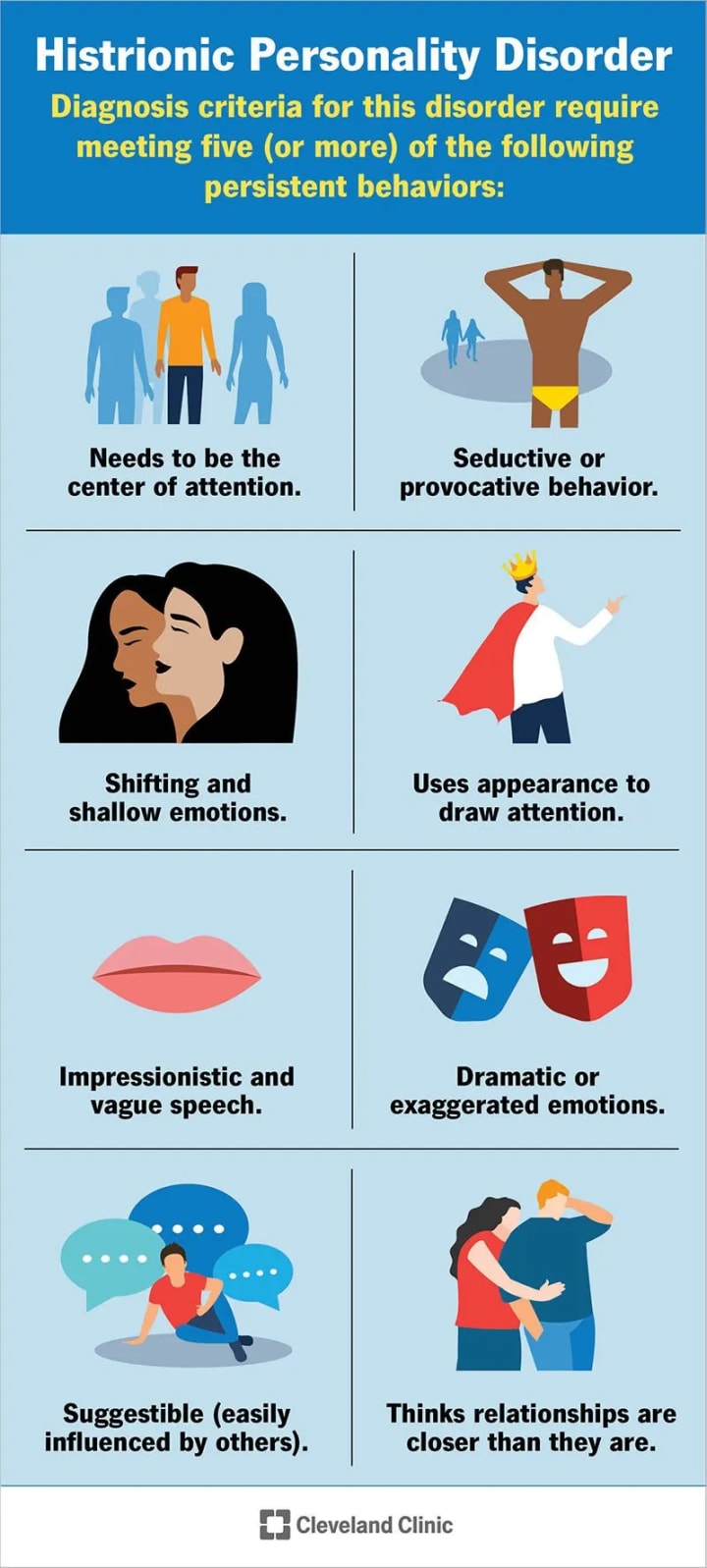
Many doctors do not like the term histrionic as it comes from the sexist and outdated term hysteria, which was often used as a diagnosis for women who were simply standing up for themselves. But, for me, having a disorder to point to, helped me empathize with her. Which ultimately helped with my own healing journey.
I don’t believe you need to forgive your abuser in order to heal. However, having a reason behind the abuse helped me rationalize my complex childhood trauma in regard to my mother’s verbal abuse and neglect.
Her vague language and inability to maintain any relationships was a huge eye-opener. Inappropriate flirting was another huge symptom my mom lives with. Even during my high school tennis matches, when it was 50 degrees, she would be walking around in mini shorts and a tank top, talking low with my teammates’ dads, as their wives watched with disgust from their fold-out chairs.
My mother has no friends, yet whenever she meets someone new, she is the brightest person alive. She is all hugs and kisses, and her voice is never quieter than a yell. When people first meet her they are immediately sucked into her energy. She’s like a white, black hole. But after a week or so, when they realize she has remembered nothing they’ve said. And after her energy refuses to dip into a more natural conversation, they eventually leave. My mother believes she has hundreds of friends. But I haven’t met a single one that lasted longer than a year.
I hope that the DSM keeps this disorder on its list. Many doctors want to lump it into narcissistic personality disorder. But for me, this diagnosis finally led me to an understanding beyond my suffering. I could finally have sympathy for her and understand that cutting her out of my life truly is the best thing I could do for both of us.
I hate to admit it, but me and the rest of my family are enablers. We allow her to drink and carry on the way she does because ignoring her is easier than having a hard conversation that might lead to disappointment or nowhere.
The final straw between my mother and her children came at my brother’s wedding. My mother drank heavily and talked loudly, despite the somber occasion. The father of my brother’s bride was expected to pass soon due to complications of his cancer diagnosis. They rushed the wedding so that her father could walk her down the aisle and dance on their big day. But my mother, making the day about her, sobbed about feeling old and complained about not having a date, all the while chugging beer after beer.
The shame of being around her has always confused me. Especially as people, who didn’t know my mother well, would seem to always come to her defense. “But, she’s your mom! Mothers always love their babies!” Some people must be lucky I guess, to live in such a delusion.
My heart goes out to anyone with a loved one with this disorder. It is so hard to understand how someone who claims to love you more than anything in the world, in fact only loves themselves and their addictions.
I’ve met people who’ve had partners they believe to have HPD, but I’ve yet to meet someone who has a parent with it. That’s why I’m writing this down and putting it out into the world. I really want to meet people who have experienced the same stress that comes with having an emotionally immature parent. I want to hear from you desperately, as I fear I’m still that teenager, lashing out for attention and understanding.
Thank you for reading. This article was originally posted on my Medium page through the Grief Book Club. I'm happy to be putting it back out into the world.
About the Creator
Keep reading
More stories from Kera Hollow and writers in Families and other communities.
Christmas Abroad: Celebrating the Holidays Without Family
I moved to South Korea in 2017. I was twenty-two years old and excited to start my career as an English Second Language Teacher. With a Bachelor's degree and six hundred dollars in my bank account, I set off for Busan.
By Kera Hollow27 days ago in Families
Wise~Guys
— Look Behind what's in Front of You ~ Make Good Choices — Hey, So how you Doin'..! Made~Men — Mobster Movies romanticise a distinctive, elegant appearance, impeccable attire style, along with the 'Families' expressive lingo. Making their 'Bones' gave them Panache — with vintage fedoras, tailored pin-striped suits, mirror-polished wing-tip shoes adorned with tassels; with their 'Gun Moll' gorgeous dates on their arms.
By Jay Kantor11 days ago in Families




Comments
There are no comments for this story
Be the first to respond and start the conversation.