
How Childhood Attachment Shapes Adult Heartbreak
The love we learn first becomes the love we think we deserve

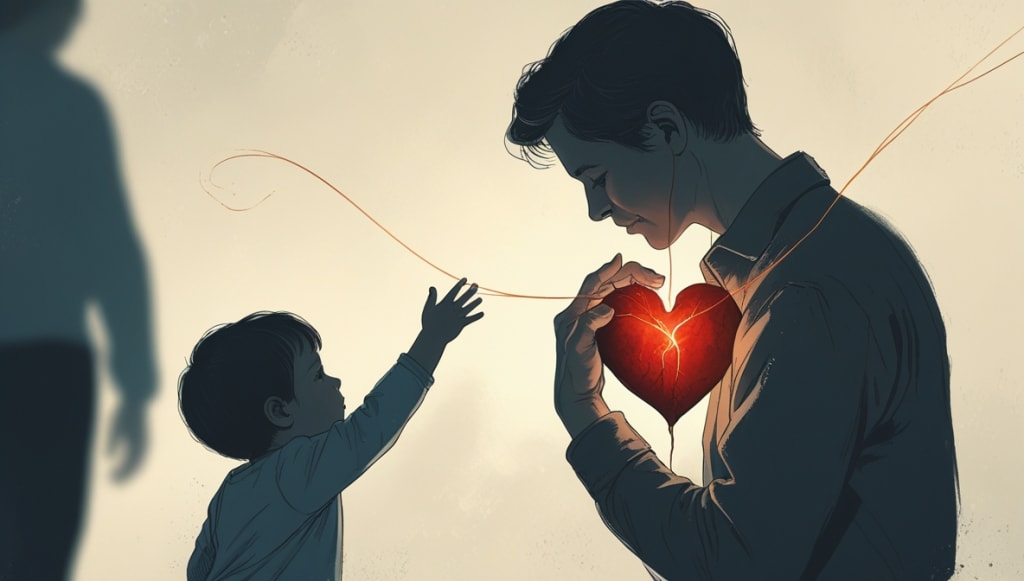
I was twenty-eight years old, sitting in my therapist's office for the fifth time that month, crying over yet another failed relationship. This time it was Marcus—kind, stable, emotionally available Marcus—who I'd pushed away for reasons I couldn't explain.
"Tell me about your parents," my therapist said gently, sliding the tissue box closer.
I rolled my eyes. "Really? We're doing the whole 'blame the parents' thing?"
She smiled softly. "I'm not asking you to blame anyone. I'm asking you to understand yourself."
What followed was the most uncomfortable, enlightening conversation of my life. Because as I started talking about my childhood, patterns emerged that I'd never seen before. Patterns that explained every heartbreak, every self-sabotage, every time I'd chosen someone emotionally unavailable or run from someone who truly cared.
My therapist was right. The blueprint for heartbreak had been drawn long before I ever fell in love.
The First Language We Learn
Attachment theory sounds complicated, but it's actually quite simple: the way our caregivers respond to us as children teaches us what to expect from relationships as adults. It's our first lesson in love, trust, and worthiness.
My mother loved me—I never doubted that. But her love came with conditions. It appeared when I was good, obedient, successful. It vanished when I was needy, emotional, or imperfect. I learned early that love was something I had to earn, not something I inherently deserved.
My father? He was there but absent, physically present but emotionally distant. He worked late, hid behind newspapers, and responded to my excitement or sadness with the same uncomfortable silence. I learned that expressing needs pushed people away. So I stopped expressing them.
I didn't know it then, but I was learning a language—the language of anxious attachment. And I would speak it fluently in every romantic relationship I'd ever have.
The Dance We Can't Stop Repeating
My first serious relationship was with Jake. He was charming, unpredictable, and emotionally unavailable. Our relationship was a rollercoaster—intensely passionate one week, ice-cold the next. I never knew where I stood, and that uncertainty drove me crazy.
But here's the twisted part: it also felt familiar. The push and pull, the constant need to prove myself, the anxiety of wondering if today would be a good day or a bad day—it all echoed my childhood. I was trying to earn Jake's consistent love the same way I'd tried to earn my mother's approval.
When he'd pull away, I'd chase harder. When he'd show affection, I'd melt with relief. I was addicted to the cycle because somewhere deep inside, I believed this was what love looked like.
After Jake came David, then Ryan, then Christopher. Different faces, same pattern. I was attracted to men who made me work for their attention, who kept me guessing, who made me feel like I had to be perfect to be loved.
The Good Guy Problem
Then I met Marcus. Sweet, consistent, emotionally intelligent Marcus. He called when he said he would. He communicated clearly. He didn't play games. He made me feel safe.
And I couldn't stand it.
Within three months, I was picking fights over nothing. I felt suffocated by his reliability. I started noticing flaws that weren't really flaws—he texted too much, he was too eager, his kindness felt boring. The anxiety I'd felt with the others was missing, and without it, I didn't recognize the feeling as love.
I broke up with him on a Tuesday night, citing some vague excuse about "not being ready." He took it gracefully, which only made me feel worse.
That's when I ended up in therapy, finally asking the question I should have asked years earlier: Why do I keep destroying the good things in my life?
Unpacking the Invisible Suitcase
My therapist explained that I had an anxious attachment style, likely formed by my inconsistent childhood experiences with love and attention. Children with anxious attachment grow into adults who:
Crave intimacy but fear abandonment
Need constant reassurance
Mistake anxiety for passion
Feel uncomfortable with stable, secure love
Self-sabotage healthy relationships
Are attracted to emotionally unavailable partners
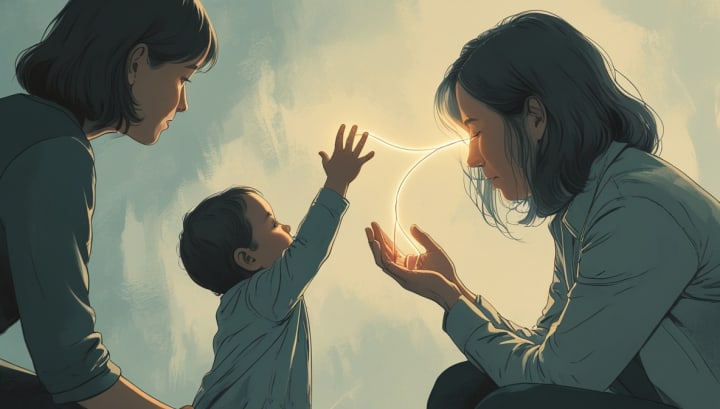
Each point hit me like a revelation. I wasn't crazy or broken. I was operating from a childhood survival mechanism that no longer served me.
She also explained that Marcus likely had a secure attachment style—the ability to be intimate without losing himself, to give space without creating distance. His consistency wasn't boring; it was healthy. But to my nervous system, trained to associate love with anxiety, healthy felt wrong.
I'd been running from the very thing I claimed to want: real, stable love.
The Patterns We Pass Down
The more I explored my attachment style, the more I saw how it infected every corner of my life. At work, I overperformed constantly, terrified that my value was tied to productivity. In friendships, I was the perpetual people-pleaser, abandoning my own needs to avoid conflict. In romantic relationships, I shape-shifted into whoever I thought my partner wanted me to be.
I'd spent thirty years trying to earn love without realizing I was teaching people to withhold it.
But here's what broke my heart most: I thought about the future. If I had children someday, would I pass this down to them? Would they learn that love is conditional, that emotions are inconvenient, that their worth depends on their performance?
That thought terrified me more than any breakup ever could. I couldn't control my past, but I could control what I carried into my future.
The Long Road to Secure
Healing attachment wounds isn't linear. It's messy, uncomfortable, and requires looking at truths you've spent decades avoiding. But it's also the most important work you'll ever do.
I started small. I practiced expressing needs without apologizing for having them. I sat with discomfort instead of running from it. I went on dates with stable men and didn't immediately disqualify them for being "too nice."
I also did something radical: I called my mother. Not to blame her, but to understand her. As we talked, I learned that she'd had an anxious attachment style too, shaped by her own complicated childhood. She'd loved me the best way she knew how, with the emotional tools she'd been given.
Understanding didn't erase the pain, but it did something more important: it gave me compassion. For her. For myself. For the child I was who learned to equate love with earning.
Rewriting the Story
Six months after our breakup, I reached out to Marcus. Not to get back together, but to apologize and explain. I told him about my attachment style, about the therapy, about how I'd mistaken his kindness for weakness and his stability for lack of depth.
He listened. And then he said something that changed everything: "I knew you were scared. I could see it. I just hoped you'd stay long enough to realize I wasn't going anywhere."
We didn't get back together. The timing still wasn't right, and I still had work to do. But his words planted a seed: Maybe I wasn't unlovable. Maybe I'd just been looking for love in languages I'd learned as a child.
The Breaking and the Becoming
Today, I'm in a relationship with someone who feels both exciting and safe—a combination I didn't know was possible. There are still moments when my anxious attachment flares up, when I feel the old urge to test his love or create distance before he can.
But now I recognize it for what it is: an old wound trying to protect me from a danger that no longer exists. I pause. I breathe. I communicate instead of catastrophize.
It's not perfect. I'm not healed. But I'm healing. And that's enough.
Why This Matters
If you find yourself in the same painful relationship patterns, repeating the same heartbreaks with different faces, I want you to know: you're not broken. You're not too much or not enough. You're not destined for lonely.
You're carrying wounds that weren't your fault, responding to old programming that once kept you safe but now keeps you stuck.
The love we learn first becomes the template for every love that follows. But templates can be redrawn. Patterns can be interrupted. And the story written in childhood doesn't have to be the story that defines your life.
Your past shaped you, but it doesn't have to script your future. Understanding where your heartbreak comes from is the first step toward building the love you actually deserve.
And you deserve so much more than what you learned to accept.
-------------------------------------
Thanks for Reading!
About the Creator
Keep reading
More stories from Ameer Moavia and writers in Families and other communities.
The Emotional Impact of Growing Up Unloved
Nina was thirty-four when someone asked her what she needed, and she realized she didn't know how to answer. Her friend had noticed she looked exhausted—working sixty-hour weeks, managing everyone's problems, never saying no to anyone. "What do you need right now, Nina? How can I help?" Nina opened her mouth. Closed it. Felt panic rising. "I'm fine. I don't need anything." But that wasn't true. She was drowning. She just had no idea what she needed because no one had ever asked before. And more fundamentally, she'd learned by age seven that her needs didn't matter.
By Ameer Moavia2 months ago in Psyche
In the End, Family Is Everything
"Family is not always about blood. It is about the people who choose to stand beside you when life becomes difficult." In a world that moves too fast, where everyone is chasing something — success, money, recognition — there is one place where we can still return without needing to prove anything.
By Zakir Ullah6 days ago in Families
Hottest in the Office
Dear Rafi, You’re very distracting to work around. For the first second I saw you the other day, I thought you were some type of executive. It took a moment to realize no, you were just the new guy, dressed up for the job he wants. Be still, my heart.
By Gabriel Shames6 days ago in Pride



Comments
There are no comments for this story
Be the first to respond and start the conversation.