
The Emotional Impact of Growing Up Unloved
The Adult Who Forgot She Mattered


Nina was thirty-four when someone asked her what she needed, and she realized she didn't know how to answer.
Her friend had noticed she looked exhausted—working sixty-hour weeks, managing everyone's problems, never saying no to anyone. "What do you need right now, Nina? How can I help?"
Nina opened her mouth. Closed it. Felt panic rising. "I'm fine. I don't need anything."
But that wasn't true. She was drowning. She just had no idea what she needed because no one had ever asked before. And more fundamentally, she'd learned by age seven that her needs didn't matter.
The House Where Needs Went Unnoticed
Nina grew up in a house where she was fed, clothed, sheltered. Her parents weren't abusive. They didn't hit her or scream at her or do any of the obviously terrible things that would make someone say, "You were unloved."
They just... didn't see her. Not really.
When eight-year-old Nina came home crying because kids at school had excluded her, her mother said, "Stop being dramatic. Go do your homework."
When she tried to share excitement about winning a writing contest, her father barely looked up from his phone: "That's nice, honey."
When she was scared at night and wanted comfort, she learned quickly that calling out would be met with irritation: "You're too old for this. Go back to sleep."
One by one, Nina learned the lessons that would shape her entire life: Your feelings are inconvenient. Your achievements don't matter. Your need for connection is a burden. The way to be acceptable is to need nothing.
By adolescence, Nina had perfected the art of self-sufficiency. She didn't ask for help with homework, emotional support during breakups, or attention when she was struggling. She handled everything alone because that's what you did when your emotional needs had been consistently dismissed.
"Nina's so independent," her parents told relatives proudly, not realizing that independence at twelve wasn't maturity—it was survival.
Dr. Jonice Webb's research on childhood emotional neglect reveals that children who grow up emotionally unloved don't develop a sense of inherent worth. They learn their value is conditional on not needing things, not causing problems, not requiring emotional labor from others.
Nina had learned all of this. And she carried it into adulthood like invisible baggage, wondering why she constantly felt empty despite doing everything "right."
The Adult Who Couldn't Receive
At thirty-four, Nina was successful by external measures. Good job. Nice apartment. Lots of friends who relied on her for support, advice, help with everything.
But when her friend asked what she needed, Nina froze. Because receiving felt dangerous. Needing things felt shameful. Asking for help felt like admitting she was fundamentally deficient.
Her therapist—she'd finally started seeing one—asked her to try something: "This week, I want you to ask someone for help with something small. Anything."
Nina spent the entire week unable to do it. She'd draft texts asking friends for favors, then delete them. She'd start to ask a coworker for assistance, then stop herself and figure it out alone.
"I couldn't do it," she admitted in her next session. "Every time I tried, I felt this crushing shame. Like asking for help meant I was weak or broken or too much."
"That's what happens when you grow up unloved," her therapist explained gently. "You internalize the message that your needs are burdensome. So as an adult, you'd rather suffer alone than risk being a burden to anyone."
Research by Dr. Gabor Maté shows that children who grow up emotionally neglected often become adults who can give endlessly but cannot receive. They overfunction in relationships, become everyone's therapist, give until they're depleted—all while being unable to ask for anything in return.
Nina saw this pattern everywhere in her life. She was the friend everyone called in crisis but who never called anyone herself. The employee who took on extra work but never asked for support. The daughter who still tried desperately to earn her parents' attention through achievement, even though she was an adult who shouldn't need their validation anymore.
She was exhausted. But asking for help felt more terrifying than continuing to burn out alone.
The Relationship That Exposed the Wound
Nina dated someone named David who genuinely wanted to know her. Not the helpful, capable, always-fine version she showed everyone. The real her.
"How are you feeling?" he'd ask after a hard day.
"I'm fine," she'd say automatically.
"No, really. How are you feeling?"
"I said I'm fine."
He'd look at her with this expression—concern mixed with frustration. "You never let me in. You never need anything. You never ask for support. It's like you're determined to do life completely alone even though you're in a relationship."
"I don't want to be a burden."
"A burden? Nina, that's what partners do. We support each other. But you only let it go one direction. You support me constantly, but you won't let me support you."
"I don't need—"
"Everyone needs support sometimes. But you've convinced yourself that needing things makes you weak. And it's making me feel like you don't trust me. Like I'm not safe enough for you to be human with."
After that conversation, Nina sat alone in her apartment and cried. Because David was right. She'd been so conditioned to believe her needs didn't matter that she'd made herself into someone without needs. And it was destroying her from the inside.
Dr. Sue Johnson's attachment research shows that people who grow up unloved often struggle with intimate relationships because intimacy requires vulnerability. And vulnerability requires believing you're worthy of care. If you learned in childhood that your emotional needs were unwelcome, you won't believe you deserve to have them met in adulthood.
Nina wanted intimacy with David. But she didn't believe she deserved it. Didn't believe she was worthy of being cared for. Didn't believe her needs mattered enough to voice them.
She'd spent twenty-six years proving she didn't need love. And now, when someone was offering it, she didn't know how to receive it.
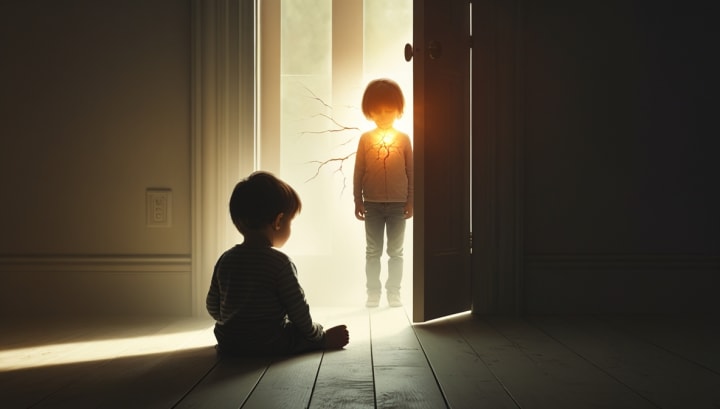
Learning That She Deserved to Matter
In therapy, Nina started the painful work of recognizing how growing up unloved had shaped her.
She'd learned to read everyone else's emotions with precision—hypervigilant to her parents' moods, always trying to be what they needed so she might finally be seen. But she'd completely lost touch with her own internal experience.
"What are you feeling right now?" her therapist would ask.
"I don't know," Nina would answer honestly. Because she'd spent so many years disconnecting from her feelings that she'd lost access to them.
She'd learned to define her worth by her usefulness—if she couldn't help someone, fix something, or provide value, she felt she had no reason to exist.
"What would happen if you just existed?" her therapist asked. "If you weren't useful to anyone? Would you still have worth?"
Nina couldn't answer. Because deep down, she believed: No. If I'm not useful, I'm nothing.
She'd learned that love was something you earned through perfect behavior, not something you inherently deserved. So she spent her life trying to be perfect, agreeable, helpful—anything to earn the love she'd never been given freely as a child.
The work was recognizing these patterns weren't truth. They were adaptations to an environment where she hadn't been loved. And those adaptations—while they'd helped her survive childhood—were now preventing her from living fully as an adult.
Dr. Peter Levine's work on developmental trauma shows that healing requires learning a different truth: You matter. Your needs matter. Your feelings matter. You are worthy of love not because of what you do, but because of who you are.
Nina needed to learn this. Not just intellectually, but in her nervous system. In her bones.
The Grief That Came First
As Nina started healing, she had to grieve. Grieve the childhood she didn't have. The parents who couldn't see her. The little girl who learned to disappear to be acceptable.
She grieved all the times she'd needed comfort and gotten dismissal. All the achievements that went unnoticed. All the feelings she'd suppressed because no one cared to hear them.
"I'm angry," she told her therapist one day. "I'm so angry that I had to raise myself emotionally. That I had to figure out how to be a person alone because my parents couldn't be bothered to actually know me."
"That's healthy anger," her therapist said. "You have every right to be angry about what you didn't receive."
Growing up unloved leaves a particular kind of wound—it's not what happened, but what didn't happen. There's no dramatic trauma to point to. Just an absence. A void where attunement, validation, and emotional presence should have been.
And that absence shaped everything. Nina's inability to ask for help. Her constant need to prove her worth through usefulness. Her belief that her feelings didn't matter. Her struggle to receive love even when it was offered.
All of it traced back to those early years when she learned: You don't matter enough to be seen. Your needs don't matter enough to be met. Your feelings don't matter enough to be acknowledged.
The Woman Who Finally Believed She Mattered
Two years into therapy, someone asked Nina what she needed, and this time, she had an answer.
"I need help. I'm overwhelmed with work and I need someone to just listen while I talk through it."
It felt vulnerable. Scary. But also... right.
Her friend said, "Of course. Tell me everything."
And Nina did. And the world didn't end. She wasn't rejected for having needs. She wasn't dismissed for struggling. She was simply... supported.
Nina is learning, slowly, that she matters. That her needs are valid. That asking for help doesn't make her a burden—it makes her human.
She's learning to recognize her own feelings instead of just reading everyone else's. To believe her worth isn't conditional on her usefulness. To receive love instead of only giving it.
She still struggles. The old patterns are deep. But she's finally understanding what took thirty-four years to learn:
Growing up unloved wasn't her fault. The message she internalized—that she didn't matter—was never true. She mattered then, even if no one showed her. And she matters now.
The little girl who learned to disappear is finally learning to exist. Fully. Unapologetically. With needs and feelings and the radical belief that she deserves to be seen.
Nina looks in the mirror now and sees someone worthy of love. Not because she's finally perfect, but because she's finally learning: she always was.
Growing up unloved shaped her. But it doesn't define her anymore.
She matters. She always did.
-----------------------------------------
Thanks for Reading!
About the Creator
Keep reading
More stories from Ameer Moavia and writers in Psyche and other communities.
When Love Feels Like Anxiety
Caleb loved Iris so much he couldn't sleep. Not in the romantic, staying-up-talking-all-night way. In the lying-awake-at-3-a.m.-heart-racing-mind-spiraling way. In the checking-his-phone-every-five-minutes-when-she-didn't-text-back way. In the can't-eat-can't-focus-can't-function-unless-he-knew-she-still-loved-him way. People said he was in love. And maybe he was. But it didn't feel like the love depicted in movies or described in songs. It felt like standing at the edge of a cliff, constantly terrified of falling. It felt like his entire nervous system was wired to one person, and if she withdrew even slightly, his whole world collapsed. It felt, more than anything, like anxiety. They'd been dating for eight months, and Caleb had never felt this way about anyone. He thought about Iris constantly. Needed to know where she was, who she was with, whether she was thinking about him. When they were together, he felt euphoric. When they were apart, he felt like he was suffocating. "You're so intense," Iris said one evening after he'd texted her fourteen times because she hadn't responded for two hours. "I was just at dinner with my sister. I'm allowed to not text you for a few hours." "I know. I'm sorry. I just... I worry when I don't hear from you." "Worry about what?" Caleb couldn't articulate it. That he worried she'd realize he wasn't enough. That she'd meet someone better. That she'd wake up one day and wonder why she was with him. That every moment she wasn't actively choosing him felt like she might be about to leave. "I don't know," he said instead. "I just love you a lot." But it didn't feel like love. It felt like drowning while pretending to swim.
By Ameer Moavia2 months ago in Psyche
Top tipple tricks
Been thinking a lot about drinking, lately. Not least because of a recent episode of over-indulgence and the inevitable after effects. Some readers may recall the earlier articles I wrote about beating the booze. Here I set out an experiment in techniques for cutting down on my alcohol intake. The experiment was successful, the techniques worked, and I have armed myself with an arsenal of weapons in the war against the demon drink. I have yet to fire the first round however. It's all a question of timing (perhaps procrastination).
By Raymond G. Taylor6 days ago in Psyche




Comments
There are no comments for this story
Be the first to respond and start the conversation.