
Grief Unchained: Experiencing Family Loss, Trauma, and Healing
My journey through family deaths, sorrow, and the path to recovery


“Today, in our “shut up, get over it, and move on” mentality, our society misses so much, it’s no wonder we are a generation that longs to tell our stories.”
― Elisabeth Kübler-Ross, On Grief and Grieving: Finding the Meaning of Grief Through the Five Stages of Loss
Grief is a universal experience yet deeply personal in its manifestation. It is raw and transformative.
My story is about the loss of multiple family members and the profound impact of my beloved dog, Betty's, death. This story came to me as intertwined threads of memory, trauma, and the path to emotional and mental recovery.
The Chain of Loss
I cried more when my dog, Betty, died than when my grandfather, uncle, and grandmother went. They all passed away one after the other, as if they were pulling each other into the grave like a chain.
My grandfather was the first. It was after a long illness in bed. He probably had some form of liver cancer after years of drinking, trying to cover some earlier traumas and motorcycle accident pains which forever changed his life. So he struggled to remain alive until my dad got home from abroad, and everyone considered it a miracle when he died in my father’s arms.
My uncle died almost 9 years later. It was not that soon after my grandfather, but at least he was a father to his kids longer and left a legacy of a hard-working life. It turned out he had a brain tumor that was already too advanced to be operated on. The signs have all been there all along, but in his family, they were not talking much about what bothers who and never really talked much in general about themselves, except for complaining about the condition of life and how others had it better.
My grandmother passed away, a few years later, by that time a smaller version of herself, after having lost the love of her life and one of her two sons.
Losing my grandfather, uncle, and grandmother within a short span of years felt like an unending wave of sorrow. Each loss added to the burden of the previous one, creating a compounded grief that was overwhelming and hard to navigate.
The Unexpected Depth of Pet Loss
A few months later, my grandma’s dog, Betty, which I used to be very attached to and called mine, died too. That’s when something inside me broke completely.
I cried for all of them together. I mourned my childhood, from which only the memories of summer days and grandparents’ love remain. I cried like a small child; without wiping my tears and snot, I cried on the street while driving and into my bowl of soup.
Reminiscing about the carefree childhood days I spent with my grandparents brought me some comfort, even if bittersweet and overwhelming. I could keep their spirits alive through my memories and feel their presence even in their absence. It was a therapeutic balm for my aching heart.
Grieving While Pregnant
“When someone is telling you their story over and over, they are trying to figure something out.”
― Elisabeth Kübler-Ross, On Grief and Grieving: Finding the Meaning of Grief Through the Five Stages of Loss
I was pregnant with my eldest when my grandma passed away. I was already living in a foreign country, but I visited every two months. I always felt guilty that I was away, aware that my grandma was old and perhaps didn’t have too many years left. My only comfort was that she lived with my parents, so she was well taken care of.
My husband and mother-in-law comforted me when we learned of her passing, proving that sharing the burden of loss can make it a bit more bearable.
I didn’t go to her funeral because I was afraid I would lose the pregnancy and I had this wound for many years.
In therapy, I talked about it many times and I know I could have gone to the funeral, but I didn’t have the strength to travel in the first trimester of my pregnancy. It felt like my grandma was with me already in spirit, watching over me, and I even hoped she would be reborn as my son (farfetched as it may sound, but I didn’t recognize her in him).
I learned that there’s no life without death. Grieving is a skill that can’t be learned from theory. It has to hurt like hell before it starts to ease even a bit. I lost all my grandparents before any of them could meet my kids, their grand-grand-kids and that hurt even more.
The Burden of Suppressed Emotions
The cycle of grief resurfaced years later, triggered by Halloween and a deep-seated fear of confronting my past. It came back with memories and whispers from my other grandma, who passed away when I was 12.
Years after my grandparents’ deaths, I realized that my lingering insomnia and constant sense of unease were more than just grief. They were not even as much of a postpartum effect as I thought. My primary care doctor played a crucial role in my recovery. She noticed my symptoms went beyond normal grief and referred me to a trauma specialist. This early intervention was pivotal.
Therapy helped me understand that I was experiencing symptoms of PTSD. The trauma of multiple losses had left a deep psychological scar.
Therapy also revealed that I had learned to suppress my emotions from my mother, who, in turn, had learned from hers. This generational habit of blocking pain and presenting a facade of strength had left me emotionally stunted.
My mother kept telling me during my first postpartum how women are strong and we can do everything, are able to move mountains, and even more. I had to hide my real feelings, bury them deep down, and learn to cry and mourn only when I was alone.
Reflecting on my journey, I wish I had sought help earlier, but I had no idea. The years of suppressing my emotions only worsened my condition. Early intervention could have mitigated much of my suffering. But finally, I still got the help I needed, and I could move on towards healing.
Embracing Pain in Therapy
I had learned from my mother and grandmother to suppress my grief, to appear strong. But in therapy, I realized the importance of expressing my pain. Allowing myself to cry and mourn openly was the first step towards healing.
I didn’t deny the pain anymore; I finally didn’t sugarcoat things. I visualized my inner child, offering her the compassion she had long been denied. I only knew to turn on the volume high and sing my heart out, hoping that all these emotions would disappear and I wouldn’t have to deal with them.
I hugged myself and pulled my knees to my chest. I rocked back and forth and cried a lot, for hours on end, for days on end. This process of self-soothing was foreign to me, and yet it provided so much release and finally closure with all the deaths and suppressed emotions from my childhood.
I finally understood that grief was real and necessary. I even started reading more on the topic and went as deep as to journal on my losses, getting reconnected with my past through these waves of emotions that were foreign to me until I realized they were all part of life.
“Grief can be described as an acute and overwhelming sense of loss. It is basically a phenomenological experience (Osterweis, Solomon, & Green, 1984). A major loss almost always results in a state of deprivation for the entire personality, in adults and children alike, which may become helplessly engulfed with strong waves of emotions.” — Grief, Loss, and Bereavement: An Overview, by Naji Abi-Hashem
The Healing Power of Tears
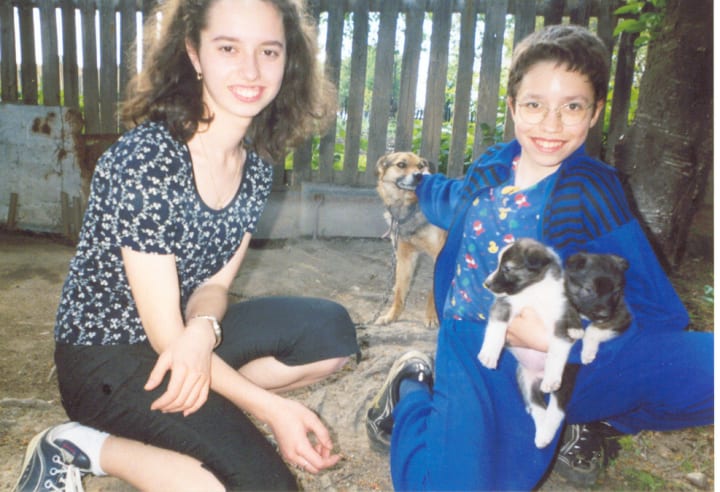
I wish I could conjure Betty’s comforting presence, next to me playing ball in the garden, a contour that comes to soothe me, her tiny wet nose stroking my little hand, with her big eyes encompassing and understanding all my worries.
But the truth is that she’s no longer here; she simply no longer exists. I can’t find her anywhere, just like my grandfathers, uncles, and grandmothers, pieces torn from me and gone forever, gaps that hurt when life lets me go for a bit, and I have a moment to look at myself like a sieve.
These losses have left deep gaps in my heart, but I have learned to live with them. It’s been a long journey. I now recognize that mourning and pain are integral parts of life, not to be buried but to be integrated into our beings.
The memories of those I have lost continue to shape me, but I am now more resilient after allowing myself to feel and mourn.
Sharing my story made me realize that trauma is a universal experience. So many people go through this, yet they don’t have the emotional capacity to cope with it. Connecting with others online who have had similar experiences, regardless of their background, helps me feel less isolated and more understood.
I wanted to share with you this song, which soothes me these days when the memories resurface and I miss my lost ones all over again.
Sources:
- Abi-Hashem, Naji. (1999). “ Grief, Loss, and Bereavement: An Overview “. 18. 309–329.
- Parkes CM. Bereavement in adult life. BMJ. 1998 Mar 14;316(7134):856–9. doi: 10.1136/bmj.316.7134.856. PMID: 9549464; PMCID: PMC1112778.
- O’Connor MF. Grief: A Brief History of Research on How Body, Mind, and Brain Adapt. Psychosom Med. 2019 Oct;81(8):731–738. doi: 10.1097/PSY.0000000000000717. PMID: 31180982; PMCID: PMC6844541.
---
***I originally published this story on Medium.***
💗 Thank you for reading! Hearts, pledges, and tips are motivating me to write more. I appreciate your support.💗
You could also buy me a coffee or a tea and/or let me know your ideas in the comments section.
About the Creator
Gabriela Trofin-Tatár
Passionate about tech, studying Modern Journalism at NYU, and mother of 3 littles. Curious, bookaholic and travel addict. I also write on Medium and Substack: https://medium.com/@chicachiflada & https://chicachiflada.substack.com/
Keep reading
More stories from Gabriela Trofin-Tatár and writers in Families and other communities.
How My Grandmother’s Legacy Goes Beyond the Wrinkles
The Shifting Generations of the Women Before Me Over the course of history, women’s roles have changed and evolved, creating an array of stories. All the way from the early fights for suffrage to the current fight for equality, women have skillfully maneuvered through social changes, questioning conventions and reshaping their roles in significant ways.
By Gabriela Trofin-TatárExclusive • about a year ago
Wise~Guys
— Look Behind what's in Front of You ~ Make Good Choices — Hey, So how you Doin'..! Made~Men — Mobster Movies romanticise a distinctive, elegant appearance, impeccable attire style, along with the 'Families' expressive lingo. Making their 'Bones' gave them Panache — with vintage fedoras, tailored pin-striped suits, mirror-polished wing-tip shoes adorned with tassels; with their 'Gun Moll' gorgeous dates on their arms.
By Jay Kantor18 days ago in Families
The quiet sound of families breaking
There is a kind of silence that is louder than any noise. It is the silence of a child waking in the night and realizing their parent is gone. It is the silence of a kitchen table with one chair suddenly empty. It is the silence of a home that still looks the same, but no longer feels the same. Across the United States, thousands of families live inside that silence. Not because of war. Not because of disaster. Not because of death. But because of policy.
By Kaylee Souther7 days ago in Families




Comments (1)
I am very sorry for your consecutive losses and trauma which you suffered. But you are very strong to learn and share with others that hiding pain does not make you strong, express it and embrace yourself. You need love, care and support to tackle that pain. Not to penetrate that pain inside your body and soul. Thanks for sharing and making others too realize the concept of grief.