
Generational Bond
Akunna, the younger generation, seeks guidance from her grandmother Nuliajuk, who has lived through the changes but is deeply pained by the loss of their ancestral environment. This bond highlights the passing of traditions and the emotional burden of losing something so integral to their identity
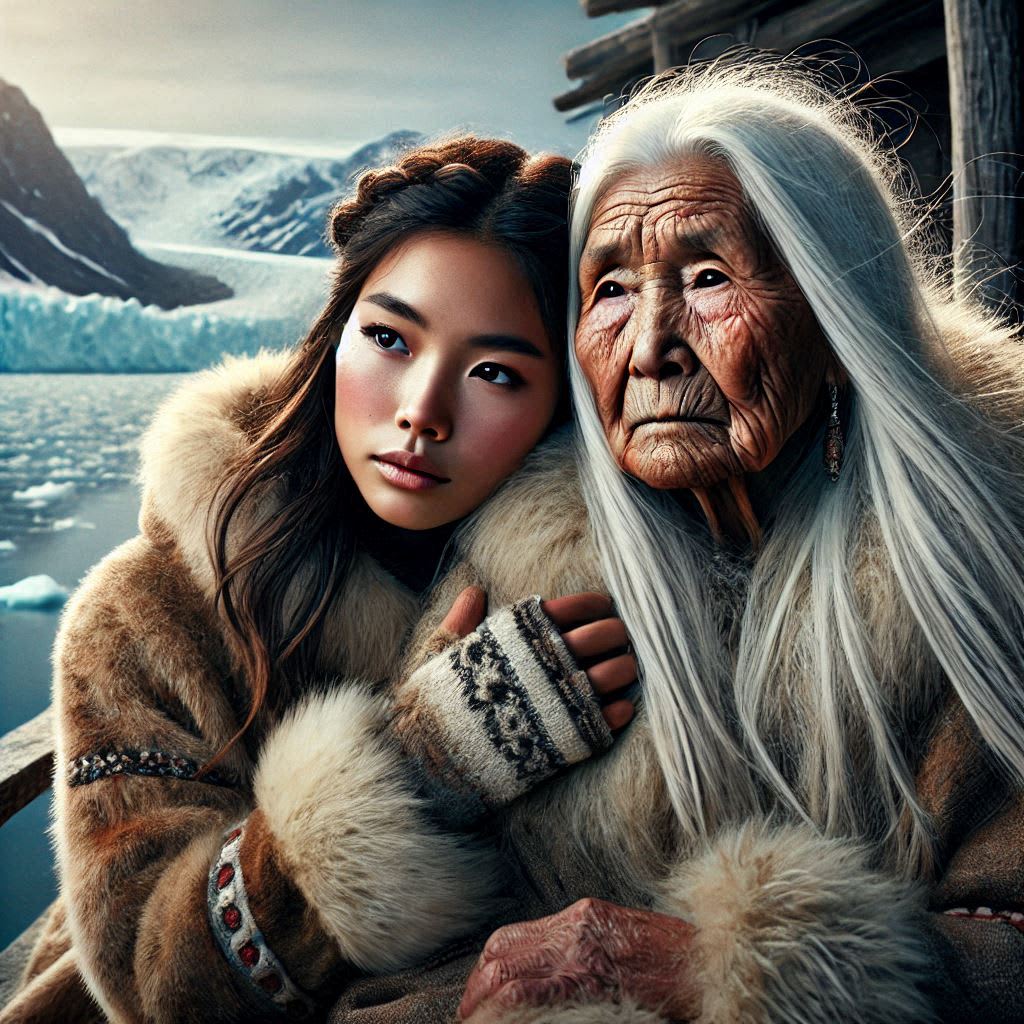
The wind whispered through the Arctic village of Nuvuk, carrying with it the sharp bite of cold air and the echoes of a time long past. Akunna pulled her fur-lined hood tighter around her face, her breath visible in the icy twilight. She stood on the wooden porch of her grandmother’s house, watching the faint light of the setting sun dance across the fractured surface of the glacier in the distance.
The glacier, once a towering sentinel of ice that stretched endlessly across the horizon, now seemed frail, its edges crumbling into the sea like forgotten memories. Akunna swallowed the lump in her throat. She knew she had to talk to her grandmother, Nuliajuk, but the words felt heavy, too full of pain to say aloud.
Inside, the small house was warm, the air thick with the smell of seal oil burning in the lamp. Nuliajuk sat in her usual spot by the fire, her hands busy weaving a new seal-skin glove. Her movements were slow but deliberate, each stitch a testament to decades of practice. Her white hair was tied back loosely, and her deep-set eyes seemed lost in thought.
“Grandmother,” Akunna said softly, stepping inside and closing the door behind her.
Nuliajuk looked up, her weathered face breaking into a small, tired smile. “Akunna, my child. Come, sit with me.”
Akunna obeyed, settling onto the floor beside her grandmother. The fire crackled softly between them, its glow casting shadows that danced on the walls. For a moment, they sat in silence, the only sound the rhythmic click of Nuliajuk’s needle.
“I went to the glacier today,” Akunna began hesitantly. “It’s smaller than ever. The ice… it’s melting so fast.”
Nuliajuk sighed deeply, her hands pausing mid-stitch. She looked into the fire, her eyes reflecting its flickering light. “Yes,” she said, her voice heavy with sorrow. “The ice has been leaving us for a long time. It is not like it was when I was young. Back then, the ice was our home, our protector. It gave us life.”
Akunna felt a pang of guilt. She had heard the stories many times—of how the ice provided everything her people needed: food, shelter, even guidance. But those stories felt distant, like they belonged to another world. Now, the ice was disappearing, and with it, the traditions that had defined their way of life for generations.
“Grandmother,” she said, her voice trembling, “what will we do when the ice is gone? How will we survive?”
Nuliajuk set down her work and reached out, taking Akunna’s hands in her own. Her touch was warm, her skin rough from years of labor. “We will do what we have always done, my child. We will adapt. We will survive. But it will not be the same.”
Akunna looked into her grandmother’s eyes and saw a depth of pain she had never fully understood before. It wasn’t just the loss of the ice that hurt—it was the loss of everything the ice represented. The knowledge of how to hunt seals on the frozen tundra, how to build igloos to withstand the harshest storms, how to read the ice and the stars to navigate the land. All of it was slipping away, melting like the glaciers.
“I feel so helpless,” Akunna admitted, tears welling up in her eyes. “I want to save the ice, to save our way of life, but I don’t know how. It feels like it’s already too late.”
Nuliajuk pulled her granddaughter closer, wrapping an arm around her shoulders. “It is not your fault, Akunna. This world is changing because of things far beyond our control. But that does not mean we are powerless. Our strength lies in remembering who we are, in holding onto the spirit of our people, even as the world around us changes.”
Akunna rested her head on her grandmother’s shoulder, her tears falling silently. “But how do we do that, Grandmother? How do we hold onto something that’s disappearing?”
Nuliajuk was quiet for a moment, her gaze distant as if searching for an answer in the flames. Then she spoke, her voice steady and full of resolve. “We tell our stories. We teach our children. We pass down the knowledge of our ancestors, even if the ice is no longer here to guide us. The ice may fade, but the spirit of our people will not. It lives on in you, Akunna, and in the generations to come.”
The words hit Akunna like a wave, their weight both comforting and daunting. She realized then that her grandmother was right. The ice might be disappearing, but its legacy didn’t have to. It was up to her and others like her to carry that legacy forward, to ensure that the stories, the traditions, the very essence of their culture, would not be forgotten.
They sat together for a long time, the fire burning low as the night deepened. Finally, Nuliajuk spoke again, her voice softer now. “Do you know why I still make these gloves?” she asked, holding up the unfinished piece in her hands.
Akunna shook her head.
“Because it reminds me of who we are,” Nuliajuk said. “Each stitch is a connection to the past, to the people who came before us. When I finish these gloves, they will not just be gloves. They will be a piece of our history, a part of our story.”
Akunna nodded, her heart swelling with a mix of sadness and hope. She realized that her grandmother wasn’t just teaching her how to survive—she was teaching her how to live, how to carry the weight of their heritage with pride.
The next morning, as the first rays of sunlight broke over the horizon, Akunna stood outside, staring at the glacier in the distance. It was smaller than ever, but it still stood, a reminder of the resilience of the land and its people.
She took a deep breath, the cold air filling her lungs, and made a silent promise. No matter how much the world changed, she would carry her people’s spirit forward. She would honor the bond between generations, ensuring that the stories of the ice and the wisdom of her grandmother would never be forgotten.
And as she turned back toward the village, she felt a flicker of hope—fragile but strong, like the ice that still remained.
About the Creator
Keep reading
More stories from David Jedidiah and writers in Families and other communities.
The Last Ice
The wind howled through the remote Arctic village of Nuvuk, its icy fingers curling around the small wooden homes that stood proudly against the relentless cold. But today, the wind felt different. It was colder than usual, almost unnatural, as if it carried with it a foreboding message—one that had been whispered for years but now could no longer be ignored.
By David Jedidiahabout a year ago in Fiction
Wise~Guys
— Look Behind what's in Front of You ~ Make Good Choices — Hey, So how you Doin'..! Made~Men — Mobster Movies romanticise a distinctive, elegant appearance, impeccable attire style, along with the 'Families' expressive lingo. Making their 'Bones' gave them Panache — with vintage fedoras, tailored pin-striped suits, mirror-polished wing-tip shoes adorned with tassels; with their 'Gun Moll' gorgeous dates on their arms.
By Jay Kantorabout a month ago in Families



Comments
There are no comments for this story
Be the first to respond and start the conversation.