
Following My Father: Palo Alto, Part One
Sixth Grade

My family left San Francisco at the end of fifth grade. Why? Beats me. Dad still worked at John Blum's firm downtown. We moved many times during the years he worked for him. I've written before about how nonsensical most of our moving seemed. Dad had wanderlust in addition to a tendency toward the geographical cure.
From Palo Alto, Dad rode the commuter train to work. I often accompanied him on the many weekends he went to the office. We walked the long blocks from the train station to his office near Mission Street.
Dad took me up to Market Street, too. We went to his favorite office supply shop. Long before the big stores, like Office Depot and Staples, office supply stores were independently run affairs sprinkled throughout the city. Dad always bought me a pencil or pen.
From the stationery shop we walked to used bookshops on the way back to the station. Browsing through old books was a favorite hobby of Dad's and mine. The shops were little holes in the wall, quaint and a tiny bit musty.
Palo Alto is named after a redwood tree called El Palo Alto. In 1776 the DeSoto Expedition measured the tree at "five and a half yards around" and 135.7 feet tall, or about thirteen stories. It still stands in a small park near the San Francisquito Creek downtown, although it has lost a good deal of its height in 245 years.
The city grew around Stanford University. Leland Stanford was a senator and former governor of California. He was one of the robber barons in the nineteenth century, who made his money building railroads.
He and his wife established the university as a memorial to their fifteen-year-old son, who died the year before from typhoid fever. It became one of the finest universities in the world.
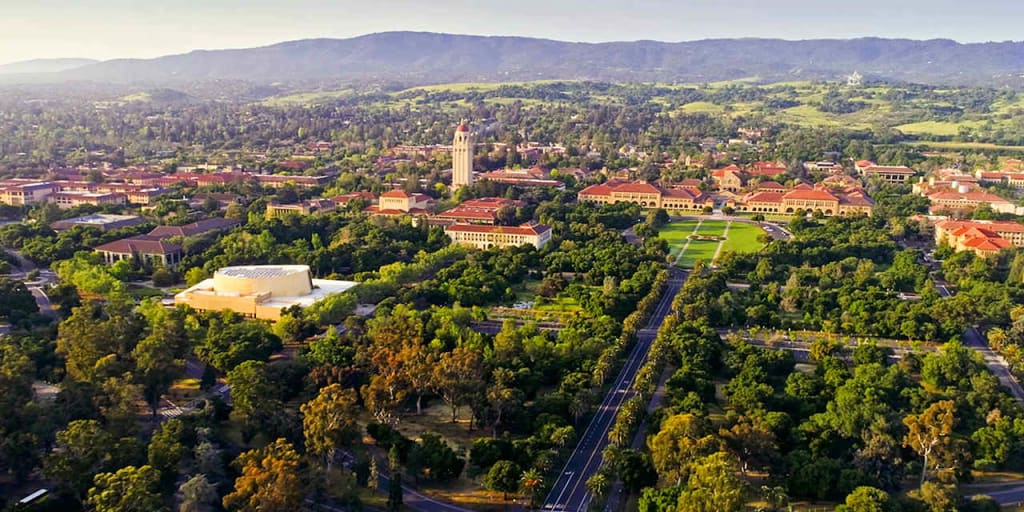
The main entrance to the university is reached by two long roads bordered by palm trees. The art deco Hoover Tower serves as an orienting feature in the distance.
The Stanford campus' original Spanish-style buildings are gorgeous, with lots of arches sheltering exterior walkways, plentiful windows, and terra cotta roofs. The vast campus is green with lawns; it offers a golf course, as well as the large Lake Lagunitas, and other features.
As a child my family visited Stanford University many times. Dad looked things up in the engineering library while the rest of us wandered around.
Mom worked at Stanford Hospital. In my recollection, that was one of the rare times she was on the day shift, and so was home in the evening. Dad and I enjoyed a period of evening domesticity that year.
We moved to a house on Alger Drive in the East Meadow neighborhood, south and east of the Stanford campus. For once, there was still some summer left when we moved in, so I had a chance to make friends before school started. The timing made a huge difference that year. I was very tired of being the new kid, a lonely situation.
Soon after we moved in, there was a knock on the door. To my surprise, it was a girl my age. She asked, "Can you play?" I introduced myself using my new nickname, Pepsi, asked Mom for permission, grabbed my bike, and we headed off.
That was the beginning of one of the best years of my childhood. Heidi and I made quick friends, the neighborhood was filled with kids, and she introduced me to her friends.
My school picture shows me with a broad grin and sparkling eyes wearing a red plaid jumper over a white blouse, my favorite outfit, new for the first day of school. Mom bought us few clothes, but always a new outfit or two for school each year.
I loved Palo Alto's warm summer weather. San Francisco is notorious for fog, especially in the summer! A San Franciscan always carts a sweater or coat along because even though the day might feel warm and sunny now, you can bet it probably will be cold later! We used to feel sorry for all the tourists in shorts when the fog rolled in.
Heidi was a cute, funny, smart, and energetic girl who made me laugh.
We rode bikes more than anything else. I still had my bike from St. Helena, and became more daring a rider. Heidi and I put our hands in the air most of the time, only grabbing the handlebars when necessary.
Heidi lived around the bend with her parents and older sister. German immigrants, I'm not sure her mother spoke English. Her father must have, in order to work in the States. I never got to know them. I don't think I ever went into their house. Even so, Heidi and I were close.
Another classmate lived a couple of houses from mine. Her name was Chrissy. She was a cute, bouncy, funny girl with a younger sister and brother. Her brother had a condition that caused him developmental delays. The most I remember about her parents is that they were much younger than mine (most kids' parents were) and bought donuts every Saturday morning!
Next to Chrissy's house lived a family with four little boys. The mother let her four-year-old run free around the neighborhood. This would become problematic for me. I got tired of having him around. Not having any experience with little kids, I knew nothing about asserting myself with them.
On the corner across from my house lived a bohemian family, highly unusual for the conservative early 1960s Palo Alto. The mother had long hair she kept in a low pony tail and wore long skirts.
Most women curled their hair and sprayed it to stay in rather rigid shape. A woman always wanted lift to her hair, and hopefully bounce, although the hairspray kind of ruled that out! Those were the days of teasing, or "ratting" hair; of bouffants and Beehives, flips and page boys, and Pixie cuts; of pointed bras; of padded bras; of the smallest waists women could get.
Even girls my age wore uncomfortable curlers to bed -- the price of looking pretty the next day. Blow dryers came out only years later. Sometimes we dried our hair before bed, sitting with our heads in large plastic caps attached to the hair dryer, which stood on a table nearby. Then we put our hair in sleep caps to protect it from losing its curl.
My mother usually wore shirtwaist dresses and heels, even at home. Others wore slacks and blouses. Women did not wear jeans; Levi made them only for boys and men back then.
For us kids, it was the age of surfer shirts, surfer cuts, and the Beach Boys. Our fathers wore suits, white shirts, and ties to work
The most unusual thing about the bohemians' house was a large monkey cage near the front door. The smell was quite overpowering. A little spider monkey screeched and jumped around in it. I never knew anyone else with a monkey.
The other smell was liver. It always smelled like that in there, and I wondered if the family ate that every night.
One of the daughters was a girl around our age named Toni, a mixed race girl, cute and petite. I never got to know her well. She rode bikes with us and occasionally invited us to swim.
In a nearby house lived a family with four little boys. Their mother let the four-year-old roam the neighborhood. He often showed up at our house.
I had no experience with little kids, and found his constant presence annoying. I had no idea how to deal with him. He was cute, but enough was enough.
After several months of the little Joey's coming around, one day he found me in the garage, and would not go home when I told him to. I am still horrified at what I did next. In desperation, I grabbed a bottle of Windex and sprayed it at him. It got in his eyes. He screamed and clutched at his face. Winnie ran out, helped him, and scolded me roundly. I was embarrassed and ashamed for a long time after that.
____________________
When I started school, it was so wonderful to know other kids already! It made my transition very smooth.
My teacher was a young man named Mr. Keller. Tall, with a buzz cut, and nice-looking, he was an excellent teacher. As I had in fifth grade, I studied hard and did well. Teachers tend to like kids like that.
Having friends brought out my exuberant, funny side -- a side I hadn't really known I had so much. It made me popular with girls and boys alike. It made me cute. It made me happy.
Mr. Keller often found me amusing. He tolerated my occasional blurting out in class. When a group of us girls were caught throwing spit balls that stuck to the ceiling of the girls' bathroom, we hardly got in trouble.
That fall I was in my pink wallpapered room with the big artsy flowers when I was startled to find boys outside my open window one night. A boy named Louis lived in back of us with his widowed mother. A gate led from one house to the other. Louis, Tommy, and Craig from my class got together and decided to pay me a visit. It was all in fun, and I hurried them away before my parents came.
That Halloween a group of us got together to go trick or treating. What a new and wonderful experience for me! The year before in San Francisco my Halloween left much to be desired. Mom took me down to the Presidio for an event in a big hall. I dressed as a bag of bones, a theme Winnie concocted as a teenager. But she had dragged around real bones that clattered on the ground. My costume was nothing to compare with that.
I felt uncomfortable with all the kids running around, and going around the tables for treats and activities by myself felt most unpleasant. I wished I had stayed home. No one seemed to like my costume. The night was a bust. I waited on a stoop outside for Mom to pick me up.
So, finding myself walking down the dark streets with my friends in Palo Alto thrilled me. Our bags quickly filled as we ran up and down the walks to the decorated front doors. What a difference!
Winnie came to live with us in Palo Alto, a nice thing for me. Not only did I have her company in the evenings after work, but she owned objects useful to me.
Like Tampons.
I started my period about halfway through the school year. I had dreaded that. Unlike many other girls' mothers, mine never had that talk with me. I suppose she felt that because there were three older females in the family, I would have picked up what I needed to know.
Granted, I did not need to be told menstruation was going to happen. My family, Dad included, called it, "falling off the roof." I never heard anyone else use that euphemism, but I looked into it, and it was used in the nineteenth into the twentieth centuries.
I was aware when I stayed in Emma's house in St. Helena at age nine that old-fashioned women used cloth rags before there were sanitary napkins. I knew the general supplies one needed.
The thing was, I didn't want to "become a woman." Misogyny was rampant in those days. My father was no exception. So, growing up in a household where women were disparaged (although admired at the same time) was not conducive to my wanting to become one.
When I started my period, I felt embarrassed, and went to great lengths to hide it. It took me until I was 13 to acknowledge it. And, only because Winnie's tampons and sanitary napkins were not available to me, so I had to ask Mom to buy them for me.
The summer after sixth grade, at Y camp, on a hike, the Kleenex I used because I forgot to bring supplies, fell out of my pants. Girls asked me if it were mine. I said, "No!"
On a visit to Bevy's she asked me if I had started. I denied it. She did not believe me.
On a trip back east with Mom when I was twelve, I bled profusely. We stayed with Mom's best childhood friend and her husband. I accidently clogged the toilet with bloody toilet paper. That was impossible to hide. All I could think of was the husband's having to plunge it, thereby knowing my terrible secret.
Dad's misogynistic tendencies paled in comparison to many men's, I'm sure. He by no means thought of us as only good for serving men. Mom worked; he valued that. Mom was not a great housekeeper or cook; he did not complain about that.
Dad often complimented her on her appearance. Mom wasn't beautiful, but a nice looking woman. She was self-conscious, though, about many aspects of her appearance: the gap between her front teeth, which caused her to try to hide them when she smiled; the fact that she couldn't hold her stomach in because of three caesareans when her muscles were cut in half; and, her petiteness.
Both Mom and Dad took pride in Mom's large bosom. Large breasts were probably the most desirable feature of a woman's figure, as they had been since the Flapper era of the 1920s.
This cultural factor, Mom's tactlessness, and my parents' behavior around Mom's breasts combined to make breast size a focus in our family, and later, a painful issue for me.
After my sisters left home, for some reason my parents felt free to display Mom's breast and Dad's appreciation for them in front of me. While Mom cooked breakfast in the nude, Dad sat at the table wearing his boxer shorts. I made every effort not to glance at his underwear because his genitals were visible as he sat.
Whenever Mom passed by Dad, he fondled her breasts and said something like, "Jeannie, you have such wonderful breasts."
In therapy when I was a young woman my therapist and I talked about my issues with breasts. My therapist's opinion was that my parents' behavior was a form of sexual child abuse.
As a teen and young woman, I was small-breasted. Mom and Sylvia often mentioned it. Mom didn't gloat, but Sylvia did. Gloating was her style.
I had ambivalent feelings about breasts. The small size of mine embarrassed me. And, the thought that Mom might have breast fed me made me "barf."
When we were lovers, the man who became my first husband told me he had never known anyone whose breasts were as small as mine. Well, thanks a lot, Abdul.
As a young woman, I was very slender. Now, it's hard to imagine how I ate so little. Dinner was my main meal. Usually I was so busy with classes and studying that I forgot to eat.
The late sixties and early seventies were the era of Women's Lib and "Ban the Bra!" Many large-breasted women went braless. Sylvia called them "braless wonders." I often went braless, too. In that regard, my small breasts were an asset -- my breasts didn't swing and jiggle when I walked!
I hated shopping for bras. For one thing, they were uncomfortable. But mainly, I was embarrassed to look for and pay for a size 36A!
Mom was less than tactful with my friend Dona. Before the wedding when I married Abdul, we women dressed and put our makeup on at Sylvia's nearby house. Dona was donning her dress when Mom handed her a pair of rolled up socks and said, "I think you ought to use the in your bra."
Poor Dona, she was stung and furious, but merely flushed and turned away. We laughed about the incident many times later.
The other objects of Winnie's that appealed to me were her bras. The other girls and I wanted bras badly, even though we had little if anything to support.
Instead of asking Mom to buy me a training bra, I "borrowed" a sweet little bra with teal and pink flowers from Winnie's dresser. You might call it stealing, but to me, who maintained a childish opinion that what was hers was mine, it wasn't.
Speaking of bras, women in the early sixties wanted their breasts to stick out. Pointy bras were in! When we lived in Los Angeles when I was thirteen, Winnie came to visit. She excitedly showed Mom and me a picture of the custom bra she ordered. Here's what it looked like.
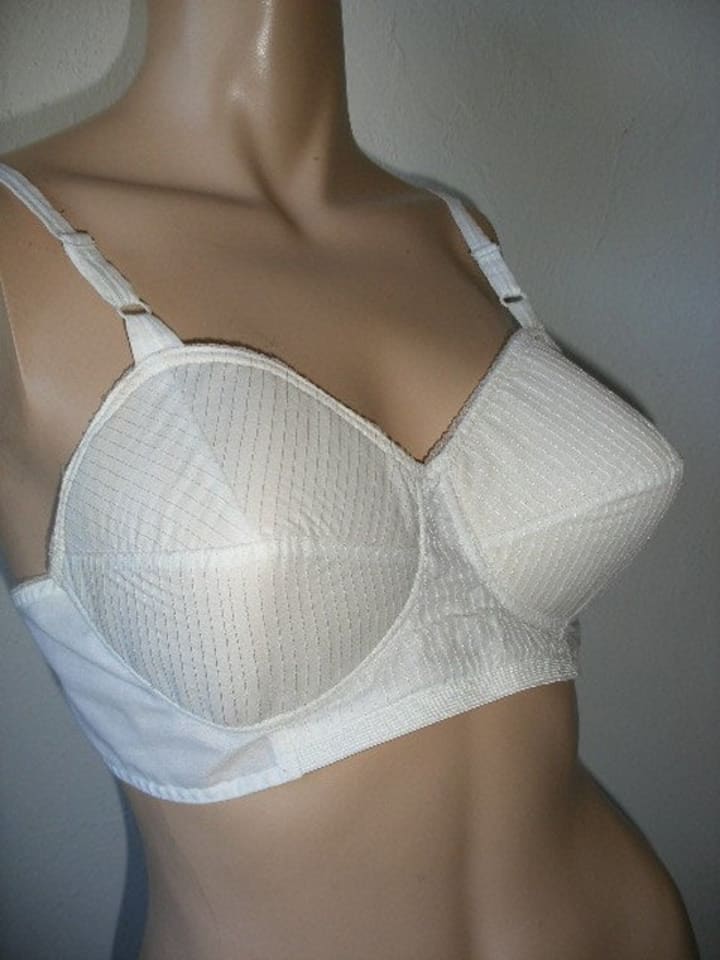
I thought it was absurd to want your breasts to look like that!
____________________
The biggest thrill of my sixth grade year was in February when the Beatles appeared on the Ed Sullivan Show. If you don't know who Ed Sullivan was, let me tell you. He was the host of a long-running variety show on TV. He stood in a distinctive way, with his hips thrown forward and his arms crossed. Often, he leaned his chin on one hand and rolled his eyes. He smoked incessantly. His humor was dry. He was, to me, unattractive and awkward.
Ed Sullivan was well-known for finding talent that he showcased on his show. Much of America tuned in on Sunday evenings.
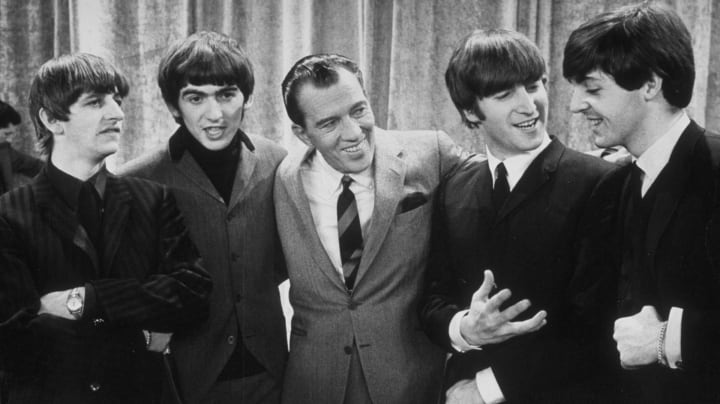
The Beatles opened with “All My Loving” by Paul McCartney singing “Till There Was You." They wrapped up the first set with “She Loves You.” At the end of the show, they sang “I Saw Her Standing There” and “I Want to Hold Your Hand.”
I don't know which one of those was my favorite. I loved them all.
The Beatles became so iconic here and around the world, that it is difficult for me to imagine that many people don't know about them. I really don't know if younger people are aware of just what a phenomenon they were, or if they know anything about them at all.
The Beatles were a rock group from Liverpool, England. They wore suits and ties. Their hairstyles were dubbed "Beatle cuts" that became wildly popular. Prior to that, men's hair was generally cut very short and kept well-trimmed. After the Beatles, a trend started for men to wear their hair longer.
Audiences for Beatle's concerts were largely made up of teenage girls, who screamed and gyrated. They reached toward the stage and waved. They strained at the chain link fences and tried to climb the stage. At at least one concert fans did get on the stage, forcing the Beatles to flee. Not infrequently, some female fainted and had to be picked up and carried out.
In the beginning, the Beatles presented themselves as wise-cracking, stunt-loving characters. Their music blended R&B and Rock and Roll. Their fame opened a path for other British groups to gain popularity in America, such as the Bee Gees, the Animals, and Chad and Jeremy.
Here's an example of the Beatles' early lyrics from "I Saw Her Standing There."
Well, she was just seventeen
You know what I mean
And the way she looked
Was way beyond compare
So how could I dance with another
Ooh, when I saw her standing there?
Well, she looked at me
And I, I could see
That before too long
I'd fall in love with her
She wouldn't dance with another
Ooh, when I saw her standing there
Well, my heart went "boom"
When I crossed that room
And I held her hand in mine
You can't get too much more innocent than to say, "Well, my heart went boom!"
Beatles music evolved into more sophisticated forms as time went on. Contrast the lyrics from The Fool on the Hill to "I Want to Hold Her Hand."
Day after day, alone on a hill
The man with the foolish grin
Is keeping perfectly still
But nobody wants to know him
They can see that he's just a fool
And he never gives an answer
But the fool on the hill
Sees the sun going down
And the eyes in his head
See the world spinning round
Well on the way, head in a cloud
The man of a thousand voices
Talking perfectly loud
But nobody ever hears him
Or the sound he appears to make
And he never seems to notice
By 1968 the Beatles said they felt spiritually exhausted and wondered what all their fame and fortune meant. Traveling to India, they stayed for an extended period to study under Maharishi Mahesh Yogi at his ashram. It would seem they got turned onto hashish there, and later other drugs. Their music, as well as their album covers became psychedelic in flavor there for a while. "Strawberry Fields Forever" is an example:
Let me take you down, 'cause I'm going to Strawberry Fields
Nothing is real and nothing to get hung about
Strawberry Fields forever
Living is easy with eyes closed
Misunderstanding all you see
It's getting hard to be someone but it all works out
It doesn't matter much to me
Let me take you down, cause I'm going to Strawberry Fields
Nothing is real and nothing to get hung about
Strawberry Fields forever
No one I think is in my tree
I mean it must be high or low
That is you can't you know tune in but it's all right
That is I think it's not too bad
Let me take you down, cause I'm going to Strawberry Fields
Nothing is real and nothing to get hung about
Strawberry Fields forever
Always know, sometimes think it's me
But you know, I know when it's a dream
I think a "No," I mean a "Yes"
But it's all wrong
That is, I think I disagree
Let me take you down, cause I'm going to Strawberry Fields
Nothing is real and nothing to get hung about
Strawberry Fields forever
Strawberry Fields forever
Strawberry Fields forever
Pretty clearly a trip.
After the Beatle's went to India, men's suits and shirts began to sport Nehru collars, and a flair for other things Indian came into popularity -- cotton bedspreads, brass candlesticks and goblets, intricate hanging earrings, brass cow bells. I wore on on a leather thong around my neck as a teenager!
There were other evolutions of the Beatles and their music. We children of the early 1960s hold fond memories of when they first came on the scene. We shared innocence, exuberance, and laughter with them. Nothing can replace that.
The Beatles led the "British Invasion." All things British were in. Any number of musical groups and duos arrived in the states, like the Moody Blues, Tom Jones, Chad and Jeremy, and the Hollies.
Our new fascination with Britain came to include fashion designers. Mary Quant introduced us to mini-skirts, and later hot pants, those super short shorts that hid little. Laura Ashley popularized dresses made of small prints with full, often long, skirts.
Twiggy, a stick-thin model with huge, heavily made-up eyes and blond hair worn short, epitomized the look for many girls and women. She looked too gaunt to me, but she became extremely famous and I loved the clothes she modeled.
Twiggy popularized what came to be known as go go boots. Go go boots were white, came to mid-calf, and had low heels. It is thought that go go dancing was named after them. A gogo in French means, "abundance, galore," in turn deriving from a gogue, "joy, happiness." It seems it was the energy that appealed in the name.
Mom bought me my first pair of go go boots when we lived in Los Angeles in eighth grade. I remember quite vividly heading to a huge discount clothing store on Olivera Street, the Mexican part of downtown, to add a short navy blue A-line dress with wide white accents to go with them.
Mom, of course, and my sisters, too, identified with the earlier generations of fashion -- the shirt dresses and heels, pointy bras, coiffed or Pixied hair. So, the British craze never really affected them.
Yeah, their hem lines went up a bit in the sixties and seventies, down in the eighties and nineties. But none of them were the mini skirts and go go boots and bell bottoms and surfer shirts and culottes like I did.
It's so interesting how most all of us dress, behave, speak, even believe and think so much in keeping with our own generation. I am a baby boomer and my earlier experiences are imprinted. I remember John Kennedy's election, and the Cuban Missile Crisis, and the first time the Beatles were on the Ed Sullivan Show. I remember the Civil Rights Movement and Martin Luther King's famous "I have a dream" speech. I remember the horrors of the Vietnam War. I remember Laugh In and the young Goldie Hawn, the Smother's Brothers, Peter Sellers in the Pink Panther and Audrey Hepburn in Breakfast at Tiffany's. And so much more that marks me as a baby boomer.
Of course, we baby boomers don't all share the same beliefs, thoughts, lifestyles, personal experiences. This became clear to me when Trump was elected and so many of his supporters were older Americans.
Each of us comes from our own family situation, our own genetic heritage, our unique set of experiences. It just fascinates me to remember all the cultural influences that shaped my experience, and to continue to explore how I processed them to become the person I am today.
_______________________
In the spring a few of us girls put together red and white "cheerleading" outfits. They consisted of white pleated skirts, white cotton blouses, red pullover sweaters, red socks and white sneakers. We rolled up our skirts to make them shorter.
We practiced in an exterior hallway at Cubberley High School. No one was around on the weekend, so we not only could imagine ourselves essential parts of the school, but make as much noise as we wanted.
"Rah, rah, sis boom bah" we shouted, as we rolled our arms, kicked our feet, and jumped as high as possible. I don't know if we knew any more cheers, except, "Yeah!"
When I was in high school I felt a certain disdain for cheerleaders and jocks. Maybe if I had stayed in that neighborhood in Palo Alto and had not become so jaded and turned off to school through all our moving, I might have continued my bouncy ways.
As it was, we moved away at the end of the school year, not to another city, but to a neighborhood on the other side of town. Instead of continuing into junior high with the kids I knew in Fairmeadow Elementary, I lived directly across the street of a rival junior high. This began my jerky journey through the rest of school. I will talk about that in future posts.
My boyfriend in sixth grade was another popular kid named Tommy. He was shorter than me, with a cute, rounded face and long blond bangs. He and his older brother lived with their widowed mother several blocks away. Tommy did really well in school; everyone knew he was smart.
Tommy was the first boy I ever kissed. Thinking back to those times gives me such a warm feeling. Eleven-year-old children were truly innocent in those days. We girls felt no pressure to pretend to be sexual, nor did we worry about boys being sexual with us.
I know there were girls who were molested by dads, grandfathers, uncles, priests, brothers, strange men; but I don't think those of us who were fortunate never even thought such things could happen. At least, I never did.
We girls fantasized more about love and romance than our male peers, I think. Maybe I'm wrong. We certainly had crushes on boys and men.
A boy named Miles, who lived with his divorced mother in an Eichler house, developed a real crush on me. I liked him, but not in that way. He was very smart. Funny, too.
I lost track of the kids at Fairmeadow. It was my fault entirely. I was so underlyingly furious at my parents, it led to depression so severe I ate a mushroom in my yard with the idea of killing myself. I was embarrassed about attending a rival junior high and thought my friends there would hate me. Totally irrational, I know.
I met Miles again in high school in San Francisco. I will save that story for later.
____________________
Tommy looked like a young little surfer. We all tried to, with our wide-striped t-shirts. Rivalling our interest in the Beatles were the Beach Boys, those quintessential surfers.
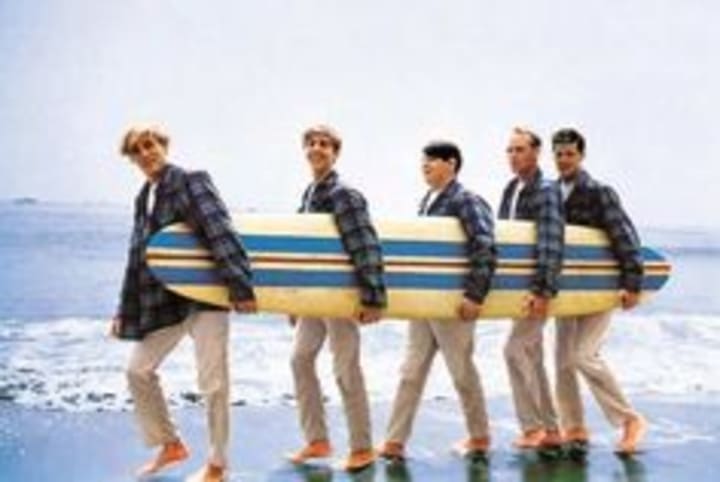
The Beach Boys began with three brothers playing in their garage and undoubtedly annoying many neighbors. Brian Wilson was 16 and recruited his little brothers and an 11-year-old neighbor to sing harmony with him. The Wilson father played piano, and Brian observed and then tapped into his own incredible musical talent to create The Beach Boys.
The composition of the group shifted while the group evolved, got their first paying gig in 1961, and made it to Billboard with Surfin' Safari in 1962. In 1963 Surfin' USA hit the top ten.
In sixth grade my favorite Beach Boy's song was I Get Around. It goes like this:
Round round get around, I get around, yeah
(Get around round round I get around, ooh-ooh) I get around
From town to town (get around round round I get around)
I'm a real cool head (get around round round I get around)
I'm makin' real good bread (get around round round I get around)
I'm gettin' bugged driving up and down the same old strip
I gotta find a new place where the kids are hip
My buddies and me are getting real well known
Yeah, the bad guys know us and they leave us alone
I get around (get around round round I get around)
From town to town (get around round round I get around)
I'm a real cool head (get around round round I get around)
I'm makin' real good bread (get around round round I get around)
I get around (round, get around-round-round,…
The song has a bouncy tune that appealed to my eleven-year-old bouncy nature.
At the end of the school year a group of us went to a dance at Cubberly High. The youngest there, we were intimidated by the older kids' skilled dancing. I jumped right in, though. I loved to dance, and practiced in my room or with my girlfriends, so I felt relatively confident.
Since we went as a group, we girls didn't have to wait for a boy to ask us to dance. Girls never danced together in public then.
I was especially good at the Jerk, that goofy-looking dance. There were so many dances, and I knew most of them. I liked the the Frug, the Swim, and the Twist. The Mashed Potato was also fun. All of these are fast-paced; when it came to slow dancing, we were pretty much at a loss.
One day I came home to the familiar refrain, "We're moving in two weeks, get packing." Mom and I drove around neighborhood after neighborhood until we found a large house on the corner of Middlefield and North California Street, across from Jordan Junior High.
I would come to hate that school, but will save that topic for my next post. I hope you are enjoying my story. As you can see, my family's moving so often exposed me to many towns and cities in California. Our mobile lifestyle taught me many things, some of which I am glad to know; some, not so much.
Join me in Palo Alto, Part Two.
About the Creator
Caroni Lombard
As a child my family moved often. In my story, I share that experience; what it was like and how we coped.
But my story is not just for those who share my experience of growing up in a highly mobile family. It's for anyone who's human.
Keep reading
More stories from Caroni Lombard and writers in Families and other communities.
Following My Father
Our last summer in St. Helena ended with a shock that set both Bevy's family and my family into turmoil. Bevy and I were kept in the dark for a while, but sensed something was going on. We began to overhear snippets, even though the grown ups stopped talking when we approached. One day Bevy figured it out and whispered to me, "Sylvia is pregnant!"
By Caroni Lombard5 years ago in Families
Wise~Guys
— Look Behind what's in Front of You ~ Make Good Choices — Hey, So how you Doin'..! Made~Men — Mobster Movies romanticise a distinctive, elegant appearance, impeccable attire style, along with the 'Families' expressive lingo. Making their 'Bones' gave them Panache — with vintage fedoras, tailored pin-striped suits, mirror-polished wing-tip shoes adorned with tassels; with their 'Gun Moll' gorgeous dates on their arms.
By Jay Kantor18 days ago in Families
Forever Mommy
You are placing bricks, one on top of the other, oblivious to the couples pressing their noses to the glass that separates them from you. The room on this side of the glass has many more like you, in all shapes, sizes, colours, and ethnicity scattered on tables, chairs and mats, playing and laughing unaware of the fate that awaits you on the other side of the glass. The couples on the other side are seated in a waiting room awaiting their turn to view from the glass and choose their prospective offspring. It’s a thrift store of the unwanted and used.
By Poonam Desai2 days ago in Families



Comments
There are no comments for this story
Be the first to respond and start the conversation.