

Our last summer in St. Helena ended with a shock that set both Bevy's family and my family into turmoil. Bevy and I were kept in the dark for a while, but sensed something was going on. We began to overhear snippets, even though the grown ups stopped talking when we approached. One day Bevy figured it out and whispered to me, "Sylvia is pregnant!"
I met this news with an open mouth that I quickly closed and laid my closed fist against.
My parents later said that Sylvia did it on purpose to get back at them for leaving her in St. Helena while they took me on the long trip back east. While they were responsible people, I don't think I ever became aware of their acknowledging mistakes. To leave your sixteen-year-old daughter home alone all summer made a pregnancy very likely, it seems to me.
My parents' reaction included moving us again, abruptly. This was the geographical cure in action, a malady that prompted all our moves. When Dad encountered difficulties or became depressed or overly anxious, he convinced Mom that we needed to move to the next place where our problems would be solved. The place we were in had suddenly become terrible. The new place would cure everything.
Sylvia used to complain, "Mom never puts her foot down!" This was true. I think most other mothers would have at least objected, or maybe left. Mom's bond with Dad was too strong for that. She put him on a pedestal, and we followed suit. Dad centered and disrupted our lives both.
Dad was an exceptional man. His intelligence, kindness, and interest in my friends appealed to people. He was not much interested in socializing, and did not engage in activities and enthusiasms that most dad's did. Sports held little interest; playing games with us was not his thing. He was quiet, sincere, and capable.
Our lives revolved around his work. If we made the slightest complaint to Mom, she would say, "We have to help Daddy," or "Daddy's work is what's most important."
Throughout my childhood Dad told me over and over again what wonderful things would happen in the new place -- what a wonderful town or city we were heading to. I wanted to believe my father. I wanted to help make the next place the one where our dreams would come true. I made every effort to move without complaint and to adjust and adapt to whatever came my way.
For her part, Mom never seemed to consider how all the moving affected us kids. Instead, she simply made her familiar announcement, "We're moving in two weeks, start packing." Only in her eighties did I once hear her acknowledge that it might have been hard for us
In the early 1960s, there were no birth control or morning after pills. Abortion was illegal, leaving girls and women only two options: have the baby or risk their lives to have an illegal abortion.
I doubt Sylvia would have wanted an abortion, anyway. She had a committed boyfriend in Bill, Bevy's oldest brother. And, I think she saw this as an opportunity to get married and escape our mobile lifestyle.
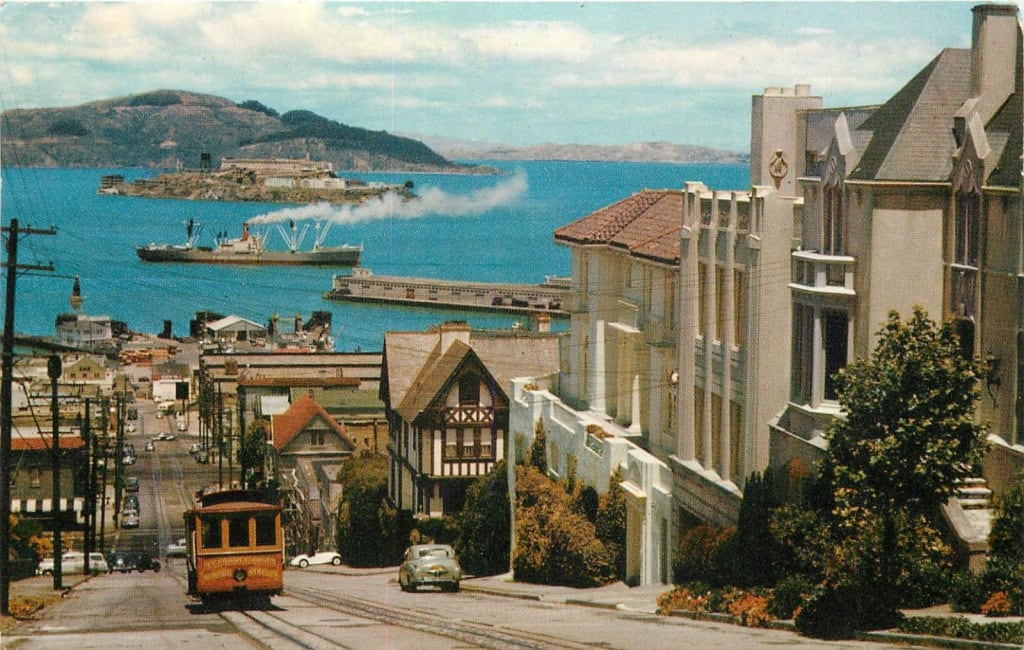
Mom and Dad hurriedly found an apartment for us at the very top of Pacific Heights in San Francisco, and rented a place for Sylvia and Bill across from the Westlake Shopping Center.
A wedding was arranged at the lovely old First Presbyterian Church on Van Ness Avenue. Our families ate dinner at an upscale Italian restaurant called El Portale on Fulton across from an entrance to Golden Gate Park.
We sat at a long table. The adults drank highballs and Bevy and I enjoyed our Shirley Temples. After dinner, a space was made for us to perform our numbers from the humiliating Calistoga Talent Show a few weeks before. We wore identical outfits Mom brought back from her trip back east -- pink and peach cotton shorts and tops. Pictures were taken and applause freely given.
Mom and Dad paid for Sylvia and Bill to spend the night at the lovely Hotel Carmel in Carmel-by-the-Sea south of Monterey. We met them there the next morning, ate a pancake breakfast at Sambo's, and wandered around downtown with its quaint and expensive shops and galleries.
Those of you who don't remember Sambo's might be interested to learn about it. Sambo's was a pancake house chain with the theme of the children's story Little Black Sambo. The sign outside showed a little boy in a turban holding a parasol and smiling at a hungry tiger.
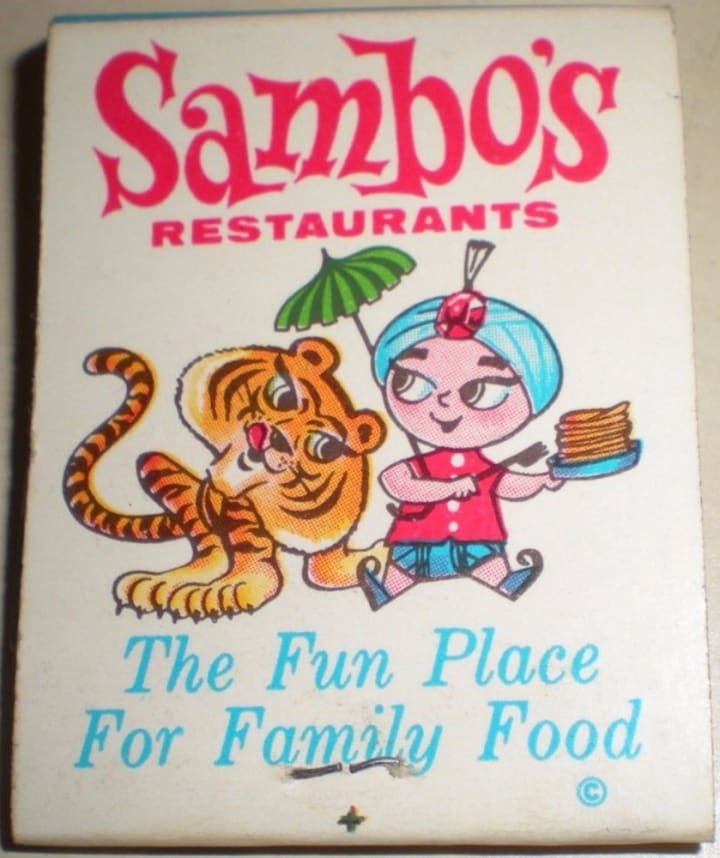
Inside the restaurant hung illustrations from the story in which a little south Indian boy gives his clothes and belongings away to hungry tigers who threaten to eat him. Each tiger wants to be the best dressed one. They chase each other around a tree and turn into ghee, or butter. Sambo's mother uses it on pancakes.
Prior to the early '60s, the signs and interior showed a dark-skinned boy more closely resembling the one in the book. But many regarded the story as racist, and the story met with fierce objection, so the boy's skin was lightened.
Even when it was published in 1899 as part of the Humpty Dumpty series, the way Sambo was portrayed offended some. In the mid twentieth century it met with criticism from Langston Hughes, who objected to drawings of the boy in a "pickaninny" style, a derogatory depiction, he felt.
Interestingly, the original store in Santa Barbara retained the name Sambo's as late as 2002. Many of the stores in the larger chain responded in a desperate attempt to survive by changing the name to things like "The Jolly Roger" and "No Place Like Sam's." But by the early 1980s, the chain went out of business.
When we ate at Sambo's, we found nothing racist in the illustrations. Mom read the book to me when I was little. There is nothing racist about the story itself. Anyway, we didn't think about racism much, if at all. I just loved the fun illustrations from the story that dotted the interior.
Inside, the boy was dark-skinned, and a magical man called "The Treefriend" rode a unicycle. I still think Little Black Sambo is a clever and adorable story.
Sylvia and Bill faced many challenges as a teenaged married couple. The situation also put a tremendous financial burden on my parents. At nineteen, Bill needed to finish his AA in drafting in order to find a job, so my parents supported them for a couple of years. They transitioned into just helping them out. Fortunately, Dad made good money and Mom worked, too.
Despite renting a two-bedroom apartment for Sylvia and Bill in Daly City, and providing for them otherwise, including giving them Dad's brand new BMW, we still had money to live in a large apartment on Pacific Heights, attend plays and concerts, and take trips almost every weekend.
The prosperity my parents experienced then did not always follow us as we roamed around the state. Moving is expensive! There is the time off work, the moving expenses of transporting your belongings, and so on. In our case, we often moved so quickly that we stayed in motels or hotels or short-term rentals before we found a place to live. Most of our belongings went into storage.
Now, the way my parents handled storage made for a lot of losses. Dad often got angry when he had too many bills. Just one of the irrational things about our lives, this anger was often directed at storage companies. Several times it led to his refusing to pay the bill. Guess what happened to our stuff.
All this loss of objects, many of which were precious to me, predisposed me to hold onto things. I have largely broken the habit now, but still rationalize in many ways that clutter experts warn against. I own, and sometimes wear, clothes I've had for forty years! One piece is a pink, fuzzy, long cardigan. I wear it, but if it falls on the floor in my study I leave it because my dog likes to lie on it! He's on it now!
The thing is, I don't like to have to buy something new when, for example, a sweater I like and that looks good on me comes back into style. If I gain or lose weight, I hang onto the clothes that don't fit me in case I gain or lose the weight in the future. This practice actually does benefit me because my weight has fluctuated many times since I hit menopause. (I'm currently too heavy.)
After my husband died two years ago, I went on a spree of giving clothes away. Then, with room in my closet, I organized it again by type of clothing -- long pants here, capris there, skirts there, and so on. (Next, I ought to get rid of my skirts. I never wear them.)
The rapidity and abruptness of our moving usually resulted in Mom's and my driving around neighborhoods searching for For Rent signs. They tended to be few and far between. It was truly a frustrating and sometimes agonizing process.
My job was to read the map and give Mom directions. I started this job when I was ten.
The wide variety of houses and apartments in the towns and cities of California is quite astonishing. We probably went through most types of them, as long as they were in good neighborhoods. Mom and Dad and I lived in some pretty funky places later on, though.
Mom and Dad chose the apartment on Pacific Heights largely because it stood directly across the street from my elementary school. Now that both Winnie and Sylvia lived elsewhere, there was no one to watch me after school. I never had a babysitter except my sister in my life.
Mom worked the evening shift, the only one available to a recent hire. My parents gave me a key on a string to wear around my neck and sent me off to school.
Effectively an only child now, there were many things that caused me anxiety. One, there was no one to help me if I needed it. Two, the Cuban Missile Crisis was happening. Three, two boys started to follow me home from school.
The Cuban Missile Crisis sent me into a panic that October. The fear permeated our society. Maybe other children were more protected than I was. My parents, Dad especially, talked about news and politics at the dinner table.
When my sisters came to dinner, they discussed and often argued. Dad's intolerance for disagreement resulted in his banging his hand loudly on the table. Unpleasant, to say the least.
Mom was not an arguer, and my unpleasant experiences at the dinner table made me avoid arguments. For much of my life I was unable to argue my points. For example, when my second husband yelled at me I was unable to defend myself. Instead I spaced out. I was hardly able to think and felt like my head was filled with cotton.
After years of psychotherapy, I learned to be more assertive and feel capable of defending myself. But sometimes I encounter people or situations it is just not worth arguing with or about. Also, I tend to be calm in crises, and with most people can calm them down. I may not change their minds, but we might have a discussion after that.
During the missile crisis, at school we practiced "duck and cover." We crouched under our desks and put our arms over our heads. How this might protect us from the impacts of a nuclear missile was unclear, but we had to believe it would. Other drills involved snaking in long lines down halls and stairs to the basement of the school. Then we ducked and covered.
Our kitchen sported a red and white air raid sign that said what to do in case of an attack. Every time I went into the kitchen my anxiety rose sharply.
People were building bomb shelters in their backyards. They were stocking up on goods. Every evening Walter Cronkite addressed the status of the crisis to the nation.
At the same time, I adored Jack Kennedy, who was elected when we lived in St. Helena. I was comforted to know he was our president.
A skinny white boy named Sonny and a good-looking black boy named Camasau followed me home from school for a while in fourth grade. It scared me so much I refused to go to back. I screamed and cried when Mom tried to get me to go to school in the morning, uncharacteristic behavior for me.
Mom consulted with my teacher and we met with her. She assured me that the reason the boys followed me was that they liked me; neither would think of hurting me. She would talk to them so they would stop.
Her intervention worked. I had no problem with not wanting to go to school again until I was a sophomore in high school. I will tell you about that in the future.
It strikes me as odd that Mom did not arrange for me to have a contact in the building, someone I could call upon should I need or want to. I knew no one. This proved to be problematic on the days I forgot my key. With nowhere to wait until my Dad got home at six, I often had to go to the bathroom long before that. On many days I ended up wetting my pants, despite my best effort to hold it. This produced a large puddle on the smooth marble floor of the exterior foyer. To my knowledge, no one ever slipped, or complained about it.
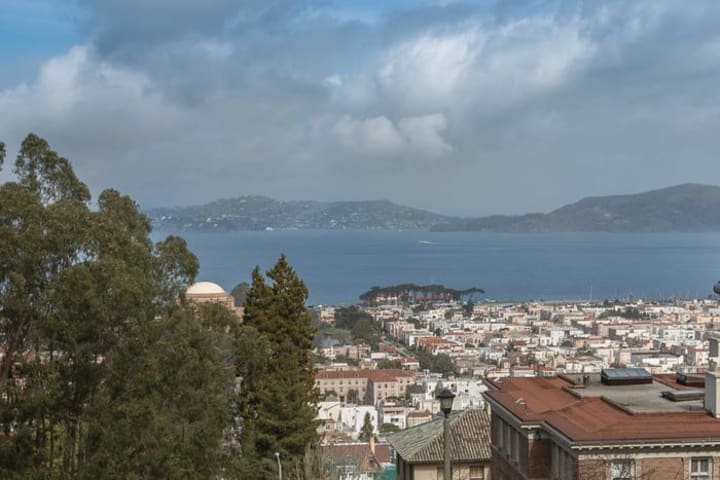
On most afternoons I unlocked the heavy glass and metal entrance door, climbed the stairs, and unlocked the door to our apartment. First, I watched the Three Stooges. Then, I stood and looked out the living room windows at the back. The view from there was of San Francisco to the south and east over the inner Richmond; the Fillmore; Geary Boulevard, with the big, flat, concrete Sear's Roebuck at the corner of Divisadero; the Western Addition; the inner Mission, Hunter's Point, and in the far distance, the east bay. The view seemed cold and unfriendly to me.
Directly below was Jackson Street. A girl from my class lived there in a house that faced me. I fantasized how it would be to have an attentive mother home after school. The girl always wore lovely, full dresses and her hair was neatly braided. Mom dressed me nicely enough, but somehow it seemed that that girl was more cared for.
I told you it was my ambition to become a famous actress and singer. I spent many of my afternoons were playing Winnie's romantic albums. Julie London sang a lovely version of "Can't Help Loving' That Man" from Showboat, one of my favorite musicals. Here's how it goes:
Fish gotta swim
Birds gotta fly
I gotta love one man till I die
Can't help lovin' that man of mine
Maybe he's lazy
Maybe he's slow
Maybe I'm crazy
Maybe I know
Can't help lovin' that man of mine
When he goes away
That's a rainy day
And when he comes back
That day is fine
The sun will shine
He can come home
As late as can be
Home without him
Ain't no home to me
Can't help lovin' that man of mine
Can't help lovin' that man of mine
My parents and I watched Andy Williams every week, and I developed a huge crush on him. I played an album of his, too. I especially loved "Can't Get Used to Losing You," set to a bouncy tune. The first four stanzas go like this:
Guess there's no use in hangin' 'round
Guess I'll get dressed and do the town
I'll find some crowded avenue
Though it will be empty without you
Can't get used to losin' you
No matter what I try to do
Gonna live my whole life through
Loving you
Called up some girl I used to know
After I heard her say "Hello"
Couldn't think of anything to say
Since you're gone it happens every day
Can't get used to losin' you
No matter what I try to do
Gonna live my whole life through
Loving you
In fifth grade I was old enough to venture out from the apartment on my own. Many were the days I trudged down and then up again to California Street where the closest library was.
I loved libraries ever since I was a second grader and took myself to the little one across from the elementary school on my way home to our house in St. Helena. There I took out books from the Math Can Be Fun series. There were many little books in that series on different school subjects. I wanted to read Frank L. Baum's Wizard of Oz series, but found them way too difficult. And the illustrations were very different from the Hollywood movie!
In fifth grade favorite books included A Wrinkle in Time and the Mr. Bass series, long out of print. Those followed the adventures of two boys who meet a funny little man on the beach near their Pacific Grove homes when his rocket is grounded for need of repair. He is bald, sort of reminiscent of a smart Elmer Fudd. The boys gather what he needs. He takes them into space in his rocket ship.
Another book, also out of print, was called The Good Mother about a Hungarian family that lives in a village. What compelled me about it was the attentiveness and nurturance of the mother. I loved the culture, as well, especially the folk dancing. In college I became a folk dancer myself at the Mandala Folk Dance Center in San Francisco. It was owned by Neal Sandler, a man who later became my second husband and my son's father.
Sometimes I was invited to my friend Annabelle's house. We walked down a steep hill and along a path through a eucalyptus forest to her home in the Presidio, where her father was an Army officer. Their house was red brick and stood on a short street of like houses.
Her father often invited me along when the family took their speedboat out on the bay. What a fun and refreshing experience! When the water was choppy, I got seasick. When it wasn't I enjoyed the brisk breeze.
We often got off at Fort Baker, near the Marin side of the Golden Gate. There we ventured into the Spanish-style officers' mess for something to eat.
Back in San Francisco we satisfied our raging appetites at a Mexican restaurant in Playland, an amusement park along the Great Highway and Ocean Beach.
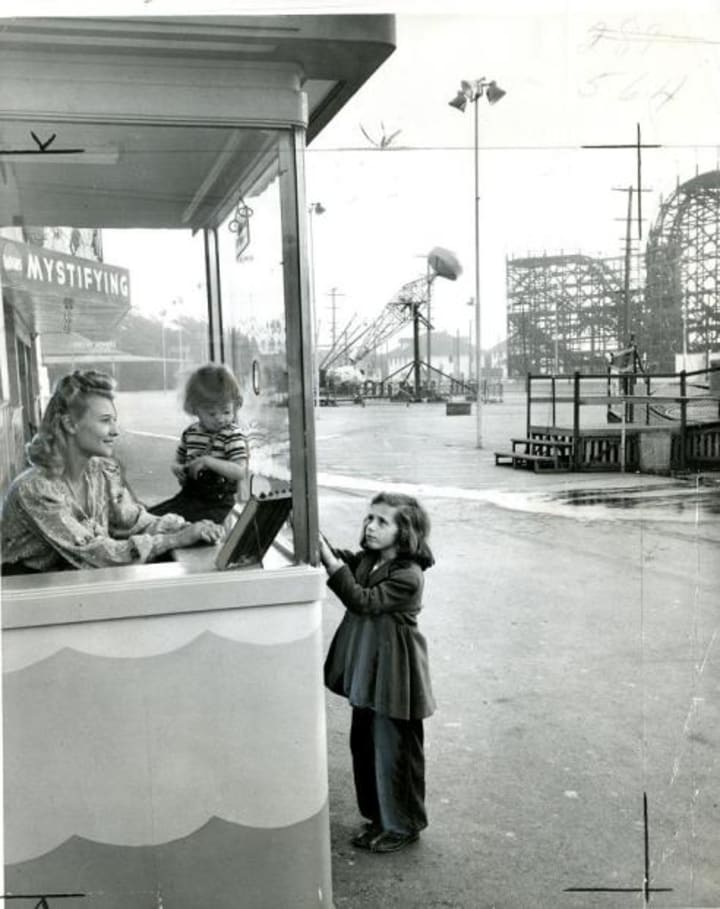
Playland was built on the site of a 19th century squatter's settlement called Mooneysville-by-the-Sea. Around 1884, a steam railroad brought people to Ocean Beach. At the same time came the construction of the Beach Pavilion, where people came to dance, listen to concerts, or drink in the saloon. An early roller coaster called the Thompson Gravity Railroad was also built.
In the 1890s came trolley lines ending near Ocean Beach. They were called the Sutro Railroad, the Cliff House Railroad, and the Ferries.
Many other attractions followed, including the Fun House, carnival games, and the Diving Bell, and a carousel that spun so fast I was afraid to ride it.
The carousel had golden rings mounted on poles. People, generally men, tried to catch them for prizes.
The Diving Bell was a little scary. A large, round, iron building dived down into sea water. People crowded in, and down it went. I remember seaweed and moss undulating in the water.
I felt awed and somewhat frightened by the Laughing Woman, with her fat, rosy-cheeked, big-mouthed face and wild gestures. She was in a glass case at the entrance to the Fun House.
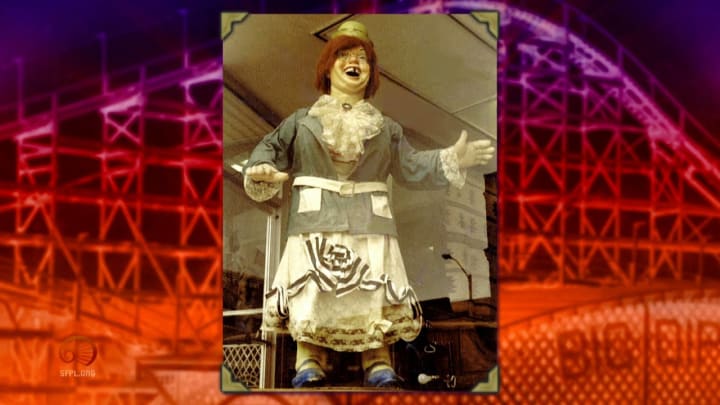
I liked to go in there, even though when I was little it truly scared me. Once you entered, you had to find your way through a mirrored maze. Inside, you never knew when air would shoot up beneath you.
When I was old enough I loved grabbing a burlap bag, climbing the stairs, and sliding down the wide, smooth, wooden slope. Even when I was older I did not like to sit on the disk that spun around. I did not like having nothing to hold onto but the floor. I did not like being spun off.
After dinner, Annabelle's father drove us home through dark streets. When he dropped me off my stomach was satisfied and I was exhausted.
I loved Annabelle's mother, an Italian immigrant who met her father during World War II, I imagine. She was beautiful and kind. I loved spending the night there. Annabelle and her little sister had a room at the front of the house. Her sister slept with their parents on those nights.
As with other times when I was with other mothers like Mrs. Harcourt, I didn't want to go home. One day I was sick with a bad sore throat and wanted to stay there. Mom came and got me.
It wasn't that I didn't enjoy being with Mom and Dad. It was that on weekends at home I got little attention, as they were involved in their own activities. Dad often used the time to work at his big mahogany desk in their bedroom. Mom was busy catching up with housework or writing letters for Dad.
Most weekends we either attended plays and musicals at the Geary or Curran Theater or took off in our Chevy Greenbriar van for Cambria, where my parents bought a lot. The hope was to build a home that meant we would finally have one of our own. My parents were forced to sell the lot a few years later due to financial issues, so that dream, like many others, never came to pass.
The van had that new car smell and it made me carsick, especially when we drove down along the coast route. Highway One is absolutely gorgeous, and extremely windy. I would lie on the back seat and suffer for much of the way. Still, it was my favorite way to travel to Cambria. I loved passing San Simeon, high on a hill to the east.
The other route was along Highway 101, the inland route. Once past San Jose, there were only flat farmlands backed by the coast range. That, at least, was beautiful. Otherwise, the terrain was gold or green along foothills that curved gracefully on the horizon. In summer the area was arid, with dry, cracked riverbeds.
We either stopped in Paso Robles and cut over to the coast through farmland full of trees and quaint farms; a creek we often stopped at to wade and collect rocks; or we went further to San Luis Obispo and cut over from there. That route required us to drive many more miles, first west to Morro Bay, then north to Cambria. There was an intermediate route we sometimes took. It came into Highway One just south of Cambria. A very steep and curvy grade led down the mountain. I did not enjoy that then, although as a teenager I loved to drive it.
Wherever we traveled, my parents pointed out features of the natural world -- trees and their lovely and interesting leaves; mountain ranges; lakes and rivers; and, wonderful views. I developed the same habit, which often gets on my son's nerves when I interrupt the conversation for fear he will miss it! I most often point out clouds, sunsets, and sunrises.
In Cambria, we sometimes stayed at a small motel where oodles of moths flew inside and out. This bothered me no end. My mother scolded me and told me to be quiet and go to sleep. She scolded me rarely, and I felt dismayed and hurt by her impatience. I felt that if she really cared for me she would have done something about the moths.
Other times we stayed at the Cambria Lodge. I much preferred that. It had many cottages set along the sides. And no moths!
Whenever we traveled I found it rude and annoying that my parents woke me up at 5:00 with their talking. They made instant coffee with tap water and we ate sweet rolls we picked up along the way. We always got an early start.
We loved Cambria with its quaint downtown. It was, and has become again, an artist's colony. More than downtown, we loved the beaches. Cambria is known for moonstone, a milky white, smooth beach rock. We were beach combers ever since we arrived in California when I was three. Dad bought a tumbler. The rocks that resulted were absolutely beautiful and felt cool and glassy. We kept them in a flat, black lacquer bowl everywhere we went. Mom kept them on prominent display until she was in her eighties. Sadly, they were lost after Mom moved to Arizona from California with her third husband. He was a nasty man. She developed dementia. No one thought to take the bowl of rocks while they packed up the house when she went into an assisted living facility.
My parents made friends with Geneva Hamilton, the librarian in the tiny library downtown. She was in intelligent, interesting woman who raised her by then grown son on her own. She took many trips to South America, and once brought back a green parrot. We took care of Samson for a while when we lived in Capitola when I was fourteen.
Sometimes I got dressed in my best dress with huge polka dots on a white background, fat petticoat, brimmed hat, and gloves to take the bus downtown to meet Dad and travel back with him. I enjoyed that, but passing through the Fillmore made me a little nervous. In those days it was not the best neighborhood. Long before fixing up Victorians became popular, they became rundown and shabby.
I was no stranger to taking the bus, nor to downtown after our many excursions there. In my life I would spend many years in San Francisco. It remains my favorite city.
I had two other girlfriends in San Francisco. Mom and I met Ellen and her mother while swimming one evening at the downtown YWCA. In that very different time, people did become acquainted in many places; it was not like it is today. People are so socially inept, or afraid, or simply not interested now. It makes me sad.
Ellen's mother was divorced and single. She and Ellen lived in the Marina district, down the hill to the north of Pacific Heights. The Marina is a nice area. On the hill are perched mansions, transitioning down to flats and apartment buildings, then back to mansions along the water at Marina Green.
On Saturdays I sometimes trudged down the hill to meet Ellen on Green Street, where we went to the movies. Sound of Music was my favorite. I developed a crush on Baron von Trapp! Who knows, maybe that began my habit of becoming involved with older men!
My other friend was Diana. I don't remember her last name. Her father was the Australian ambassador. She lived in a mansion down a steep set of cement stairs on Broadway.
The living room was huge, with a view of the bay. We played ping pong in the rumpus room and slept on silk sheets. The cook gave us snacks we ate in the small, but lovely, backyard.
Diana was an energetic and funny girl. I enjoyed her, and I enjoyed her accent!
My fifth grade teacher, Mrs. Squataguaza, was a large, middle-aged woman. She demanded a lot of us, but her fairness and kindness won me over. She was the first teacher who conveyed to me that I was smart. She also acknowledged my artistic side.
She chose me to design a mural for Thanksgiving. The class made figures cut from construction paper, and I placed them on the scene. This experience gave me confidence, something that was new to me.
Having friends added to my confidence. Other children liked to play with me! I became more outgoing.
Sylvia's baby turned one in March. My niece Joyce grew into a sweet little girl. Tiny, she was overpowered by her younger sister, who was born six months later. Deanna was of a bigger, sturdier build. She seemed to have inherited a lot of her great grandmother Emma's genes.
Sylvia, in my opinion then and now, was overly protective of her daughters. She acted as though she didn't trust me with them. I was never allowed to hold them. Nevertheless, I loved my little nieces, and as they grew they admired their Aunt Helen.
I used the nickname Pepsi. The advent of this occurred on Annabelle's dad's boat. For her eleventh birthday he took us on a ride. We played a game where we all chose names of soda pop. I came up with Pepsi. Because my last name was Koch, pronounced like Coke, everyone thought it was great. My sister Winnie calls me that to this day, 58 years later!
One of the things my parents and I sometimes did on weekends was to walk across the Golden Gate Bridge. Many people with children get someone to park their car in the lot on the Sausalito side, but not my parents. I can tell you, walking both directions on the Golden Gate is exhausting for a ten-year-old!
The summer after fifth grade I went to a Y camp in Mendocino county. The bus ride was several hours, much of it on a narrow and windy road along the coast. I got the worst case of carsickness I ever did.
The entrance to the camp was barely visible from the highway. The bus turned into the redwood forest and proceeded down a long dirt road.
Man, I loved that camp! It was the perfect place. The redwoods shaded it and helped to cool the temperature. Rustic cabins were scattered among the trees. We swam in a moss-lined natural spring water pool. At night we sang Kumbaya and other camp songs in a little amphitheater at the side of the hill.
I missed my parents, but soon was having so much fun my homesickness went away. We took hikes and washed with Fels Naptha in the ice cold creek when we got back to prevent poison ivy. We made crafts with pinecones, sticks, and leaves. I made friends with other girls and with the counselors. We camped outside. We waited for our parents to send care packages. All the kinds of activities campers do.
One day we took a hike to a large lake on the other side of which was a boy's camp. We were told that the boys were pretty wild, and had been known to row boats over to the girl's camp. We girls were both a little frightened and titillated by the boys invading our camp.
I'll tell you one thing I learned: an orange tastes awfully good when you don't have candy available!
Sally Taft was a friend I made at Y camp. We stayed in touch for a few years. She was an exuberant, witty, girl with a flair for telling jokes. She lived in Atherton, a wealthy enclave on the San Francisco peninsula.
Sally was adopted. In her teens her feelings of abandonment caught up with her and she had a very hard time. I hope she made it through and has had a happy life.
I visited her once. She lived in a sprawling house in a neighborhood bordered by a stone wall. There were no sidewalks or fences; the properties were simply separated by the streets.
Her room was like one out of a fantasy for me. Kept neat by her mother (my mother never cleaned my messy rooms!), white louvers covered the windows, letting in filtered light. A window seat held toys and books. Sally's bed was neatly made in a light blue quilted bedspread with matching pillow shams.
Sally's mother was older. Despite her crippling and painful rheumatoid arthritis, she took care of Sally and her father without complaint.
Sally's father descended from William Howard Taft, the 27th president. I don't know what he did, but he was a very nice man.
To me, camp away from home is an important experience for children. It is an introduction to a safe (hopefully) separation from parents. They learn to relate to other trustworthy (hopefully) adults. They gain a sense of adventure. They have intimate experiences with other children. They come to appreciate and learn about nature. Most importantly, they have lots of fun.
I was fortunate to have many camp experiences from the time I was nine to eleven, and again at fourteen and fifteen. Although the ones when I was a teen were not as pleasant for me due to the camp situation, I still benefited from the time spent there. At Kennolyn Camp I was taught to swim excellently and got my life saving certificate; went scuba divin;, rode horses under the guidance of a strict old Calvary colonel; camped on a beach in Carmel; learned of a doctor who practiced in an iron lung; met a lovely girl from Venezuela; made friends with a male counselor who became important to me later; learned that rich kids will steal someone's homemade jacket; and helped make a mosaic fountain.
Perhaps most importantly, my parents decided to move to the tiny seaside town of Capitola down the mountain from the camp. I will describe life there in a future post.
I hope you have enjoyed my post as I share my experiences as a child in a family that moved a lot.
For now, hasta luego!
About the Creator
Caroni Lombard
As a child my family moved often. In my story, I share that experience; what it was like and how we coped.
But my story is not just for those who share my experience of growing up in a highly mobile family. It's for anyone who's human.
Keep reading
More stories from Caroni Lombard and writers in Families and other communities.
Following My Father
We moved from the Oakland Hills to St. Helena in the Napa Valley shortly before the end of the school year in first grade. Dad's decision to move us at that time led to a crisis between my oldest sister. About to graduate high school from Oakland Tech, a school Winnie loved and felt proud to attend, she felt betrayed and refused to go. She arranged to stay with a friend for those last weeks of school.
By Caroni Lombard5 years ago in Families
Wise~Guys
— Look Behind what's in Front of You ~ Make Good Choices — Hey, So how you Doin'..! Made~Men — Mobster Movies romanticise a distinctive, elegant appearance, impeccable attire style, along with the 'Families' expressive lingo. Making their 'Bones' gave them Panache — with vintage fedoras, tailored pin-striped suits, mirror-polished wing-tip shoes adorned with tassels; with their 'Gun Moll' gorgeous dates on their arms.
By Jay Kantor16 days ago in Families
Product of Lies
Product of Lies My earliest recollection of a lie was at the age of five. It was the Christmas holiday week, and my mom and dad were have an annual Christmas party for friends that included a couple children. The night was a fantasy, like the Nutcracker Suite without dancing. Our house length sunroom, which I always called the ball room was fully decked out in silver and gold garland, hung from each of the recessed lights in the entire room, which made the light refracting off of the tinsel, shimmer and flicker throughout. There was beautifully delicious food laid out and beverages for the kids and the adults. I was going to be a long evening of magical socializing in holiday vignettes.
By Alexandra Grant5 days ago in Families
Miss Persephone's Manual to a Seemingly Ordinary Life
Miss Persephone was found at the dining table, her blue eyes swollen, her tears arriving and retreating like the tides of the ocean. Earlier that day, her family had visited her in the retirement home where she had lived for eight years. It was her eightieth birthday.
By Imola Tóth2 days ago in Fiction



Comments
There are no comments for this story
Be the first to respond and start the conversation.