

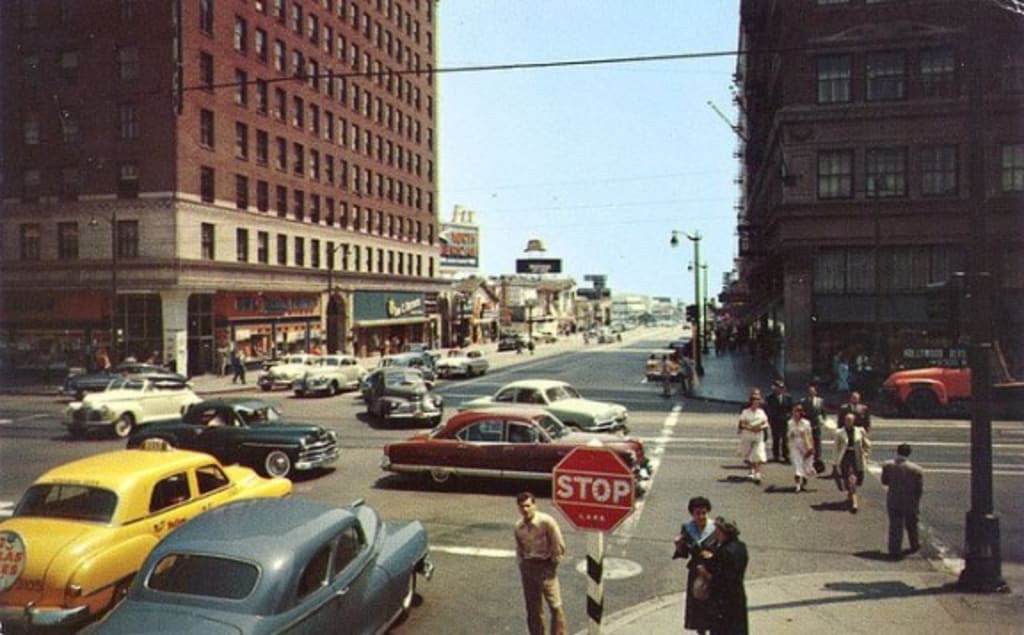
When I was almost 13 my parents and I moved to Los Angeles from Palo Alto. Our neighborhood in between North Hollywood, Wilshire Boulevard, and Olivera Street, the famous street in the Mexican area of downtown.
It was a relief to me to be away from Palo Alto, where I spent a miserable 7th grade.
We stayed in a motel for a while while my parents looked for a place to live. One day I took a walk. The air was so foul I could taste the toxic smell.
If you agree with certain politicians that environmental regulations should be rolled back, you can take it from me, you do not want the air to return to the way it was before regulations.
Cars regularly spewed thick, putrid exhaust. In Los Angeles, with its many freeways and heavy traffic, the smog became truly unbearable. You could hardly see when the smog was bad. And your eyes stung.
Although it was not publicized then, physicians must have seen the connection between patients with lung disorders and the poor quality of the air they breathed.
The only saving grace was when the sea wind blew the smog somewhere else. (Thanks a lot, LA.) Because the city of Los Angeles sits in a bowl, pollution gathers there.
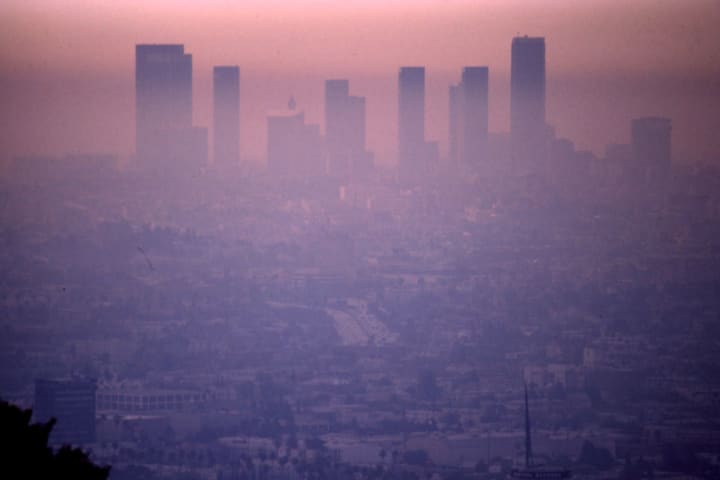
The caption under this picture reads: LA's mid-century smog was so bad, people thought it was a gas attack.
_______________
My mother and I spent days and days searching for a place to live. Mom drove our Greenbriar van through all kinds of neighborhoods, from Beverly Hills, to a neighborhood near Hollywood Boulevard, to the hills of Pasadena.
Beverly Hills was, of course, way too pricey for us. I don't know why Mom even took us there. It was interesting to see, though, and to wonder what it was like to live in those fancy houses and mansions. When I think of Beverly Hills I think pink, as many of the houses were pinkish stucco.
I so much wanted to live in Pasadena. The houses on the flatland included marvelous bungalows with wide porches, gables, and shingles. Other houses and neighborhoods were not appealing. One was of newer houses that seemed like attempts to mimic the homes of movie stars. The neighborhood seemed cold with the many front yards paved over or covered with gravel.
We drove around the Pasadena Hills. The winding roads were difficult to find our way around. Mom had seen an ad for a house, but by the time we got there it was rented.
Mom and I spent hours and hours of my childhood looking for places to live. I read the map and gave Mom directions. I became skilled at it.
One thing about the experience was that I had the opportunity to see many kinds of homes, which was interesting. Each one stimulated my imagination as I wondered what it would be like to live there.
Finally, my parents found a tiny apartment where we lived for a month or so. I spent my days watching The Monkeys, the Flying Nun, Gilligan's Island, and Love Boat.
While we lived in that apartment, Dad told me stories about his life in LA as a kid. I was surprised to learn that he lived with his grandmother as a young boy.
Dad described his bed. It was one that rolled out from a compartment in the wall. If an earthquake shook the house, his bed rolled back into the compartment!
Dad was a bit player on Our Gang. Those of you who are not familiar with that show might be interested to learn about an important phenomenon in the early part of the 20th century.
Our Gang was also known as Little Rascals. It was a series of movies about the shenanigans of a group of poor children. It was the first time black and white children were portrayed as equals. Some people criticized scenes in which black kids were shown, for example, to ooze black blood. But the white kids were also stereotyped and made fun of.
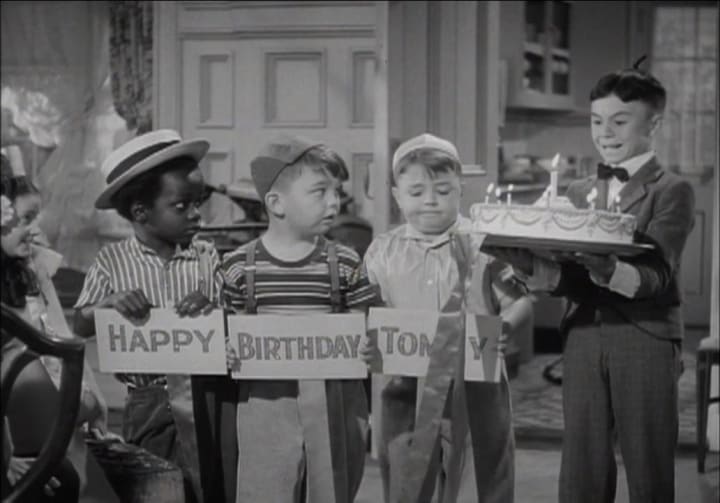
The white characters included the "fat boy" and the "freckle-faced kid." A major, comical character was Alfalfa. He was a funny-looking kid with a piece of hair that stuck up from his head.

Our Gang began in 1921 as a silent film series, and remained so until 1929. Actors came and went, few to continue on as successful actors. One who did was Jackie Cooper, whose career lasted into adulthood.

_________________
A small swimming pool lay at the back of the building. I met a very nice man, who lived with his partner there. It was the first time I made friends with a homosexual. I was open to making friends with people of all sexual orientations, races, and religions, as I am today.
Tragically, after we moved we found out that his partner had shot him to death.
From that apartment we moved to a house that had been Marie Dressler's home. The house was split into a large apartment where we lived, and two smaller ones. I never met our neighbors.
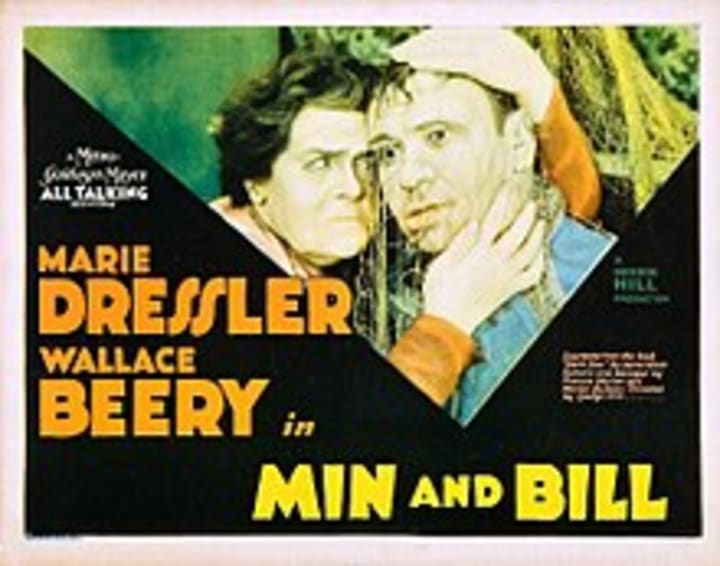
Marie Dressler was a famous actress in the early part of the 20th century. She started out in silent films, then was a Depression Era star. In 1934 she won an Oscar for Best Actress for her role in a comedy film called Min and Bill.
Our apartment was on the second floor. The house was built on the side of a hill, and so my bedroom looked out on a driveway, as if we were on the ground floor. There was a door to a hallway the led to an exterior door. This situation worried my parents. They were afraid I would sneak out or let a boy into my bedroom.
My parents' distrusted me for the first time. It hurt my feelings and made me angry when they filled the hallway with boxes so I was blocked from reaching the exterior door.
It was the first time I was angry at my parents. It led to the one and only time my mother became physically aggressive toward me. I don't remember what the argument was about, but Mom followed me into my bedroom and tried to push me onto the bed. My reflex was to kick at her. I did not make contact. The incident shocked both of us, and nothing like it ever happened again.
But my newly-expressed anger scared my parents. Mom went to see a counselor and told me the counselor would call to make an appointment. The implication was that I was mentally ill, which made me even angrier.
One afternoon I picked up the phone to hear that the counseling center was wanting to talk to me. I told the woman I wasn't home and hung up. I never heard anything about it again.
The thing was, I was not prone to anger in general, but my parents' attitudes toward me felt unfounded and insulting. It was my budding sexuality that scared them, I know. Perhaps it was that I was a bouncier, prettier, more adventurous girl than my sisters were. Maybe it was the fact that Sylvia got pregnant at 16.
I started eighth grade in a huge brick school a few blocks away. The walk was a pretty long trek along major streets. I walked in the heat wearing a short skirt, a girdle, and stockings. Teenage girls and women wore stockings or tights under dresses in those days.
The student body was primarily Mexican. There was a small group of us that were white and black. I found the situation not only unusual, but interesting.
I learned something of what it's like to be in the minority, although we did not suffer from prejudice and mistreatment. It was more that I understood that any group smaller than any other became a minority.
The way the Mexican girls acted sometimes astonished me. At morning break, where we bought large sweet rolls at a concession in a courtyard, girls often fought. Around and around they went, screeching, clawing at each other's faces and trying, sometimes successfully, to pull each other's hair out. I suppose these fights were over boys.
The Mexican kids danced really well. The student body was large. Dances were held after school once a week in a large gymnasium. By comparison, our movements seemed jerky and awkward.
The music of Sonny and Cher, the Beatles, the Beach Boys, Diana Ross and the Supremes, and many other groups and singers were popular in the early 60s. I loved them all. Smokey Robinson's "Tracks of My Tears" was a favorite, as was "My Girl" by the Temptations.
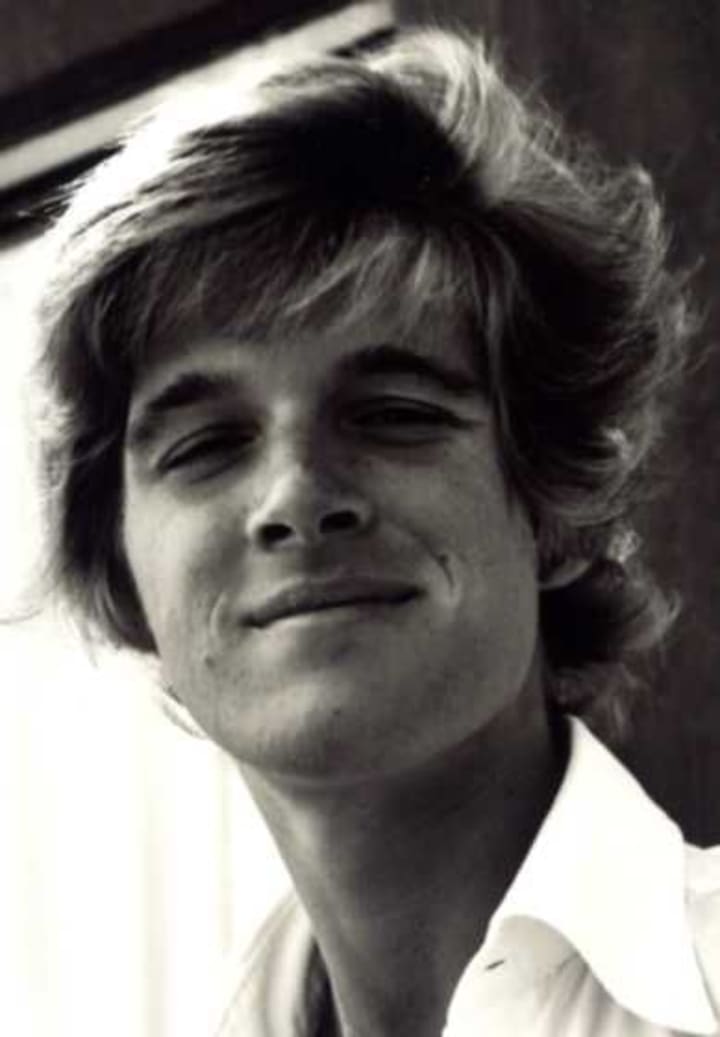
Another group I liked was more obscure -- Dino, Desi, and Billy. I developed a terrible crush on Dino, Dean Martin's son. From the picture below, you can see how cute he was!
Desi was, you guessed it, the son of Desi Arnaz and Lucille Ball. They only had two real hits, "I'm a Fool" and "Not the Lovin' Kind." They mostly opened for more successful bands, like the Beach Boys.
_________________
In contrast to an in-group, our group at school possessed no feelings of superiority. We were not a clique, just a small group of kids who were not Mexican. I made friends with two of the girls, Robyn and Melody.
Melody lived with her divorced mother in a small apartment at the end of a little street off a main drag. One day when I visited her, she told me she found a dead baby floating in bloody water in the toilet. She said her mother used a coat hanger to give herself an abortion.
This was the first time I heard of such a thing. It gave me the creeps.
Abortions were illegal in most of the country until 1974. In 11 states at that time abortion was legal under the circumstance that the pregnancy endangered the mother's life; these states included California.
In 1974 the court case settlement of Roe vs. Wade made abortions legal in all 50 states. The lawyers for a woman going by "Jane Roe, "who wanted an abortion in Texas, brought the case to court. Their argument was that making abortions illegal was unconstitutional.
The Texas court ruled in her favor, but the case was challenged. It was taken to the Supreme Court, which ruled in Jane Roe's favor.
This landmark decision has not settled the controversy around abortions, but what it did was save the lives of thousands, maybe millions, of women. It also allowed doctors to perform abortions. Prior to that, many of the doctors and others who gave abortions did so in dirty conditions and without proper training. Not only did women die, but some abortions resulted in damage to the women's reproductive organs.
My other good friend was named Robyn. She was a large-breasted girl with long, kinky hair that gave her no end of trouble. The ideal was long, straight hair. Robyn and her older sister lived with their parents and grandmother in a Colonial house on a short street filled with similar upscale homes.
That part of LA was developed in stages and at various times. It made for an oddly arranged layout, with small enclaves lying between other neighborhoods.
Robyn's house was huge and beautiful. Her room was, too. I envied her the frilly bedspread and pillow cases that adorned her double bed. The room was airy and filled with light.
Robyn's room was filled with expensive toys. Her Madame Alexander dolls were so charming. They sat at a tiny round table in front of a window.
We liked to squeeze through a passageway that led to the roof. There we sat in a small space between higher portions of the roof. We talked about boys and our ambitions. We looked down on the spacious, nicely landscaped backyard.
Robyn and I wrote flowery and illustrated poems to one another. We sent them in beautiful or cute greeting cards or in notes. We became very close that way.
The love notes did not represent homosexual feelings toward one another, at least not for me. And, Robyn never expressed any for me. Of course, lesbianism existed, but it wouldn't be for many, many years that it was accepted by the larger culture. Lesbians were stigmatized and regarded as unnatural or perverted.
It was still a terrible time for homosexual men, as well. Homosexuality was illegal. Many men were arrested, often in public restrooms. Careers were lost, marriages were ruined, family ties were broken.
Robyn's mother worked as, of all things, a clown! We were also interested in performing, not as clowns, but as actresses who danced and sang. Robyn's mother found a drama student at a local junior college, who wanted kids for a musical review he was putting on. She probably found him through Robyn's older sister, who studied drama at the same school.
Bruce was a talented choreographer and drama coach. He taught us our routines and the songs that went with them. Our performance took place in a small auditorium. Our numbers were peppy and energetic, and we were a big success.
Robyn was addicted to the Munsters and The Addams Family. Every afternoon she rushed home from school to watch them. I sort of enjoyed them, but they were really not my thing.

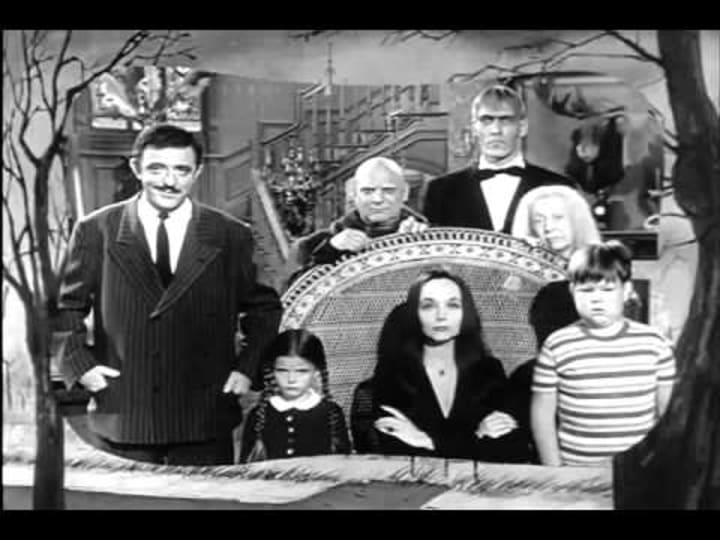
I liked shows like Gidget, the Patty Duke Show, and the Flying Nun. If you are unfamiliar with these shows, I will tell you about them.
Sally Field played Gidget, a spunky, boy crazy girl who surfed and got into predicaments her widowed father had to help her out of.

The plot of the Patty Duke Show involves a girl in Brooklyn Heights and a girl from Scotland who comes to live with her and her family. The girl looks exactly like Patty, but the girls' attitudes, likes and dislikes, and personalities are quite opposite.

The Flying Nun is played by Sally Field. Her character is a novice nun who uses the wings of her cap to fly. She lives at the Convent San Tanco in San Juan, Puerto Rico. The perky nun gets into all kinds of amusing trouble.

_________________
Winnie came to visit when we lived in LA. She was all jazzed about a bra she ordered. She showed Mom and me a picture of it in a catalog. It was the pointiest bra I ever saw. "Why does Winnie want to look like that?" I thought.
Since her Lebanese boyfriend broke her heart in San Francisco, Winnie didn't date much. She was an attractive young woman, but did not ooze sex appeal. Maybe the pointy bra was an attempt to attract more to men, I don't know.
I talked about Mom's big breasts and my parent's pride in them in Palo Alto, Part One, so I won't repeat myself. I'll just say that comfort was always what I chose bras for, and never to make my breasts appear unnatural.
My boyfriend in LA was a boy whose mother was Mexican and father white. They lived in a tiny, ramshackle place in the nearby Mexican neighborhood that began a street or two behind our house.
They once took me on a trip to the Salton Sea. Now, if you want to go to a dreary place, go there. At least it was dreary in 1965.
Salton Sea is one of the largest inland lakes in the world, and one of the lowest spots on earth at -227 feet below sea level. Because of its location in the Sonoran Desert, the Salton Sea has some of the highest temperatures in the US. From May to October it is 100 degrees Fahrenheit or hotter, with temperatures as high as 120 degrees recorded every year.
Salton Sea lies on top of an ancient lake called Lake Cahuilla. Lake Cahuilla naturally expanded and receded by runoff from the Colorado River over the centuries. The Salton Sea resulted from an accident.
In 1905. spring flooding in the Colorado River crashed through canal gates that led to the Imperial Valley, a vast area used for agriculture. For 18 months, the entire volume of the Colorado emptied into the Salton Trough, which is a rift caused by the San Andreas Fault.
The Salton Sea became 45 miles long and 20 miles wide, with about 130 miles of shoreline. Prior to the lake's formation the area was home to a major salt-mining operation.
Several resorts were built along the shore in the 1950's, but their success was short-lived. By the time we traveled there in 1965, it appeared more like a ghost settlement.
The Salton Sea once looked like this:
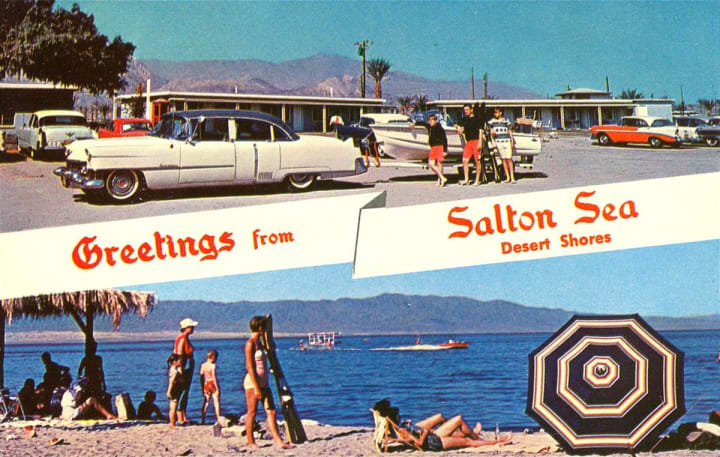
But, that is by no means my memory of it. We drove to a desolate, dreary spot. Perhaps my impression was affected by the fact that we arrived at dusk. Perhaps my impression came from where we parked at the site where buildings from a former resort were abandoned and decaying.
Since that time, agricultural runoff has increased the salinity of the lake, resulting in fish die off. Now the only fish to be found is tilapia. Nevertheless, Salton Sea continues to be a recreational spot.
The Salton Sea is a major stop for many migrating birds, such as grebes and brown and white pelicans. Sadly, due to climate change, agriculture, politics, and the discontinuation of some mandates for adding water to the lake, the Salton Sea is shrinking, a process that is expected to accelerate. This shrinking will endanger the birds.
Graham was not a particularly good-looking boy, but he appealed to me, for some reason. He was the first boy I let "feel me up." We used to sit on someone's hidden stoop in the dark. It was all quite innocent.
Graham introduced me to his friends. There was a girl whose face was scarred by some accident. She wore heavy makeup in an attempt to hide it. She was a tall girl, not very attractive, but pleasant.
A boy named Damon was devilishly handsome. He was tall and well-built, mature for his age. He exuded sex appeal, but seemed still innocent of much interest in sex.
The boy I liked the most was a large guy with the sweetest personality. He came over to my house one afternoon and was, of all things, brushing my hair, when Mom came in. She had a cow fit! She told him to leave and was very angry with me. This was my parents' hypervigilance about my approaching sexuality talking.
Underneath it all, I was a super sensitive and often sad girl. I longed for family relationships unavailable to me. I longed for nurturance and comfort. As it was I was pretty much thrown into the pool of life to swim on my own.
I felt sentimental for things in my childhood. One night I sat on the floor in front of Dad's chair while watching a Disney special. When the intro played, tears streamed down my face. I did my best to hide them. I longed for a warm world where it was safe and comforting.

When we lived on Pacific Heights in San Francisco, I watched Shirley Temple movies on Saturdays. I so much wanted to be her -- spunky, adorable, loved, talented, and surrounded by people interested in and committed to giving her the best life possible.
If you are not familiar with Shirley Temple, she was a child star of the 1930's. She began her career at age three, and was wildly successful. She tap danced and sang and charmed her way into people's hearts.
I was crazy about Shirley Temple. The characters she played invariably had adults who protected her and cared for her passionately. While her character was faced with problems, a committed adult always got her through.
One of my favorite movies was Captain January. Shirley Temple plays Star, an orphan who washed up and was rescued as a baby by a lovable lighthouse keeper. She lives a life of dancing and spitting at sailors! A nasty truant officer decides she must go to a boarding school. Star and Captain January are heartbroken and fear they will never see each other again. All turns out well in the end, as all Shirley Temple movies did.

Shirley Temple movies always made me laugh and cry. I longed to be like her. I asked my mother to give me a perm in hopes of gaining ringlets. I ended up with a frizzy mop, and couldn't wait until it grew out!
_________________
Robyn and I often wandered around that part of LA. We liked pretty, scented soaps, bubble baths, and other beauty products. In a small shop Robyn stole a bar of soap. It shocked me.
Sometimes we went to a large five-and-dime. One day she lifted a lipstick and put it in her purse. As we opened the door to leave, a security guard approached and asked Robyn if she had stolen a lipstick. Of course, she said no. The guard let her go.
I had only one other friend who shoplifted, my boyfriend John from Aptos. It always made me so nervous. I would never steal anything. The only time I benefitted from a friend's shoplifting was a time when I stayed at John's house in LA after his family moved there. I was fifteen and ran away from home. His parents were away and we ran out of food. We took the little money we had and went to the market. To my amazement, John slipped two steaks under his shirt and we walked out.
Robyn's habit of shoplifting was the only thing I didn't like about her. I wondered why she did it. Her parents were well off; it's not like she had no money.
Sometimes we walked to a grassy, isolated spot overlooking a freeway. There were no parks in the area, and this was the next best thing. We picked tiny wildflowers, talked, and wrote poems we illustrated with different color pens.
Something about my time in LA left an indelible impression on my mind that comes up every time I take a shower!
The teacher in health class was a good-looking man who was thorough in his discussions. I guess he was concerned that we didn't know the proper way to take a shower. He demonstrated how to dry ourselves off, tactfully skirting our genitals. He emphasized the importance of drying between our toes.
Every time I dry myself off I think of that teacher! I still use his method!
One night Mom dropped Robyn, Melody, and me off for a dance for teens in a nightclub along Hollywood Boulevard. We dressed in our shortest skirts and skimpiest tops, and used more makeup than usual.
The dance was put on by a popular rock radio station. We anticipated a lot of fun.
For me, it was not fun. Kids ran all over the place, causing chaos. We had to pass through a narrow staircase to get to the dance floor. Boys rudely barreled through. I was most uncomfortable.
The second problem was we had no partners, so there we stood watching others dance in the crowded room, and hoping a boy would ask us to dance.
Every so often, Mom took on an art project. She obtained some heavy cardboard, barrel-like cartons somewhere and decided to paint the designs from tiles we had depicting scenes from Argentina. The scenes were of picturesque casas, gauchos on horseback, and scenes along tree-lined streets.
Her paintings came out beautifully. I have no idea what happened to those cartons. My parents must have left them behind, because I never saw them again. Too bad they didn't take pictures of them.
Mom was a frustrated artist. She wanted to learn to paint in watercolors well, like her father. John Gurd was an artist and architect in New York. Before he married, he traveled to Europe to study and paint. He was a skilled watercolorist and brought back many wonderful paintings. I have two of the European scenes in my dining room. Another painting I have is of a beautiful woman sitting in a chair.
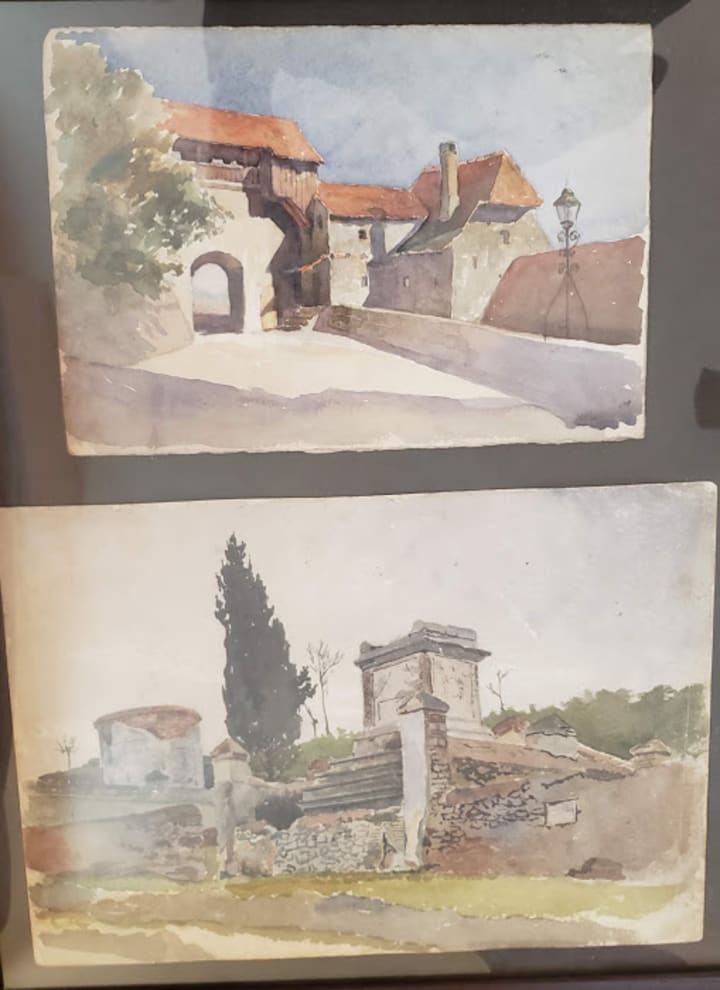
So, Mom really wanted to follow in her father's footsteps. Problem was, from the time she graduated from high school and finished nursing school, she worked and soon had children. She just didn't have the time to paint.
In the spring, before school was over, Mom’s familiar refrain, “We’re moving in two weeks, start packing,” greeted me one morning.
Robyn and I were so upset, we plotted to run away so I wouldn’t have to leave. This faulty logic of two thirteen-year-old girls made no sense, of course. And, our plan included something that would put our eighteen-year-old drama teacher in jeopardy.
From Robyn’s house, one night we sneaked off toward Culver City, where Bruce lived, a journey of about ten miles. Through the dark streets we walked, with purses slung over our shoulders.
The farther we went, the more frightened we became. Our weary sneakered feet wanted to stop and rest. The dark night and abandoned streets, with only the occasional car driving by, urged us on.
The possibility of one of those cars stopping and a strange, lewd man trying to pick us up loomed in our imaginations. The isolation and block after block of silent houses made me think of the town Meg, Calvin, and Charles Wallace found themselves in on that terrible planet Meg and Charles Wallace’s father was imprisoned on. (A Wrinkle in Time was my favorite book as a child.)
Bruce freaked out when we showed up at his door. Our naivete made us oblivious to the fact that he feared he might be accused of statutory rape by our enraged parents. He had our parents’ phone numbers from our time with him in the drama group, so he went into another room and called. My Mom showed up not long after. No one blamed him, as they knew we had surprised him.
The next day my parents loaded up our red Chevy Greenbriar van. An armchair for me sat in the back surrounded by boxes. For the eight hour drive to San Francisco I refused to talk to them, and sat sullenly with my arms crossed. I looked out the window as we passed long stretches of arid and agricultural land along Highway; windrows and eucalyptus groves; through San Luis Obispo, with the long grade from which I could see the train tracks and the tunnel I passed through many times, especially in my teen years; past Paso Robles, a familiar spot from childhood family trips; between rows of eucalyptus approaching Gilroy; through San Jose, past Cupertino, Sunnyvale, Palo Alto, East Palo Alto, San Mateo, the San Francisco Airport, South San Francisco, and finally, the city itself.

I remained angry with my parents for many things in the next couple of months – for having to attend that dreadful Presidio Junior High, with it’s gloomy brick building and arid yard, with its long cement bench on either side, where we ate lunches of peanut butter and jelly sandwiches and oranges, or other lunches our mothers’ packed in brown paper bags. For the cold flat with only beds and our dining table and chairs for furniture.
But all that is for another post. Join me for San Francisco in 1965.
About the Creator
Caroni Lombard
As a child my family moved often. In my story, I share that experience; what it was like and how we coped.
But my story is not just for those who share my experience of growing up in a highly mobile family. It's for anyone who's human.
Keep reading
More stories from Caroni Lombard and writers in Families and other communities.
Following My Father, Palo Alto, Part Two
Our move to a house right across the street from Jordan Junior High School proved to make for a miserable year for me. Throughout my childhood, it often seemed that we lived in a place I liked a lot, moved to a place I didn't like, moved to a place I liked, and so on. This was not always the case; sometimes there were two places, even three, in a row where I felt unhappy.
By Caroni Lombard5 years ago in Families
Wise~Guys
— Look Behind what's in Front of You ~ Make Good Choices — Hey, So how you Doin'..! Made~Men — Mobster Movies romanticise a distinctive, elegant appearance, impeccable attire style, along with the 'Families' expressive lingo. Making their 'Bones' gave them Panache — with vintage fedoras, tailored pin-striped suits, mirror-polished wing-tip shoes adorned with tassels; with their 'Gun Moll' gorgeous dates on their arms.
By Jay Kantor17 days ago in Families




Comments
There are no comments for this story
Be the first to respond and start the conversation.