
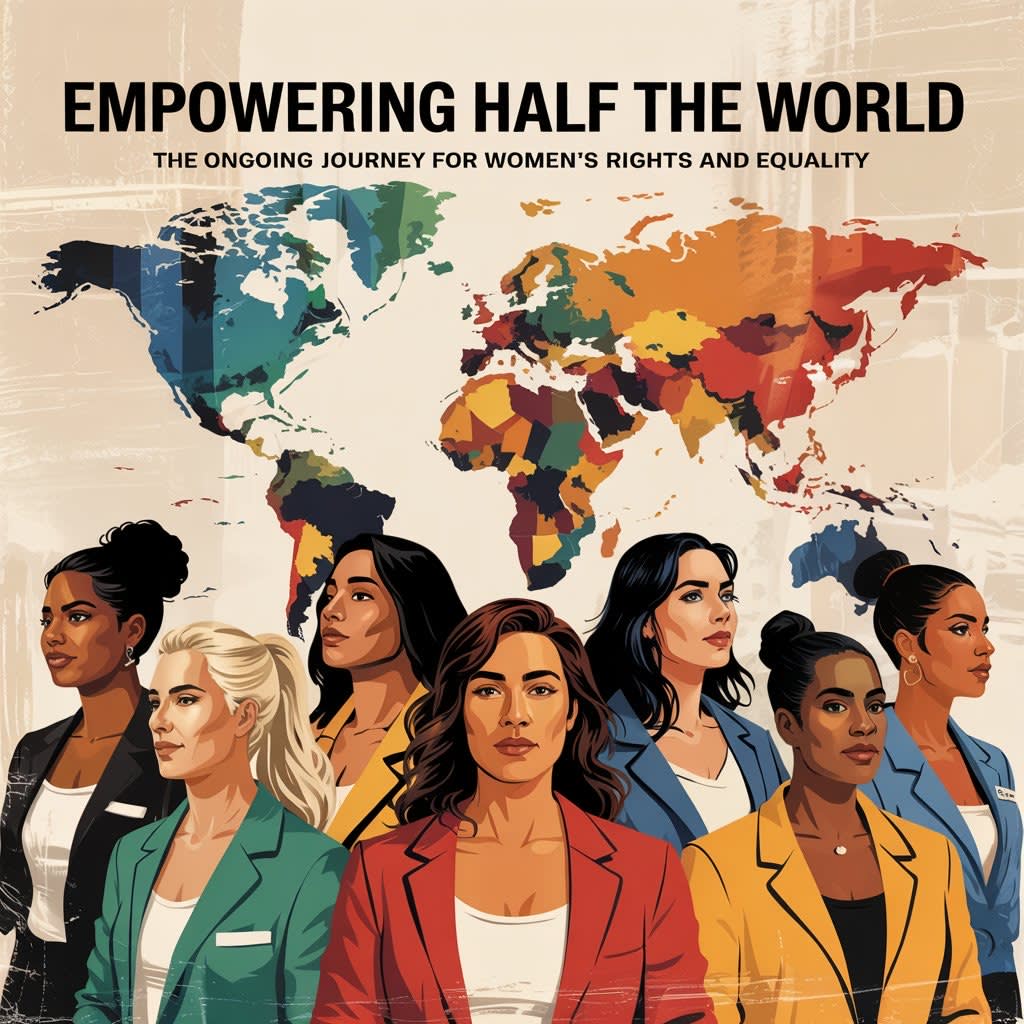
Empowering Half the World
The Ongoing Journey for Women’s Rights and Equality

Introduction
Women make up nearly half of the global population, yet for centuries, their voices have been silenced, their contributions overlooked, and their rights denied. The fight for women’s rights is not just about fairness; it’s about recognizing the inherent dignity and potential of every human being. Empowering women and ensuring their equal participation in all aspects of life is crucial to building a just, peaceful, and progressive world.
⸻
A Glance at History
The journey toward gender equality has been long and difficult. In ancient times, women were largely confined to domestic roles and often treated as property. Education, political participation, and economic independence were mostly privileges reserved for men. Over the centuries, courageous women and their allies challenged the status quo, laying the groundwork for a global movement.
The first wave of feminism in the 19th and early 20th centuries focused on legal issues, especially women’s suffrage. In 1893, New Zealand became the first country to grant women the right to vote. The second wave, from the 1960s to the 1980s, expanded its focus to workplace rights, reproductive freedom, and the fight against gender-based violence. Today, a third wave continues to challenge societal norms, fight intersectional discrimination, and amplify diverse voices in the feminist movement.
⸻
Education: The Foundation of Empowerment
Access to education is one of the most powerful tools in the fight for women’s rights. Educated women are more likely to earn a livelihood, participate in political and civic activities, and advocate for their families and communities. Despite progress, millions of girls worldwide are still denied education due to poverty, conflict, and cultural barriers. Ending child marriage, ensuring safety in schools, and investing in girls’ education are essential steps to achieving equality.
⸻
Economic Empowerment and Workplace Rights
Equal pay for equal work remains a distant goal in many parts of the world. Women often earn less than men for the same job and are underrepresented in leadership roles. Many are also engaged in unpaid or underpaid labor, especially in the care and informal sectors.
Creating inclusive work environments, enforcing anti-discrimination laws, and supporting women entrepreneurs are vital for economic justice. Paid maternity leave, flexible work policies, and affordable childcare services can also make a huge difference in enabling women to thrive professionally.
⸻
Political Representation and Leadership
Globally, women hold only about 26% of parliamentary seats. Although this number has improved in recent years, the gap remains significant. Women’s participation in politics brings diverse perspectives, improves policymaking, and leads to more inclusive governance.
Empowering women in leadership positions, both in public office and the private sector, helps challenge stereotypes and sets examples for younger generations. Gender quotas, mentorship programs, and capacity-building initiatives can help close the gap in representation.
⸻
Health and Reproductive Rights
Women have the right to make informed decisions about their own bodies. Access to healthcare, family planning, and safe childbirth are fundamental human rights. Unfortunately, in many countries, these rights are limited or under constant threat.
Reproductive rights are essential not just for women’s health, but for their autonomy and empowerment. Ensuring access to contraceptives, accurate health information, and safe abortion services (where legal) helps women control their futures and protect their wellbeing.
⸻
Ending Gender-Based Violence
Violence against women remains one of the most pervasive human rights violations. From domestic abuse and sexual assault to harassment in the workplace and online, women continue to face threats to their safety.
Ending gender-based violence requires more than laws — it demands cultural change. Education, awareness campaigns, and strong support systems for survivors are necessary. Governments, communities, and individuals must work together to challenge harmful norms and ensure justice.
⸻
Conclusion
Empowering women is not just a women’s issue; it is a human issue. When women are educated, safe, and economically independent, entire communities benefit. Achieving gender equality is a shared responsibility that requires global commitment and action at every level.
The journey for women’s rights is far from over, but each step forward brings us closer to a world where every person — regardless of gender — can live with dignity, freedom, and opportunity.
About the Creator
Niaz Ahmad
Writer with a passion for learning and sharing.You'll find articles here on everything that sparks my interest.
Keep reading
More stories from Niaz Ahmad and writers in Families and other communities.
“Wanderlust Unleashed: Adventures on the Road Less Traveled”
In a world where meticulously planned itineraries and popular tourist spots often dominate the travel landscape, a growing band of wanderers is turning to the roads less traveled—a quest not just for new destinations, but for transformative experiences. Wanderlust Unleashed: Adventures on the Road Less Traveled is more than just an ode to travel; it is a celebration of discovery, self-reflection, and the uncharted possibilities that lie just off the beaten path.
By Niaz Ahmad 9 months ago in Families
Wise~Guys
— Look Behind what's in Front of You ~ Make Good Choices — Hey, So how you Doin'..! Made~Men — Mobster Movies romanticise a distinctive, elegant appearance, impeccable attire style, along with the 'Families' expressive lingo. Making their 'Bones' gave them Panache — with vintage fedoras, tailored pin-striped suits, mirror-polished wing-tip shoes adorned with tassels; with their 'Gun Moll' gorgeous dates on their arms.
By Jay Kantor16 days ago in Families




Comments
There are no comments for this story
Be the first to respond and start the conversation.