

A few years into my career, I had taken care of many children who were close to the end of their lives. By sheer chance, none of these patients had passed away while I was their nurse. There were days—as I cared for unconscious children whose breathing had slowed to a crawl—when I was quite sure it would happen. By the end of those long shifts though, these children still held onto their lives and I went home to live mine.
The first child I helped to bathe was not one who I had known well before he died. The boy’s parents had already left by the time I entered the room, yet the space did not feel abandoned. The bright morning sun inhabited the room like a watchful sentinel, its soft light rendering every object more blanched and neutral.
This was especially true of the dead boy in the bed. He was naked except for his diaper, his smooth skin almost as pale as the pristine white sheet he was on. Some dark-blue sheets had been inscrutably placed next to his bed. I was later told that these thick drapes are used to hide pools of blood should a dying patient bleed out at the end. They remained unused that day.
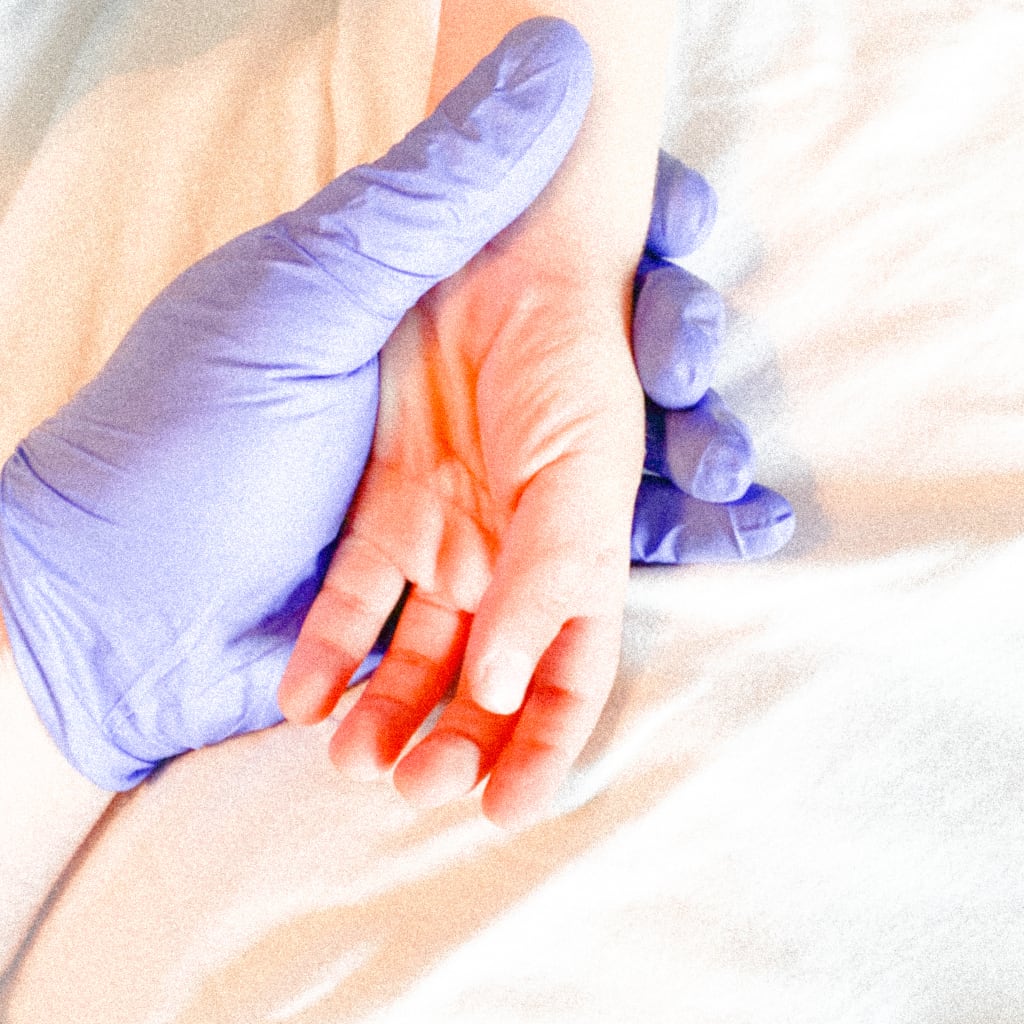
As another nurse and I bathed the boy, we said very little—hushed words within short sentences—just enough to coordinate our actions. Except for the gentle slosh of washcloths being dipped into the warm, sudsy water, the room was quiet. I remember that he was a slight boy—not more than forty pounds—but inert as he was, he felt much heavier. I held his little, limp hand in mine and lifted his arm as another nurse gently scrubbed underneath. My blue glove contrasted sharply with his light, almost translucent skin.
I had been nervous about what the experience of bathing a deceased child would be like, apprehensive about how it would feel to touch the skin of a dead person: the coldness, the weight, death so palpable in my hands. What I have learned is that when you wash the body of the dead, they don’t help you. They do not respond to a gentle tug. The playful roll-over command is lost into the ether. They don’t fight you either. There is no splashing or wriggling. Nothing. You do everything for them. This act is surprisingly challenging and usually requires two nurses—one to hold and one to wash. For a short time, we become a child’s motor. We move them and we make them clean.
Many parents choose not to bathe the body of their deceased child and I understand why: the act of bathing their child is yet another torturous experience, among many that have already occurred and all those that will surely come. It is not therapy for them, just more pain.
For others though, this difficult act is a necessary part of the healing process. I remember one mom who asked for water to be heated up so she could wash her teenage daughter shortly after she had passed. It had been a truly traumatic and painful death for this girl and her family. Just moments before, this mother had been lying on top of her daughter’s body, screaming in misery. I can still hear her piercing shrieks in my mind.
When the girl’s nurse brought the warm water to the bedside though, the mom was calm. She delicately dipped the back of her hand into the small plastic tub, checking the temperature. It was not right for her daughter, she decided.
“Could you please warm it up more?” she asked her nurse kindly. She then lovingly cleaned her daughter’s body. She washed her hair, blew it dry, and carefully styled it. Before her nurses brought the girl’s body down to the morgue, her mother gave her a manicure.
For those parents who choose to take part in it, I think this bath represents the last moment in which they may serve one who is dear to them. It is the final time they will physically commune with them too, touch them. They may not have been able to cleanse their child of their disease or the pain and anguish which it brought, but they can clean their child’s body once their pain is over. They can wash away the dirt of a world that offered no reprieve and little kindness.
Although often powerless to prevent the death of our children, we can control how we interact with them when they are alive, and for a short time after they have died. I understand the compulsion to want to keep that control for as long as possible, to be useful in any way.
For me, the most important and fulfilling part of parenthood is being useful to my children. I cannot imagine having to let go of them sooner than expected. I would choose to hold on as well, even if just for one more bath.
When it has been my duty to care for a child in this way, I have tried to do so with the heart of a father—even before I actually was one. In all these interactions I have with these children lying before me, dead or still living, I treat them like they were my own. I learned how to do this—how to be this way—by following the example of the same nurse mentors who instructed me in the care of these patients as they lived. It was a lesson mostly without words.
When we bathe these children, we are gentle and kind. There is no hurry or haste. We may softly sing songs that we know they liked and once sang along with us. If they still have the hair on their heads, we brush it until it appears as they once preferred it to be. As we clean their limbs, torso, and face, we sometimes laugh or smile as we remember funny things they said or did. We talk to these kids too—like we would have when they were still alive—and we are content when they do not reply as they once might have.
“I’m going to clean your face now, sweetie,” I remember saying once to a child who could not possibly answer back.
Even while engaged in such care at the hospital, I don’t stop being a dad. When I leave for home, I don’t magically cease being a nurse. These two roles have somehow joined together to form the imperfect whole that is me. Although the synergy can be disorienting, it also feels completely natural.
At the end of a day like this, I return home and, along with my wife, bathe our own children, read them stories, and put them to bed. It is a ritual that is equal parts utilitarian tumult and pure, floating fun. It is a raucous, giggly, occasionally tearful, definitely more water on the bathroom floor than in the tub, shampoo-mohawk filled affair. As my kids flip and flounder in the too-small tub, their wonderfully healthy and intact bodies splashing each other and splashing me, I sometimes lack the necessary parental stamina and patience to make it all the way from wet and soapy to dry with pajamas on.
“STOP SPLASHING YOUR BROTHER!” I order my daughter. The small, echoey space of the bathroom makes my command sound much louder and rougher than I intended it to be. It doesn’t seem to matter though. She ignores me.
Her younger brother, who was red-eyed and crying just moments earlier, is giggling now too, splashing back. My kids are nudists by nature, and this bath time—this wet, naked chaos—is their happy place. No matter how soaked or pissed off I may be, it is my happy place too.
As I dry off my son’s plump, cherubic body, I marvel at how healthy and strong he feels in my arms. Still holding him, I regard the wet footprints tracked down the hall by the sylph-like girl who just rejected my towel. She is no longer in sight, but I can hear her causing wet trouble in another part of our house. As my irritation subsides, I realize what I have. Tonight, my kids are with me. Tonight, they are clean.
This essay was adapted from my upcoming book, Nurse Papa, a prescriptive and heartwarming book written from the perspective of a pediatric oncology nurse and father. Also, take a listen to Nurse Papa the podcast for more illuminating stories of parenthood.
About the Creator
David Metzger
David is a pediatric oncology nurse and father. His book, titled 16 Meditations On Parenthood From A Pediatric Oncology Nurse, will be available August 2021 from GenZ press.
David is also the host and creator of the Nurse Papa podcast.
Keep reading
More stories from David Metzger and writers in Families and other communities.
The Sport Of Parenting
Just this morning, my three-year-old son threw a shoe at my head. We were out all together at a restaurant when it happened. I was not prepared for the footwear assault, but I probably should have been. What surprised me most was not that my dear son chose to beam me with one of his gross, mud-encrusted shoes, but rather that he passed up many more enticing and accessible objects to maim me with. Directly within his toddler reach was a crumb-speckled butter knife, a plastic cup filled with primary-colored crayons, a full glass of water, and a very aerodynamically designed salt shaker—yes, the kind that looks like a rocket just dying to be launched into the heavens (or a dad’s face).
By David Metzger5 years ago in Families
Wise~Guys
— Look Behind what's in Front of You ~ Make Good Choices — Hey, So how you Doin'..! Made~Men — Mobster Movies romanticise a distinctive, elegant appearance, impeccable attire style, along with the 'Families' expressive lingo. Making their 'Bones' gave them Panache — with vintage fedoras, tailored pin-striped suits, mirror-polished wing-tip shoes adorned with tassels; with their 'Gun Moll' gorgeous dates on their arms.
By Jay Kantor16 days ago in Families
The quiet sound of families breaking
There is a kind of silence that is louder than any noise. It is the silence of a child waking in the night and realizing their parent is gone. It is the silence of a kitchen table with one chair suddenly empty. It is the silence of a home that still looks the same, but no longer feels the same. Across the United States, thousands of families live inside that silence. Not because of war. Not because of disaster. Not because of death. But because of policy.
By Kaylee Souther5 days ago in Families
Do You have a Support Network?
Life is harder when you’re on your own. Human beings are social creatures, and we usually feel better when we have support from a strong social network around us. For most people, it’s our families that hold us together like glue.
By Elizabeth Woodsabout 14 hours ago in Psyche




Comments
There are no comments for this story
Be the first to respond and start the conversation.