
Zodiac and Feng Shui (3): How Ba Zi Explains Personal Energy Beyond Zodiac Signs
Understanding how environment, time, and personal energy work together in traditional Chinese Feng Shui

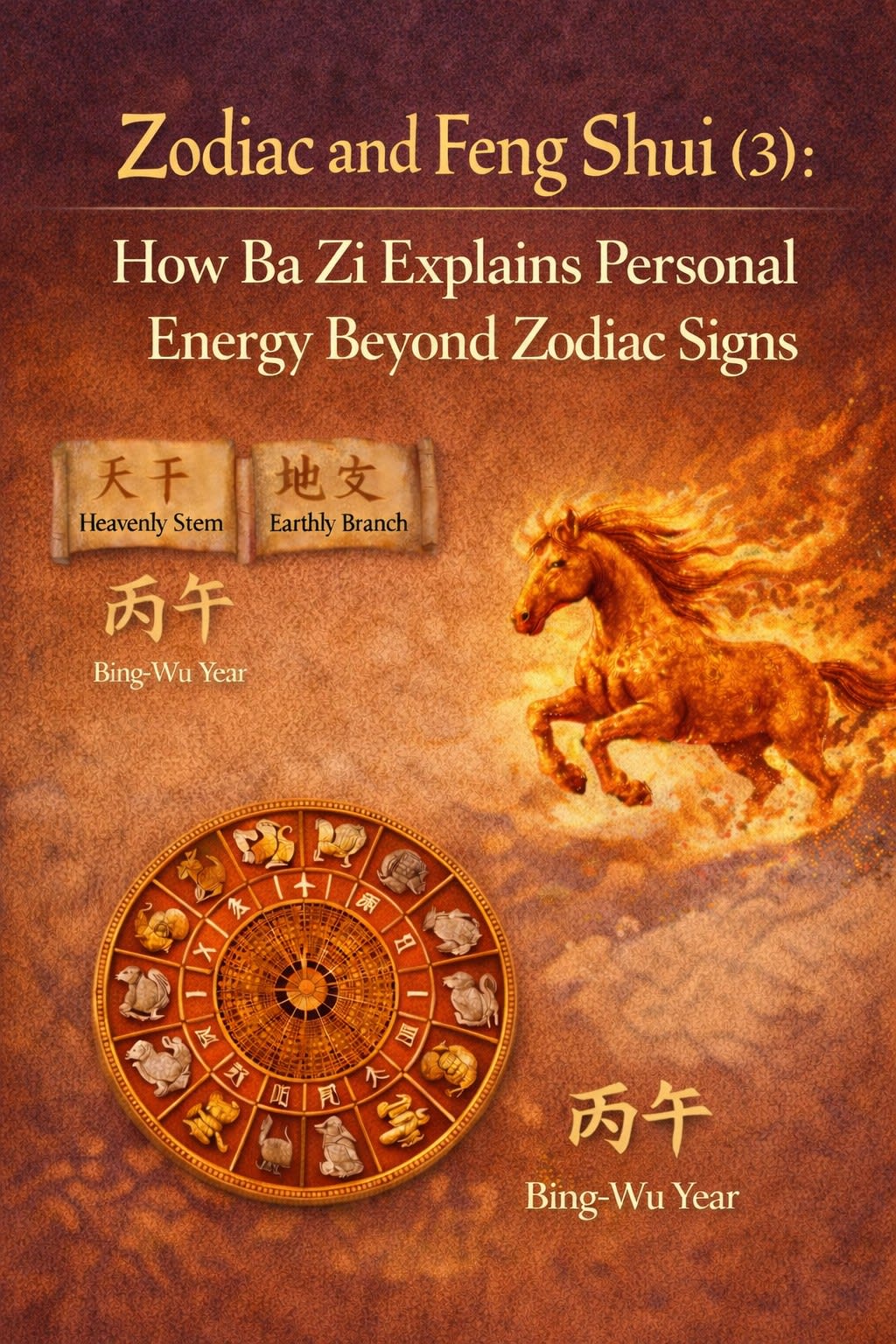
The Three Foundations of Practical Feng Shui
Practical Chinese Feng Shui consists of three main components: environment, time, and personal energy. Each plays a distinct role in shaping how Qi interacts with human life.
1. Environmental Qi: The Role of Form (Xing Shi)
The first component focuses on analyzing the environment in which we live. This includes surrounding geographical forms, the orientation of streets and avenues, and the layout of buildings around a residence. All of these physical and material forms generate their own energy fields, which influence the Qi of a building.
For example, a house located near the sea has a very different energy field from one situated on a mountain. Likewise, a residence in a dense urban center differs energetically from a detached home in a small town. These environmental distinctions play an important role in how Qi interacts with a living space.
The body of knowledge that studies environmental energy fields in Feng Shui is known as Xing Shi (形势), commonly translated as the Form School of Feng Shui.
2. Time and Qi: Seasonal and Cyclical Energy (Li Qi)
The second component examines how Qi changes over time and how these time-based energy shifts affect residential environments. The most intuitive example is the cycle of the four seasons within a year. From a Feng Shui perspective, natural seasonal changes are expressions of shifting Qi.
According to the Five Elements theory, seasonal transformation follows a clear energetic sequence:
• Winter embodies the cold quality of Water
• Spring reflects the growth of Wood
• Summer expresses the heat of Fire
• Autumn carries the contracting and sharp quality of Metal
These elemental energies circulate continuously, while Earth serves as the stable foundation underlying all seasonal change.
Such time-based energy shifts influence both people and their living environments. In Feng Shui, the study of Qi as it changes according to time cycles—whether annual cycles or longer periods such as twenty-year phases—is known as Li Qi (理气). In English, this branch is often referred to as the Compass School of Feng Shui.
3. Personal Energy: The Individual Dimension of Feng Shui
The third component focuses on an individual’s personal energy. Every person is born into—and lives within—a combined field of time and space, and is therefore naturally influenced by the Qi of both.
The study of personal Qi is fundamentally grounded in time-based energy patterns. Through this approach, an individual’s unique energy profile can be understood more precisely. The goal is to identify a person’s distinct Qi characteristics and then examine how personal energy interacts with environmental and temporal Qi.
By understanding this interaction, favorable influences may be strengthened while unfavorable factors are moderated, supporting a more balanced and harmonious life experience.
The most well-known system for studying personal energy in Feng Shui is Ba Zi, also known as the Eight Characters.
In traditional Chinese medicine, the primary focus is the human energy field itself. The body contains twelve main meridians through which Qi circulates, and practices such as Qigong and Tai Chi cultivate the regulation of Qi within these pathways.
Feng Shui, by contrast, examines the characteristics of the Qi field that interacts with human life through time, space, and environment.
In Ba Zi theory, the Eight Characters are arranged into four groups, each consisting of two Chinese characters. These four groups represent the energy of Year, Month, Day, and Hour, with each hour corresponding to a two-hour time unit.
Within each group:
• The Heavenly Stem represents universal or cosmic Qi
• The Earthly Branch represents Earth-based Qi
For example, a person born on January 19, 2009, at 11:00 a.m. would have the following Ba Zi:
• Wu–Zi (Year)
• Yi–Chou (Month)
• Jia–Zi (Day)
• Geng–Wu (Hour)
Traditionally, these characters are written vertically in four columns, visually resembling four pillars. For this reason, Ba Zi is also referred to as the Four Pillars system.
Wu Yi Jia Geng
Zi Chou Zi Wu
Why Zodiac Signs Represent Only One Part of Personal Energy
Every person has a unique Ba Zi chart. In total, there are 518,400 basic Ba Zi configurations. Within each chart, eight fundamental energetic components are formed through the combination of Heavenly Stems and Earthly Branches.
Using the example above, the eight energies are:
• Earth–Water (Year)
• Wood–Earth (Month)
• Wood–Water (Day)
• Metal–Fire (Hour)
What is commonly referred to as a Zodiac sign corresponds only to the Earthly Branch of the Year pillar—that is, the second character of the Year group. In other words, the Zodiac represents only one out of eight fundamental energy components within a Ba Zi chart.
Ba Zi theory contains a sophisticated framework for evaluating the balance of the Five Elements within an individual’s chart. Its purpose is to identify which energy is most critical for a person and to use this understanding to guide Feng Shui assessment. This is why traditional Feng Shui does not rely solely on the Zodiac when interpreting personal energy.
About the Creator
Lidong Yu
I am a Chinese Feng Shui consultant and educator, raised and trained in China. My work draws on classical Feng Shui traditions to help people better understand the relationship between themselves, their environments, and time through Qi.
Co-Parenting in the Digital Age
Co-Parenting in the Digital Age: Shared Circles, Alerts, and Neutral Tech Tools Modern co-parenting requires a modern toolkit. Beyond shared calendars, technology offers powerful ways to foster cooperation, ensure consistency, and prioritize your child's safety. The right digital approach can reduce conflict and create a more stable environment for everyone.
By Olivia Martinez6 days ago in Education
10 Unconventional but Highly Effective Ways to Learn French Faster
Most people who want to learn French all start in the same place. Grammar books, rules, written exercises, conjugation tables, structured courses, and the reassuring feeling of “making progress.” Yet after months, sometimes years, many are still unable to hold a real conversation. They hesitate, translate in their head, search for words, lose confidence, and eventually conclude that French is simply too complicated for them.
By Bubble Chill Media 5 days ago in Education


Comments
There are no comments for this story
Be the first to respond and start the conversation.