
Your Step-by-Step Guide to Academic Writing Success
Understand the Assignment
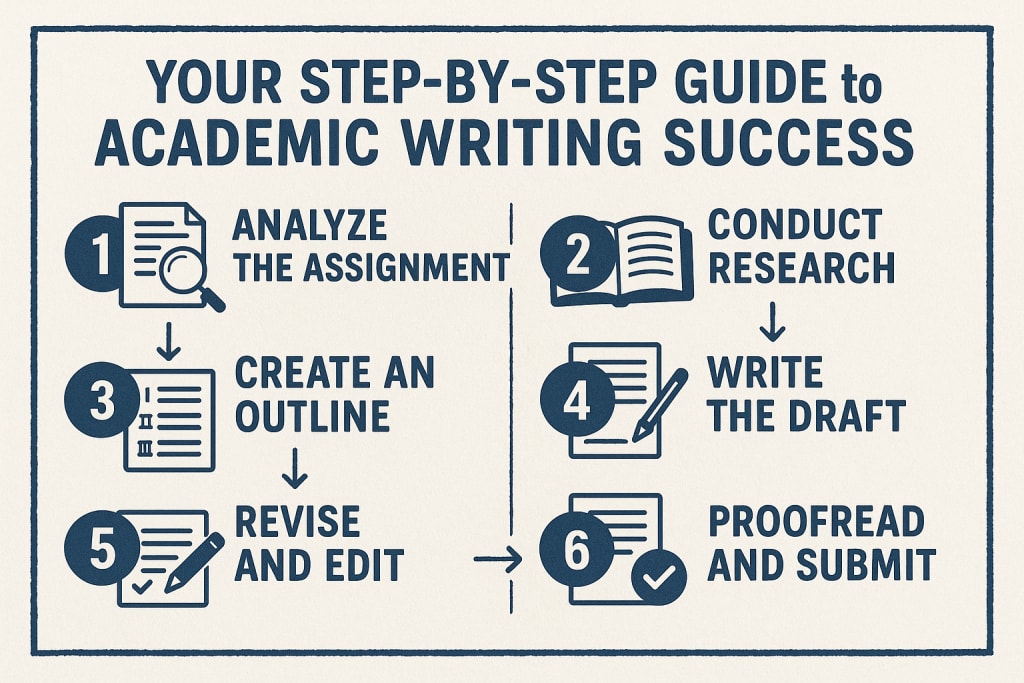
Academic writing is a key part of school, college, and university life. Whether you’re writing an essay, report, research paper, or even a short reflection, you’re expected to follow certain rules. But many students find academic writing stressful and confusing—especially when they’re not sure where to start or how to stay on track.
This guide will walk you through each step of the academic writing process in a clear, simple way. No complicated terms. No overused motivational phrases. Just real help that works.
Step 1: Understand the Assignment
Before you write anything, make sure you fully understand what the task is asking. Read the assignment brief carefully.
Ask yourself:
- What is the topic or question?
- What type of paper do I need to write (essay, report, review, etc.)?
- How long does it need to be?
- Are there any special formatting rules?
- When is it due?
If you’re unsure about anything, ask your teacher or professor. It’s better to ask early than to guess and get it wrong.
Step 2: Do Basic Research
Once you understand the question, start your research. Use your textbook, class notes, and trusted online sources to collect background information.
Make sure you:
- Stick to reliable sources (books, academic journals, official websites)
- Write down where you found your information (you’ll need this for citations)
- Look for different viewpoints—not just one side
You don’t need to collect everything in one go. Just start building a basic understanding of your topic so you can plan your argument or response.
Step 3: Plan Before You Write
Jumping straight into writing is a common mistake. A good plan helps you stay focused and saves time later.
Here’s a simple way to plan:
- Introduction – What’s the topic? What will you say about it?
- Body Paragraphs – Each paragraph should cover one main idea with examples
- Conclusion – Summarise what you said and why it matters
Even a quick outline can help a lot. You’ll know what goes where, and your writing will be more organized.
Step 4: Write a Clear Introduction
Your introduction sets the tone. You don’t need to make it fancy. Just let the reader know:
- What topic you're discussing
- Why it's important
- What your main point (or thesis) is
Keep it short and simple. Avoid trying to sound too smart or using big words you wouldn’t normally use.
Step 5: Build Strong Body Paragraphs
Each paragraph in the main part of your paper should focus on one idea.
Here’s a simple structure:
- Topic sentence – What is the paragraph about?
- Explanation – Explain your point in clear language
- Evidence – Support it with facts, quotes, or examples
- Linking sentence – Show how it connects to the next point
Use smooth transitions like “Also,” “However,” “On the other hand,” or “This shows that…” to make your writing flow.
Step 6: Write a Solid Conclusion
Your conclusion is your last chance to leave an impression. But don’t repeat everything word for word.
Instead:
- Restate your main point in a fresh way
- Summarise your key ideas
- End with a short comment or thought (but don’t add brand-new information)
Think of the conclusion as a neat ending—not a full summary.
Step 7: Use the Right Referencing Style
Referencing (also called citation) is how you give credit to the sources you used. It’s a key part of academic writing and helps you avoid plagiarism.
There are different styles like:
- APA
- MLA
- Harvard
- Chicago
Always check what your school or university prefers. Use tools like Google Scholar, Scribbr, or citation generators—but double-check them, as they sometimes make mistakes.
Step 8: Edit and Proofread Your Work
Once your first draft is done, take a short break. Then come back and read your work carefully.
Look for:
- Spelling and grammar mistakes
- Unclear or awkward sentences
- Repeated points
- Missing citations
You can read it out loud or ask a friend to review it. If your writing tool has a spell checker, use it—but don’t rely on it 100%.
Step 9: Format It Properly
Most assignments have specific formatting rules. These include:
- Font size and type (usually Times New Roman, 12pt)
- Line spacing (often double-spaced)
- Page numbers
- Title page
- Margins
Follow the instructions you were given. A well-formatted paper looks professional and is easier to read.
Step 10: Submit on Time
This one’s simple but important. Don’t miss your deadline. Always try to finish at least a day early, so you have time to check everything one last time.
Save your file with a clear name, and upload it according to your school’s submission process—either through email, an online portal, or a learning system like Moodle or Canvas.
Bonus Tips for Success
- Stay organised – Use a calendar or planner to track deadlines
- Start early – Give yourself plenty of time for research and revisions
- Ask for help – It’s okay to ask your teacher, tutor, or a writing expert
- Practice often – The more you write, the easier it becomes
- Avoid copying – Always write in your own words and give credit when needed
Final Thoughts
Academic writing doesn’t have to be complicated. It’s really just about clear thinking and clear communication. If you take your time, stay organised, and follow each step, you’ll be able to write strong assignments and essays—without all the stress.
And if you're still struggling with writing or want someone to check your work, there's help available.
👉 Visit OnlineAssignmentsHelp.com for expert support with academic writing, assignments, essays, research papers, and more.
Whether you’re in high school, college, or university, they can help you write better and feel more confident about your work.
About the Creator
Lisa Ray
Lisa Ray is a seasoned academic and career guidance expert who shares her wealth of knowledge through her blog at https://careersaid.com/. With a strong academic background and extensive experience in the field, she offers practical advice.
The Electric Command Center: China’s $7 Billion EV Fleet Revolution (2026-2034)
In 2026, the silhouette of the Chinese skyline is defined not just by skyscrapers, but by a quiet, invisible revolution. The traditional roar of diesel engines in logistics hubs from Shenzhen to Shanghai is fading, replaced by the high-tech hum of a fully electrified commercial world. But the true story isn't just about the vehicles; it’s about the "intelligence" managing them.
By Neeraj kumar4 days ago in Education



Comments
There are no comments for this story
Be the first to respond and start the conversation.