
Why Venture Capital Is Shifting Toward Deep Tech Startups?
After more than a decade dominated by consumer apps, marketplace platforms, and rapid user-acquisition models, venture capital is undergoing a noticeable reallocation of attention and funding toward deep tech — startups grounded in advanced science, complex engineering, and long development cycles — signaling a broader recalibration of risk, value creation, and technological ambition.

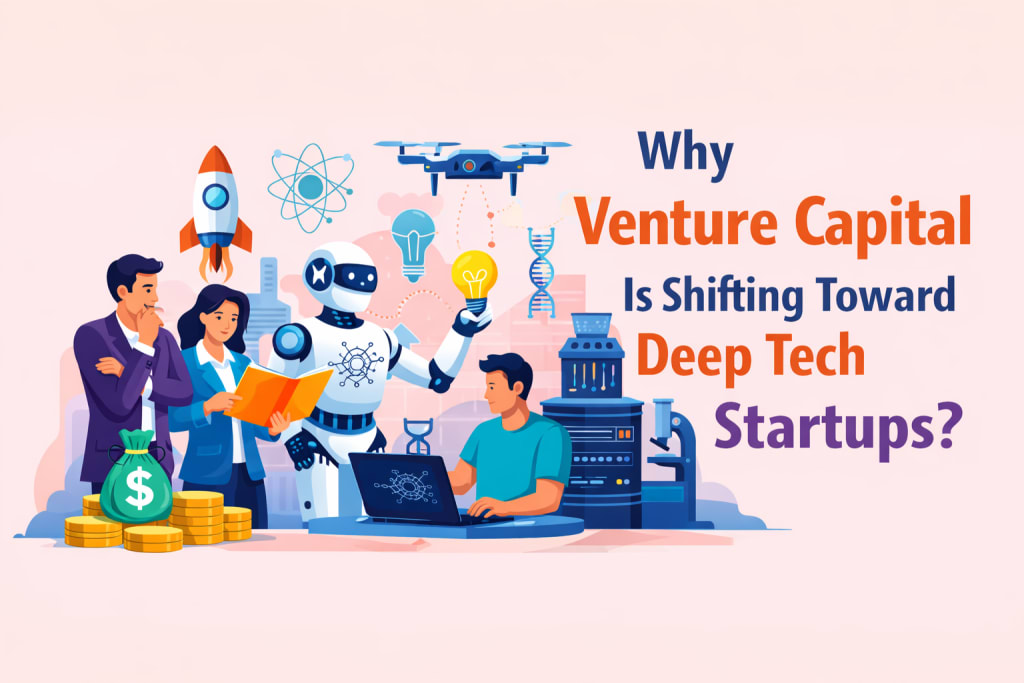
A few years ago, venture capital meetings often revolved around growth curves.
How quickly could users be acquired?
How efficiently could customer acquisition costs be lowered?
How soon could the company reach scale?
Today, a different kind of pitch increasingly commands attention. Founders speak not about viral loops but about quantum architectures, advanced semiconductors, fusion reactors, synthetic biology, and next-generation battery chemistry.
The timelines are longer. The prototypes are more complex. The risks are higher.
Yet capital is flowing in that direction.
The shift reflects more than changing tastes. It reveals structural adjustments in how investors perceive technological opportunity in a world where digital consumer markets have matured and geopolitical pressures have intensified.
The Saturation of the Consumer App Era
During the 2010s, venture capital poured into software platforms built on cloud infrastructure and mobile distribution. The economics were compelling: low marginal costs, global scalability, and fast iteration cycles.
According to PitchBook data, software startups accounted for more than 40% of global venture funding between 2015 and 2020. Many required modest initial capital compared to hardware or biotech ventures.
Yet as markets matured, competition intensified. Customer acquisition costs rose. User growth plateaued in certain segments. Public market valuations for consumer-focused tech firms experienced volatility, especially after 2021.
CB Insights reported that venture funding for consumer internet startups declined by over 30% between 2021 and 2023, reflecting investor caution around crowded markets and compressed margins.
Capital began searching for new frontiers.
Deep Tech as a Response to Structural Challenges
Deep tech startups operate at the intersection of scientific discovery and commercial application. These companies often focus on areas such as artificial intelligence infrastructure, climate technology, advanced materials, robotics, aerospace, and biotechnology.
Boston Consulting Group estimates that global investment into deep tech exceeded $60 billion in 2023, with funding growing at an average annual rate of approximately 20% over the past five years.
Why the shift?
One reason is defensibility.
Deep tech ventures frequently rely on proprietary research, patents, and engineering barriers that are difficult to replicate. Unlike consumer apps that can be imitated rapidly, advanced semiconductor designs or novel drug platforms require years of development and specialized knowledge.
Investors increasingly value structural barriers over speed alone.
Geopolitics and Strategic Technology
Government policy has also influenced capital allocation.
The U.S. CHIPS and Science Act allocated more than $50 billion to semiconductor research and manufacturing. The European Union introduced initiatives to strengthen local production in advanced technologies. China continues investing heavily in AI, quantum computing, and electric vehicle supply chains.
According to OECD data, public funding for advanced technology research increased by more than 25% across major economies between 2020 and 2024.
Venture capital often follows public investment signals. When governments prioritize strategic sectors, private investors interpret that as long-term demand.
Deep tech aligns with national priorities around energy independence, cybersecurity, and supply chain resilience.
AI Infrastructure and Foundational Models
Artificial intelligence has become a central focus of deep tech investment.
While early AI startups focused on applications — chatbots, recommendation systems, and automation tools — recent funding has increasingly targeted infrastructure providers building foundational models, specialized chips, and AI deployment frameworks.
Dealroom reports that AI infrastructure startups saw funding increase by more than 80% year-over-year in 2023, outpacing application-layer companies.
Training large AI systems requires specialized hardware and advanced research capabilities, creating capital-intensive opportunities that differ from traditional software ventures.
Investors see potential for long-term platform dominance in these foundational layers.
Climate Technology and Energy Innovation
Climate-related deep tech ventures have also attracted significant funding.
BloombergNEF reports that global investment in energy transition technologies reached nearly $1.8 trillion in 2023, spanning renewable power, electric transport, hydrogen systems, and carbon capture.
Venture firms increasingly allocate funds to startups developing battery chemistry breakthroughs, grid optimization technologies, and sustainable materials.
These sectors require extended research timelines and regulatory navigation, but they address structural global challenges.
Longer development cycles are no longer viewed as deterrents. They are viewed as necessary commitments.
The Changing Risk Appetite of Investors
Deep tech requires patience.
Unlike traditional software startups that may launch minimum viable products within months, deep tech companies often spend years refining prototypes and securing regulatory approvals.
Yet research from the European Investment Bank indicates that deep tech ventures demonstrate higher average patent intensity and longer-term revenue durability once commercialized.
Investors are recalibrating risk models.
Instead of seeking rapid exits, many funds are raising longer-duration capital vehicles designed specifically for deep tech portfolios. According to Preqin, funds with 12–15 year lifespans have increased by more than 35% over the past five years.
Capital structures are evolving alongside technological ambition.
Talent Migration and Research Commercialization
Universities and research labs have become key sources of startup formation.
MIT and Stanford collectively generated hundreds of spinout companies in the past decade, many focused on advanced materials, robotics, and biotech.
A National Science Foundation report indicates that commercialization of federally funded research projects increased by approximately 18% between 2019 and 2023.
Venture capital firms are building closer relationships with academic institutions to identify promising breakthroughs earlier in development cycles.
The boundary between research and entrepreneurship is narrowing.
Market Cycles and Return Expectations
Public market dynamics also influence venture allocation.
When technology stocks experience volatility, investors reassess valuation models tied primarily to user growth and advertising revenue. Deep tech startups offer alternative growth narratives centered on industrial applications, enterprise contracts, and government partnerships.
Morgan Stanley analysts observed that investors increasingly differentiate between application-layer companies and infrastructure-layer innovators when evaluating long-term resilience.
Deep tech often occupies the infrastructure layer.
The Role of Regional Ecosystems
Regional hubs are adapting to the shift.
Cities historically known for software startups are expanding into robotics labs, semiconductor research facilities, and clean energy incubators.
Even companies operating in mobile app development Portland and similar tech communities are witnessing adjacent growth in AI hardware startups, climate-focused ventures, and advanced manufacturing collaborations.
The entrepreneurial landscape is broadening.
Challenges and Constraints
Despite enthusiasm, deep tech faces obstacles.
High capital requirements, regulatory hurdles, and long timelines create uncertainty. According to a McKinsey analysis, deep tech startups often require two to three times more initial capital than software-only ventures.
Supply chain constraints and specialized talent shortages can further complicate progress.
Yet investors appear willing to accept these challenges in exchange for structural defensibility.
A Reorientation of Technological Ambition
The venture capital shift toward deep tech reflects a broader reconsideration of what constitutes meaningful innovation.
Consumer platforms reshaped communication and commerce. Now investors are looking toward foundational technologies that influence energy systems, manufacturing processes, and computational capacity.
Deep tech does not promise instant virality. It promises durable capability.
As global challenges intensify — from climate change to cybersecurity to semiconductor supply chains — capital increasingly flows toward startups addressing foundational systems rather than surface-level applications.
The recalibration signals a new phase in the innovation cycle.
Where venture capital once chased scale above all else, it now appears more willing to finance depth.
And depth, in today’s technological climate, may prove to be the more enduring asset.
About the Creator
Keep reading
More stories from Mary L. Rodriquez and writers in Education and other communities.
Virtual Tours & AR: Selling Tampa Homes Through Mobile Apps in 2027
Not long ago, buying or selling a home meant scheduling appointments, driving across neighborhoods, and walking through multiple properties before making even a preliminary decision. The process was time-consuming, often inefficient, and heavily dependent on physical presence.
By Mary L. Rodriquez17 days ago in Education
The Role of Intuition in Expert Programming
In discussions of software engineering, expertise is often framed in terms of explicit knowledge: algorithms, data structures, distributed systems theory, or design patterns. While these are necessary foundations, they do not fully explain high-level performance. Expert programmers routinely make correct architectural, debugging, and design decisions with minimal conscious deliberation. This phenomenon is best understood as intuition—rapid, experience-driven pattern recognition operating beneath deliberate analytical reasoning.
By Gustavo Woltmann6 days ago in Education
One Game, Many Nations: The Power of Soccer in a Shared World
Soccer is more than a sport. It is a global language. In cities, towns, and villages around the world, people gather to play and watch the same game. They may speak different languages. They may follow different traditions. Yet they understand the rules of soccer. They share the same joy when a goal is scored. This is how soccer connects cultures across the globe.
By Paul Wiedmaier5 days ago in Education



Comments
There are no comments for this story
Be the first to respond and start the conversation.