
Why Java Uses a Stack n Heap Memory Model
A Software Engineer’s Deep Dive Into How Java Actually Thinks
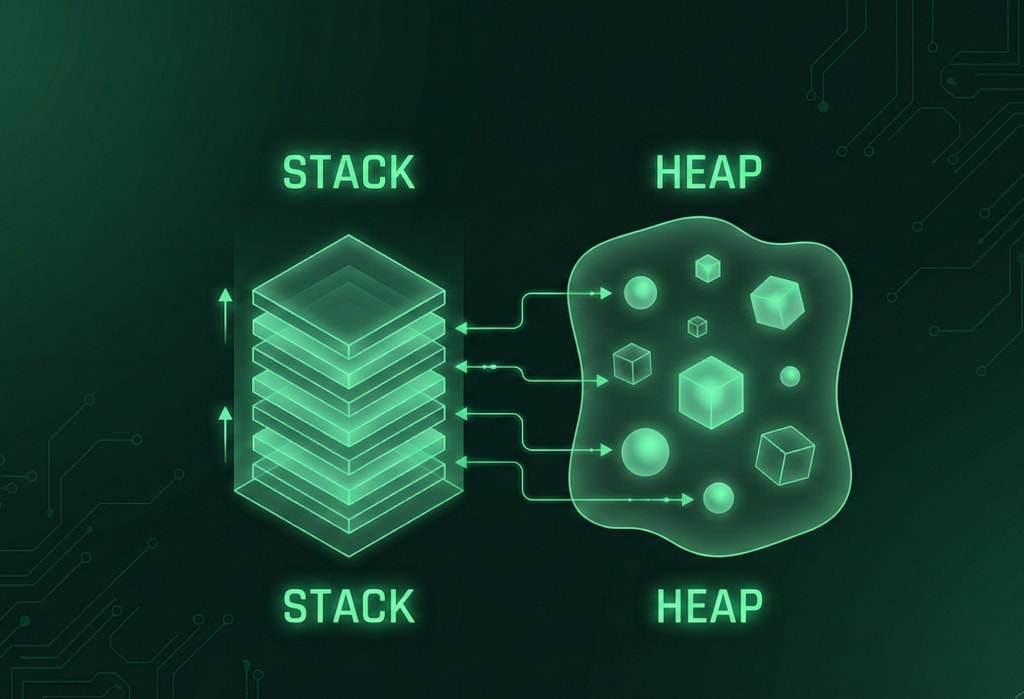
If you ve ever wondered why Java feels predictable stable, and strangely confident even when your codebase grows into thousands of files the answer traces back to one deceptively simple idea most developers overlook Java s stack + heap memory model wasn't an accident it is the backbone of everything that makes Java reliable, secure, and scalable
Yet many developers treat stack and heap like buzzwords instead of understanding the architecture level reason they exist the problems they solve, and how they shape every Java program at runtime. And if you are building a professional engineering career, this is the moment where understanding isnt optional anymore
Because here is the truth-
most of software engineers don t memorize syntax they understand memory
That is the difference between writing code and engineering software.
And once you truly see how Java uses stack frames reference passing object allocation and managed memory to enforce stability across threads platforms and hardware, you will start writing code like someone who understands the language at its core not someone reciting tutorials
Today we are going on a journey from the simplest explanation to an architecture level deep dive into why Java uses a stack and heap model and why this decision is one of the reasons Java became the backbone of financial systems Android apps enterprise backends and global scale platforms
-----------------------------------------------------------------------------------------
Why Memory Models Matter
Before we get into stack frames references garbage collection or JVM internals let's begin at the ground level with the most important question…
Why do programming languages even need a memory model at all?
Because the CPU by default does not care about your objects classes algorithms or design patterns.
It sees memory as a long series of numbered storage slots primitive raw and completely literal
Without a memory model →
- Functions would not know where their variables lived
- Objects could overwrite other objects accidentally
- Threads could steal each other's data
- Memory leaks would swallow entire applications
A language needs rules strict rules if it wants to ensure safety efficiency and predictability
Java's answer to this problem is?
split memory into two regions with two very different purposes the stack and the heap
One is fast tiny and highly disciplined
The other is large flexible and designed for long lived data
-----------------------------------------------------------------------------------------
What the Stack Really Is Lets talk about it Beyond Textbook Definitions-
Most developers hear a basic description like-
The stack stores local variables and method calls
The stack stores local variables and method calls
That is true but ,it is so surface level
Here is the real truth-
The stack is the JVM s execution timeline →
Every time you call a method Java creates a stack frame a small structured block that contains
Method parameter
Local variables
The return address
Intermediate computation values
Think of a stack frame like a self contained notebook page documenting the execution of that method
When the method ends the notebook page is tossed away instantly
1.Stack memory is extremely fast
-Operations happen instantly (O/1)
-Creating a frame? One pointer move
-Deleting it? One pointer move
-No searching, no fragmentation no complexity
2.Stack memory forces clean boundaries
-Each function gets its own private space.
- No function can touch another function's local data
3.Stack memory cleans itself
-When a function ends its stack frame disappears automatically
-No garbage collector no cleanup delays
4.Each thread has its own stack
-Local variables never mix between threads
-No competition no conflict no sharing issues
This is why Java's stack is the perfect place for….
Primitive values
Method parameters
Simple short lived data
Computation steps
The stack is order speed safety and clarity
But the stack has a limitation
It cannot store complex objects or anything whose size or lifetime cannot be predicted

-----------------------------------------------------------------------------------------
That is where the heap comes in....
-----------------------------------------------------------------------------------------
Let's see What the Heap Really Is...
If the stack is a disciplined notebook the heap is a massive warehouse
-Objects live here because:
-Objects can grow
-Objects can shrink
-Objects can be referenced from anywhere
-Objects need flexible lifetimes
-Objects may outlive the method that created them
The heap is the memory region where---->
-Every object
-Every array
-Every instance of every class..... is stored
But here is the deeper insight most developers miss
Java does not let developers manually allocate or free memory
You don not decide where objects go or when they should die
That responsibility belongs to the garbage collector which walks through the heap identifies unused objects and reclaims memory.
Why does Java do this???
Because manual memory management leads to failures that cost companies millions
-Crashes
-Memory leaks
-Buffer overflows
-Double frees
-Security vulnerabilities
Java refuses to let developers destroy applications by accident
So objects live on the heap where they can exist as long as needed and references on the stack point toward them

This leads us to the most misunderstood part of Java's model
-----------------------------------------------------------------------------------------
The Truth About References in Java
Java never passes objects directly
It passes references to objects
A reference is simply an address - ->
a pointer like value stored on the stack that leads to an object stored on the heap
This design solves multiple problems at once-
1. No accidental duplication of large objects
Copying large structures lists, maps, arrays, classes is expensive
Java instead copies the reference which is tiny
2. No direct pointer arithmetic
You can not manipulate memory addresses directly like in C.
That means no security vulnerabilities caused by bad pointer math.
3. Objects stay where they live
Only references travel
Objects remain stable inside the heap ecosystem.
4. Garbage collection can track reachability
If no reference points to an object, the GC knows it is safe to clean up
This is why Java can confidently say
"You write code. I'll manage memory"
But the truth goes deeper
-----------------------------------------------------------------------------------------
Why Java Needs Both Stack and Heap not just one...
1.If a language tried to use only a stack
-Objects couldn’t outlive function calls
-Data sharing between methods would be impossible
-Complex structures like lists and trees couldn’t exist
2.If a language used only a heap
-Every operation would be slow
-Execution would lose the strict order required for function calls
-Temporary values would bloat memory unnecessarily
java solves this by combining both
stack = execution flow
Heap = object storage
Stack+Heap they form a memory model that is
-Fast
-Safe
-Portable
-Garbage collected
-Scalable
-Thread safe
This balance is the reason Java applications can run for months or years without crashing
-----------------------------------------------------------------------------------------
The Unseen Architecture Behind Every Method Call
Every method call creates a stack frame,
that frame stores,
-Method parameters
-Local variables
-Intermediate values
-A reference to the calling frame
And when a method calls another method, a new frame sits on top.This creates a chain that acts like a call trace in real time
And Stack frames give Java a deterministic execution path
-No guessing
-No random jumps
-No wild pointer chasing
The stack s strict structure is one of the reasons Java is predictable under concurrency, load, and recursion
-----------------------------------------------------------------------------------------
How the JVM Manages the Heap Internally
By now you know objects live in the heap
But the heap is not just one big pool
It’s divided into 3-
-Young Generation (short lived objects)
-Old Generation (long lived objects)
-MetaSpace (class metadata)
Why???Because most objects die young
-temporary Strings
-Iteration variables
-Request scoped objects
-Intermediate results
These objects typically live only for milliseconds
The GC is optimized to clean these up extremely fast
Meanwhile long lived objects like configuration models caches and application level services move to the Old Generation
This lifecycle based layout makes garbage collection →
-Faster
-Smarter
-More efficient
This is part of why Java can run enterprise apps with thousands of simultaneous users
-----------------------------------------------------------------------------------------
How Stack + Heap Interact
The real relationship between stack and heap
A method starts → New stack frame created
Inside it, you instantiate an object → Allocated on the heap
The reference to that object → Stored on the stack
Method ends → Stack frame discarded
If no references remain → GC cleans the object
Short lived, high speed---- stack values
Long lived flexible ------ heap objects
This model allows Java to support
Recursion
Multithreading
Large object graphs
High-performance caching
Complex business logic
All while preventing memory corruption

-----------------------------------------------------------------------------------------
Why This Memory Model Makes Java Perfect for Large Systems
This is where the deeper implications appear
1.Thread safety by design
Each thread gets its own stack so local variables are inherently thread safe
2. Predictable allocation
Stack allocations cost almost nothing
Heap allocations follow a strict GC optimized strategy
3. Security
No raw pointers
No memory tampering
No buffer overflows
4. Platform independence
The JVM abstracts platform specific memory behavior
The stack ++heap model stays consistent across all devices
5. High concurrency
Java s memory model ensures that multi threaded applications can run without stepping on each other s memory.
This is why Java ended up powering
- Banks
- Trading systems
- Telecom platforms
- Enterprise ERPs
- Android
- Large scale distributed systems
The memory model is not a detail it is the design advantage
-----------------------------------------------------------------------------------------
Memory Semantics, JMM & Concurrency
we need to step into the Java Memory Model (JMM)
JMM defines
How threads see memory
How writes become visible
How synchronization works
How volatile synchronized and atomic classes enforce rules
This ensures-
Predictable communication across threads
Safe publication of shared objects
Correctness under concurrency
Consistency across architectures
It is the bundle of rules that keeps Java stable when multiple threads run at high speed
-----------------------------------------------------------------------------------------
By now you understand the entire architecture so let’s summarize the insight like Software engineer would
Java uses a stack + heap memory model because it wants
- Fast execution
- Safe object management
- Predictable multithreading
- Automatic cleanup
- Consistent cross-platform behavior
- Reduced developer mistakes
The stack offers
- Structure
- Speed
- Determinism
- Thread isolation
- The heap offers:
- Flexibility
- Dynamism
- Object longevity
- Managed memory
The heap offers
- Flexibility
- Dynamism
- Object longevity
- Managed memory
Together, they produce a system that
- Runs forever without leaking
- Scales across threads
- Maintains strict safety
- Supports extremely complex object graphs
- Ensures platform independence
This model is not accidental
It is the reason Java evolved into an enterprise giant
Once you view Java through the lens of memory behavior your engineering ability jumps levels.
- You begin writing code that
- Avoids accidental object retention
- Avoids unnecessary heap allocations
- Designs APIs with referential behavior in mind
- Uses immutability strategically
- Respects thread boundaries
- Ensures GC friendly patterns
- Operates with internal predictability
The stack n heap model is not just an implementation detail
It is the foundational mental model of professional Java engineering
-----------------------------------------------------------------------------------------
Final Thought,
Java s memory model is a masterclass in architectural design...
combining low level performance with high level safety blending strictness with flexibility and enabling everything from Android apps to banking systems to run reliably at global scale
If you understand this model deeply you do not just understand Java you understand why Java became one of the most resilient languages in software history
And that is how you think like a Software engineer
About the Creator
Keep reading
More stories from writers in Education and other communities.
The Energy Pivot The State of Russia’s Oil and Gas in 2026
For decades, this was the "world's gas station": Russia's pipeline network to Europe was the veins of the world economy. By 2026, that aura is dull and those veins are rerouted out of Europe. Since the collapse of the Soviet Union, the Russian oil and gas sector is facing the largest structural change.
By Neeraj kumar5 days ago in Education
Do you really need to take 10,000 steps a day?
While most people avoid spending the night in jail, Jean Béliveau jumped at the opportunity. For the past three years, Béliveau had been walking from country to country, with the goal of circumnavigating the globe on foot. This required sleeping in tents, strangers’ homes, and the occasional jail cell along the way. But this morning, as Béliveau was ready to leave, the police chief, who had agreed to his sleeping arrangement, was nowhere to be found, and the guards weren’t buying his story. Few people have the time or desire to walk such extreme lengths.
By Munesh Yadavabout 7 hours ago in Education
A Dart at Dusk
Seconds ago, the sullen sun set on the two of us… my exuberant furry companion and me. A fresh breeze embraces us, delivering welcome relief from the day’s oppressive heat. His typical stumbling and staggering along — apace with a sloth — has turned into trip-trapping, high-stepping, almost skipping along.
By Angie the Archivist 📚🪶6 days ago in Petlife




Comments
There are no comments for this story
Be the first to respond and start the conversation.