
Why Experiential Learning Is Essential for Student Success
Bridging the Gap Between Theory and Practice to Prepare Students for the Real World

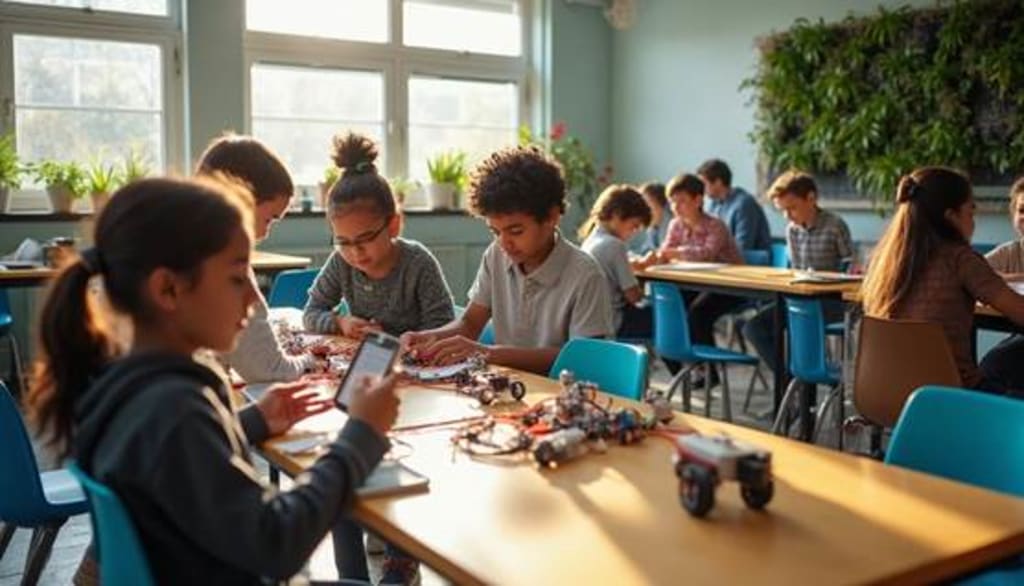
Experiential learning transforms education from passive absorption to active participation, making it indispensable for students preparing to enter an increasingly complex workforce. Traditional classroom settings often fall short in developing the practical skills employers demand, creating a significant gap between academic knowledge and real-world application.
Unlike conventional teaching methods, experiential learning emphasizes practice through real-life projects that connect theory with practical application. Project-based learning has gained significant traction because it places students at the center of their educational journey. The reasons for the success of PBL are clear - it develops critical thinking, collaboration, and problem-solving abilities simultaneously. Furthermore, this approach helps students retain information longer and understand concepts more deeply than through lectures alone.
What is Experiential Learning?
At its core, experiential learning embodies the ancient wisdom of "learning by doing" rather than merely absorbing information passively. American educational theorist David Kolb defined it as "the process whereby knowledge is created through the transformation of experience". Essentially, this approach emphasizes direct, hands-on engagement with subject matter, creating meaningful connections between theory and practice.
Definition and key characteristics
Experiential learning creates knowledge through a cycle of experience, reflection, conceptualization, and active testing. This process involves students directly interacting with materials and concepts rather than simply hearing about them. The approach is characterized by several distinct features:
· Hands-on engagement: Students actively manipulate objects, materials, and tools, experimenting and discovering through direct experience.
· Real-world application: Learning focuses on authentic problems and situations, helping students apply classroom knowledge to practical scenarios.
· Active participation: Learners take initiative, make decisions, and assume responsibility for results, often learning from natural consequences, mistakes, and successes.
· Reflection and feedback: Critical analysis of experiences helps transform concrete activities into meaningful learning.
· Collaboration: Students frequently work together, mirroring the collaborative nature of professional environments.
According to experts, experiential learning operates on six fundamental propositions. First, learning is best conceived as an ongoing process rather than in terms of outcomes. Second, all learning involves reexamining and testing previous ideas while integrating new knowledge. Third, learning requires resolving conflicts between differing perspectives. Fourth, it engages the whole person—intellectually, emotionally, and physically. Fifth, learning results from interactions between the person and their environment. Finally, learning creates knowledge rather than merely transmitting it.
How it differs from traditional classroom learning
Traditional classroom instruction typically positions students as passive recipients of information. Conversely, experiential learning places them at the center of an active discovery process. Consider this practical example: in a traditional setting, students might watch a demonstration of hammering a nail. In contrast, an experiential approach would take them to a construction site to actually hammer nails themselves, developing muscle memory and contextual understanding.
Traditional learning often emphasizes memorization of concepts and theories, with students functioning more as spectators than participants. In contrast, experiential methods encourage students to:
· Take initiative and make decisions
· Engage intellectually, emotionally, and physically
· Solve authentic problems
· Learn from mistakes and natural consequences
· Develop practical skills through direct application
The experiential approach also affects classroom dynamics. Unlike highly structured traditional environments where students might compete or remain uninvolved, experiential settings foster cooperation and mutual learning in a semi-structured atmosphere. Consequently, students often demonstrate greater motivation when they have a personal stake in the subject matter.
Why Experiential Learning Works
Research consistently validates that experiential learning delivers impressive educational outcomes across multiple dimensions. The evidence-based advantages of this approach explain why educators increasingly incorporate hands-on methods into their teaching strategies.
Boosts student engagement and motivation
The impact of experiential learning on student engagement is profound. Studies show that 81% of students want more hands-on learning opportunities in their curricula, while 80% of teachers express concern about current student engagement levels. This disconnect highlights a critical need that experiential learning directly addresses.
When students participate in real-life projects, they gain a sense of ownership over their education. This ownership transforms the learning experience from passive to active, significantly improving their intrinsic motivation. Indeed, students who engage with experiential learning demonstrate a statistically higher likelihood of applying coursework to everyday life compared to peers not involved in such approaches.
Furthermore, experiential learning creates opportunities for students to make choices and exercise autonomy throughout the problem-solving process. This freedom fosters personal investment in the subject matter, making students remarkably more responsible for their learning.
Encourages deeper understanding through doing
Traditional knowledge transfer often fails to create lasting understanding. Conversely, experiential learning enhances knowledge retention by engaging multiple regions of the brain simultaneously. As students apply theoretical concepts to practical situations, they form stronger neural connections with the material.
Through hands-on experiences, learners develop improved higher-order thinking skills and demonstrate greater complexity of understanding. Research documents statistically significant increases in students' critical thinking abilities and their capacity to analyze increasingly complex problems. This occurs because experiential learning requires students to actively investigate, experiment, pose questions, and construct meaning rather than passively receive information.
Real-World Examples of Experiential Learning
Across educational settings, practical applications of experiential learning showcase its effectiveness in diverse contexts. The following examples illustrate how hands-on approaches create meaningful learning opportunities in different disciplines.
Project-based learning in STEM
Project-based learning (PBL) has demonstrated remarkable success in STEM education. In a study involving 2,371 third-grade students, those in PBL classrooms outperformed their peers by eight percentage points on science tests. Notably, this improvement remained consistent across socioeconomic classes and reading ability levels, highlighting PBL's effectiveness for diverse student populations. Successful online platforms like Practity, are also an example of the effectiveness of PBL.
At its core, PBL connects academic content to real problems. For instance, in one compelling case study, environmental science students identified plastic pollution in their local river and established their county's first recycling program. This initiative allowed students to:
· Conduct surveys assessing community recycling knowledge
· Design outreach programs educating their community
· Develop operational procedures and schedules
· Monitor success through recycling audits and microplastic measurements
As we approach 2025, the educational landscape continues to evolve rapidly, making experiential learning not just beneficial but essential for student success. The coming years will bring unprecedented challenges and opportunities that traditional educational models simply cannot address adequately.
Adapting to a rapidly changing job market
The employment landscape in the next years will demand skills that experiential learning uniquely develops. By 2025, 85% of the jobs that today's students will hold haven't even been invented yet. Therefore, educational approaches must prepare students for roles that don't currently exist. Experiential learning addresses this challenge by developing adaptability rather than just specific content knowledge.
Furthermore, employers increasingly value practical experience over academic credentials alone. In fact, 93% of employers consider critical thinking, communication, and problem-solving skills more important than a candidate's undergraduate major. Hence, educational approaches emphasizing real-life projects provide students with demonstrable capabilities that transcend traditional academic achievements.
How Schools Can Make It Happen
Implementing experiential learning requires strategic changes across multiple educational dimensions. Schools must thoughtfully restructure their approach to teaching and assessment to create environments where hands-on learning can flourish.
Redesigning curriculum for hands-on learning
Successful curriculum redesign begins with backward design—first setting specific learning objectives, then planning activities to achieve those outcomes, and finally creating assessments that measure progress toward these goals.
When redesigning curricula, schools should incorporate:
· Inquiry-based learning opportunities where students investigate meaningful problems
· Cultural responsiveness that builds on students' diverse experiences
· Integration of social-emotional learning components
· Project-based activities that connect academic content to authentic problems
Training teachers to facilitate experiential methods
The role of teachers shifts dramatically in experiential learning—from knowledge transmitters to guides, cheerleaders, resources, and supports. Initially, many college faculty teach by lecturing simply because they never learned alternative methods.
Effective professional development must focus on helping educators:
· Develop skills in creating measurable learning outcomes.
· Learn to align curriculum with these outcomes.
· Master appropriate assessment tools and methods.
Conclusion
Experiential learning stands at the forefront of educational evolution. We've examined how hands-on approaches transform passive students into active participants who develop critical thinking, collaboration, and problem-solving abilities. These methods clearly outperform traditional classroom instruction creating meaningful connections between theory and practical application.
Research undoubtedly supports the effectiveness of experiential learning. Students demonstrate greater engagement, deeper understanding, and enhanced retention when they actively participate in their educational journey. Furthermore, this approach develops essential soft skills employers increasingly demand—communication, adaptability, leadership, and resilience—qualities that transcend specific content knowledge.
Given the rapidly changing job market, experiential learning becomes essential rather than optional. With 85% of future jobs not yet invented, students must develop adaptability alongside specific knowledge.
Schools committed to student success must therefore embrace curriculum redesign, teacher training, and alternative assessment methods.
After all, education should prepare students not just for exams but for life. Experiential learning accomplishes this goal by creating capable, confident learners ready to thrive in whatever future awaits them. Their success ultimately depends less on what they know and more on how effectively they can apply that knowledge to solve real problems—precisely what experiential learning delivers.
About the Creator
Keep reading
More stories from Daily Blog and writers in Education and other communities.
The Best Japanese Learning Books: A Complete Guide
Learning Japanese can be a rewarding experience, but finding the right resources to guide your journey is essential. Among the many tools available, textbooks remain one of the most popular and effective ways to learn. A good Japanese textbook will help you master everything from basic grammar to advanced sentence structures, while also providing essential vocabulary and cultural insights.
By Daily Blog7 months ago in Education
Beyond Speed: How High-Performance Computing Is Shaping Tomorrow’s Discoveries
High-Performance Computing is changing how people explore ideas, test theories, and solve complex problems. It allows machines to work together at great speed. These systems can handle tasks that are far too large for standard computers. As a result, High-Performance Computing and the future of discovery are closely linked.
By Jason Pruet3 days ago in Education
Designing a Meaningful Future: Strategic Planning for Mission-Focused Entrepreneurs
In today’s evolving business landscape, entrepreneurs are increasingly motivated by more than financial success. Many are building companies around a mission to create social, environmental, or community-driven impact. While passion and vision ignite these ventures, strategic planning transforms purpose into a lasting, scalable business. For mission-focused entrepreneurs, planning is not about restriction but about clarity, alignment, and sustainable growth.
By Mario Paynea day ago in Education



Comments