
When Time Stops: The Strange Reality of a Black Hole
Space

Where Physics Bends Reality
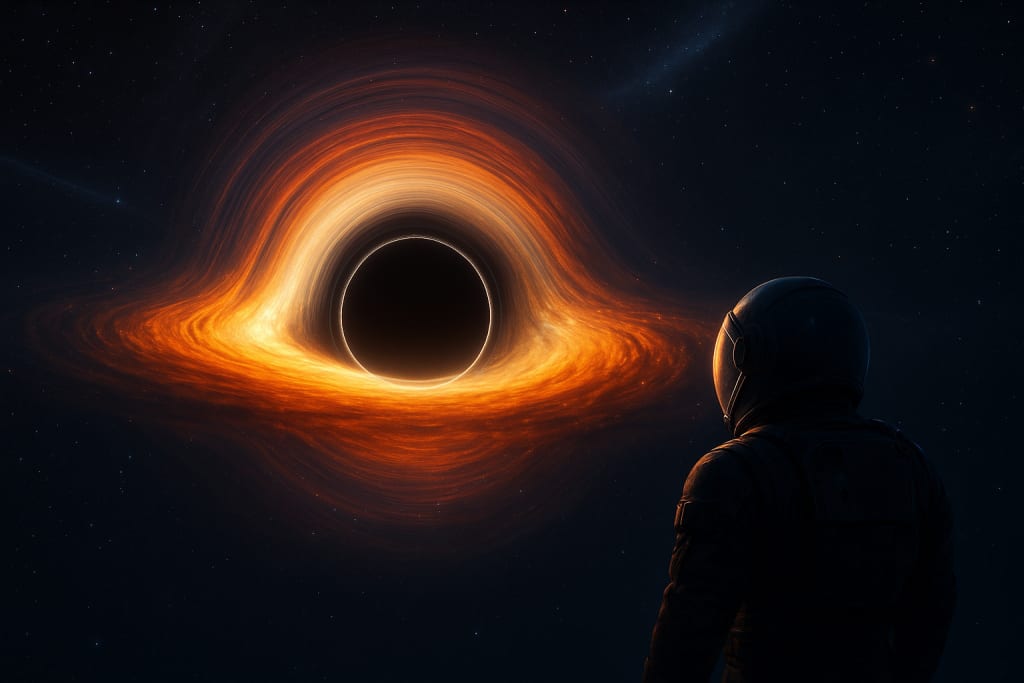
Imagine drifting through the endless dark of space, stars fading behind you, and ahead—an invisible monster: a black hole. It doesn’t shine, it doesn’t reflect light, but you feel its presence. Its gravity stretches space itself, bending everything toward its center. And here’s where the weirdest thing happens: for someone watching from afar, time itself appears to stop.
That’s not science fiction. According to Einstein’s theory of general relativity, time slows down in strong gravitational fields. And nowhere in the universe is gravity stronger than at the edge of a black hole — the event horizon, the point of no return.
A Cosmic Paradox: Time from Two Perspectives
Let’s imagine two friends: Alex, the brave astronaut, and Sam, watching from a safe distance aboard a spaceship. Alex decides to dive toward the black hole while Sam observes.
From Sam’s perspective, Alex’s descent becomes slower and slower the closer he gets to the event horizon. Every signal, every radio transmission, every flash of light from Alex’s suit becomes more stretched out in time. His movements slow to a crawl. His image fades, reddens, and eventually freezes right at the edge — like a cosmic pause button pressed forever.
But for Alex, inside his falling ship, nothing special happens at all. His watch ticks normally. He crosses the invisible boundary of the event horizon in seconds. There’s no sudden wall, no sense of stopping — only an unstoppable plunge into darkness.
How can both be true? That’s the beauty — and strangeness — of relativity. Time isn’t absolute. It depends on who’s measuring it, and where they are in the universe.
The Science Behind the Illusion
To understand why time “stops,” we have to remember what gravity really is. Einstein showed that massive objects like stars and planets don’t pull things through space — they curve space and time itself. A black hole, being the collapsed core of a massive star, creates an extreme curvature. The closer you get to it, the more space and time distort.
For an outside observer, the light waves coming from an object near a black hole get stretched — their wavelength increases, a phenomenon called gravitational redshift. The light literally loses energy as it struggles to escape the black hole’s gravity. As that redshift grows infinite at the event horizon, all signals slow down infinitely too. From our point of view, time at that point stands still.
But again, that’s just our perception. Inside the black hole, Alex’s time continues normally, though what happens next — whether he’s crushed at the singularity or enters another region of spacetime — remains one of the greatest unsolved mysteries of physics.
The Ultimate One-Way Trip
Here’s the unsettling part: Alex could never tell Sam what he sees beyond the event horizon. Not because of a malfunction, but because physics forbids it. Even light, the fastest thing in the universe, can’t escape. Once crossed, all paths lead inward.
It’s as if the universe hides its deepest secrets behind an unbreakable curtain. We can calculate what happens mathematically, but we can’t observe it directly. The black hole becomes a perfect cosmic vault, locking away everything inside — matter, energy, and even time itself.
Black Holes and the Flow of Time
This idea challenges how we think about time. We like to imagine time as a universal rhythm — ticking everywhere at once. But near a black hole, that illusion falls apart. Time stretches, bends, and fractures depending on where you stand.
In fact, the same effect happens on Earth, though at an almost imperceptible scale. Time flows slightly slower for you on the ground than for someone in an airplane. GPS satellites actually have to account for this difference to remain accurate. In space, Einstein’s equations aren’t just theory — they’re technology.
Beyond Science: The Philosophy of the Abyss
There’s something poetic about this cosmic trick. From our perspective, anything that falls into a black hole appears to freeze forever — immortal, yet unreachable. To us, Alex never truly vanishes; he just fades into stillness, his image forever suspended on the edge of eternity.
It raises a haunting question: if time can stop, what does “forever” really mean? Are black holes windows into the ultimate limits of existence — or reminders that our perception of reality is deeply incomplete?
Maybe that’s why black holes fascinate us so much. They’re not just astronomical objects. They’re symbols of the unknown — places where the rules we thought we understood collapse under their own weight.
At the edge of a black hole, science and philosophy meet. Time halts for us, yet flows for someone else. Reality fractures into perspectives, and we’re left staring into the void — wondering whether the end of time might be the beginning of something beyond our comprehension.
About the Creator
Keep reading
More stories from Holianyk Ihor and writers in Education and other communities.
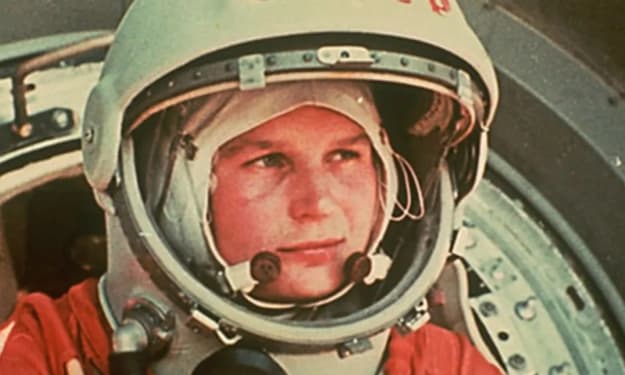
The First Woman in Space: Valentina Tereshkova’s Daring Journey Beyond Earth
In June 1963, the world watched in awe as a young woman from a small Russian village broke through the atmosphere and into the pages of history. Valentina Vladimirovna Tereshkova became the first woman ever to fly into space — a symbol of courage, progress, and human potential. Her mission aboard Vostok 6 wasn’t just a triumph of Soviet technology; it was a powerful statement about what women could achieve when given the chance to reach for the stars.
By Holianyk Ihor3 months ago in Education
The Education Situation: A Small Rant
A note: This is meant to be only a description of my thoughts and feelings towards education and my reflections on leaving the teaching profession. I understand every school/district/state/etc. is different, I am simply sharing my experiences having been a young teacher for 4 years here in Florida. For any other struggling teacher who reads this, you are not alone. I only set out to share my perspective with others who can relate and understand and to vent my frustration about a system that chewed me up and spit me out.
By Elise Spillera day ago in Education
The Rise of Online Learning in Education
Online learning has become a fundamental part of education. Many institutions now view it as essential: one report notes that 65% of colleges consider online programs critical to their strategic plans. This shift is driven by both technological advances and changing learner needs. Surveys confirm strong student demand for digital options – for example, a study found that 95% of undergraduates wanted at least one online course per semester. In other words, schools are expanding online offerings because doing so improves access and meets modern expectations, all while maintaining high-quality instruction.
By Kashif Khan7 days ago in Education


Comments
There are no comments for this story
Be the first to respond and start the conversation.