
The First Woman in Space: Valentina Tereshkova’s Daring Journey Beyond Earth
Space

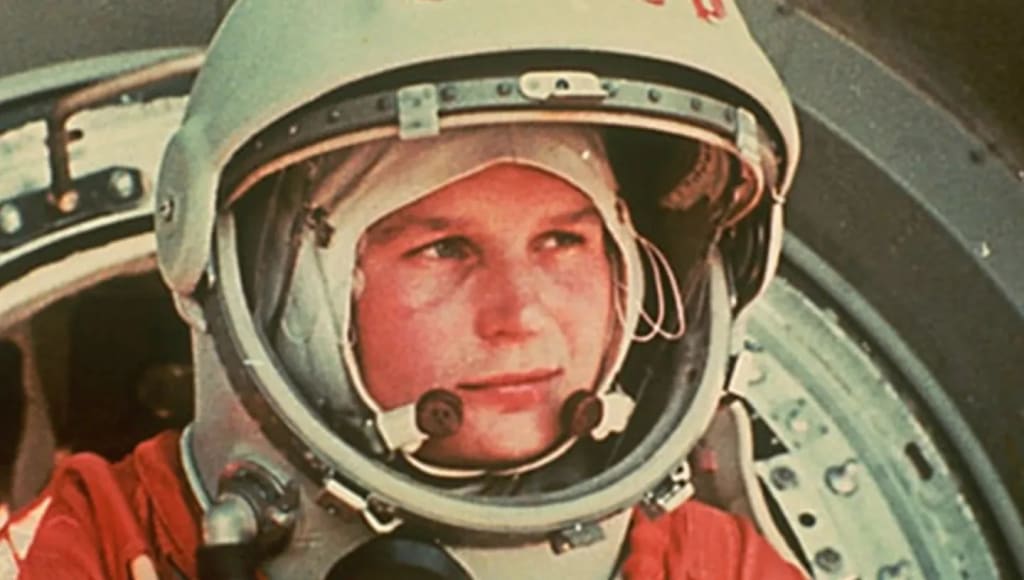
In June 1963, the world watched in awe as a young woman from a small Russian village broke through the atmosphere and into the pages of history. Valentina Vladimirovna Tereshkova became the first woman ever to fly into space — a symbol of courage, progress, and human potential. Her mission aboard Vostok 6 wasn’t just a triumph of Soviet technology; it was a powerful statement about what women could achieve when given the chance to reach for the stars.
From a Factory Floor to the Skies
Valentina Tereshkova’s story began far from the world of science and rockets. Born in 1937 in a humble village called Maslennikovo, in the Yaroslavl region of Russia, she grew up during difficult times. Her father, a tractor driver, was killed in World War II, and her mother worked long hours in a textile factory to support the family.
As a young woman, Valentina followed in her mother’s footsteps, working in the same factory. Yet she always looked upward — toward the sky. Fascinated by aviation, she joined a local parachuting club at the age of 22. Before long, she had completed more than 160 jumps. Her fearlessness in the air and her discipline made her stand out — qualities that would soon change her life forever.
A Secret Program for Space Pioneers
In the early 1960s, as the Space Race heated up between the United States and the Soviet Union, the USSR made a bold decision: to send the first woman into space. The goal was both scientific and political — to prove that socialism promoted gender equality and that Soviet women were as capable as men in the most extreme conditions imaginable.
Out of more than 400 applicants, five women were selected for training. They were all experienced parachutists with strong physical fitness and nerves of steel. Among them, Tereshkova quickly rose to the top. Her working-class background, personal resilience, and charisma impressed the selection committee and Soviet leader Nikita Khrushchev himself.
Training was grueling. The candidates endured extreme heat, cold, and isolation tests, learned spacecraft systems, and practiced parachuting in full space suits. Tereshkova passed every test. On June 16, 1963, she was chosen to pilot Vostok 6 under the radio call sign “Chaika” — meaning “Seagull.”
“This is Chaika. I’m taking off!”
At 12:29 p.m. Moscow time, Vostok 6 roared to life at the Baikonur Cosmodrome, lifting Tereshkova into orbit. She was just 26 years old. Over the next 70 hours and 50 minutes, she orbited the Earth 48 times, conducting experiments, taking photographs of the horizon and clouds, and keeping a space journal.
It wasn’t all smooth sailing. Tereshkova later revealed that the spacecraft’s navigation system had a serious error — it was programmed to move her away from Earth instead of bringing her back. Calm and focused, she reported the issue, allowing engineers to correct it from the ground. Throughout the mission, she also struggled with nausea, disorientation, and fatigue, but she refused to give up.
During the flight, she communicated with another cosmonaut, Valery Bykovsky, who was simultaneously orbiting Earth in Vostok 5. It was the first time two spacecraft had been in orbit at the same time with live communication between them — another milestone in space exploration.
When Tereshkova finally re-entered Earth’s atmosphere and parachuted safely down near Karaganda, Kazakhstan, she became a national hero overnight. Locals ran to greet her with flowers and bread, not quite believing that a woman had just fallen from the sky in a silver suit.
A Symbol of Courage and Equality
Tereshkova’s achievement went far beyond the technical success of her mission. She became a global icon — the embodiment of women’s empowerment and the Soviet ideal of equality. Streets, schools, and even a crater on the Moon were named after her.
She was awarded the title Hero of the Soviet Union, the highest honor in the country, and traveled the world as a representative of Soviet science. In one of her many speeches, she famously said, “Once you’ve been in space, you’ll never be the same again.” That sentiment captured not only her personal transformation but also the changing perception of women’s roles in science and society.
Life After Space
Although Tereshkova never flew to space again, she continued her work with the Soviet space program and later earned a degree in engineering. She became an active politician and advocate for space exploration and women’s rights. Even decades later, she has remained a beloved figure in Russia and around the world.
At age 70, she even expressed her dream of flying to Mars — “even if it’s a one-way trip,” she said with her trademark boldness. It was a reminder that her spirit of adventure never dimmed.
The Legacy of the “Seagull”
Valentina Tereshkova’s journey was more than just a first. It paved the way for dozens of women who would follow her into space — from Svetlana Savitskaya and Sally Ride to Mae Jemison and beyond. Today, women are astronauts, engineers, commanders, and scientists shaping the future of exploration.
Her legacy reminds us that courage doesn’t depend on gender or origin, but on curiosity, discipline, and the willingness to take risks for humanity’s progress.
More than sixty years later, when we look up at the stars, we might still hear an echo of her voice calling from the heavens:
“This is Chaika. Everything is fine.”
About the Creator
Keep reading
More stories from Holianyk Ihor and writers in Education and other communities.
Sixteen Sunrises a Day: Life in Orbit at 28,000 Kilometers an Hour
Every morning on Earth begins with a familiar scene — the sky softens, colors bloom, and the Sun slowly lifts above the horizon. But imagine seeing not just one sunrise or sunset a day, but sixteen of each. That’s the daily reality for astronauts aboard the International Space Station (ISS).
By Holianyk Ihor3 months ago in Education
Creating a Calm and Confident Path Toward Retirement
Retirement planning often feels intimidating, especially when people imagine complex calculations and uncertain outcomes. However, when you approach the process with clarity and patience, it becomes far more manageable. Instead of focusing on stress, thoughtful planning helps you feel confident about the future you are building.
By Michael Petruska4 days ago in Education




Comments
There are no comments for this story
Be the first to respond and start the conversation.