
When Alliance Meets Fracture: The U.S.–Israel Relationship in the Gaza War
The U.S.–Israel Relationship in the Gaza War

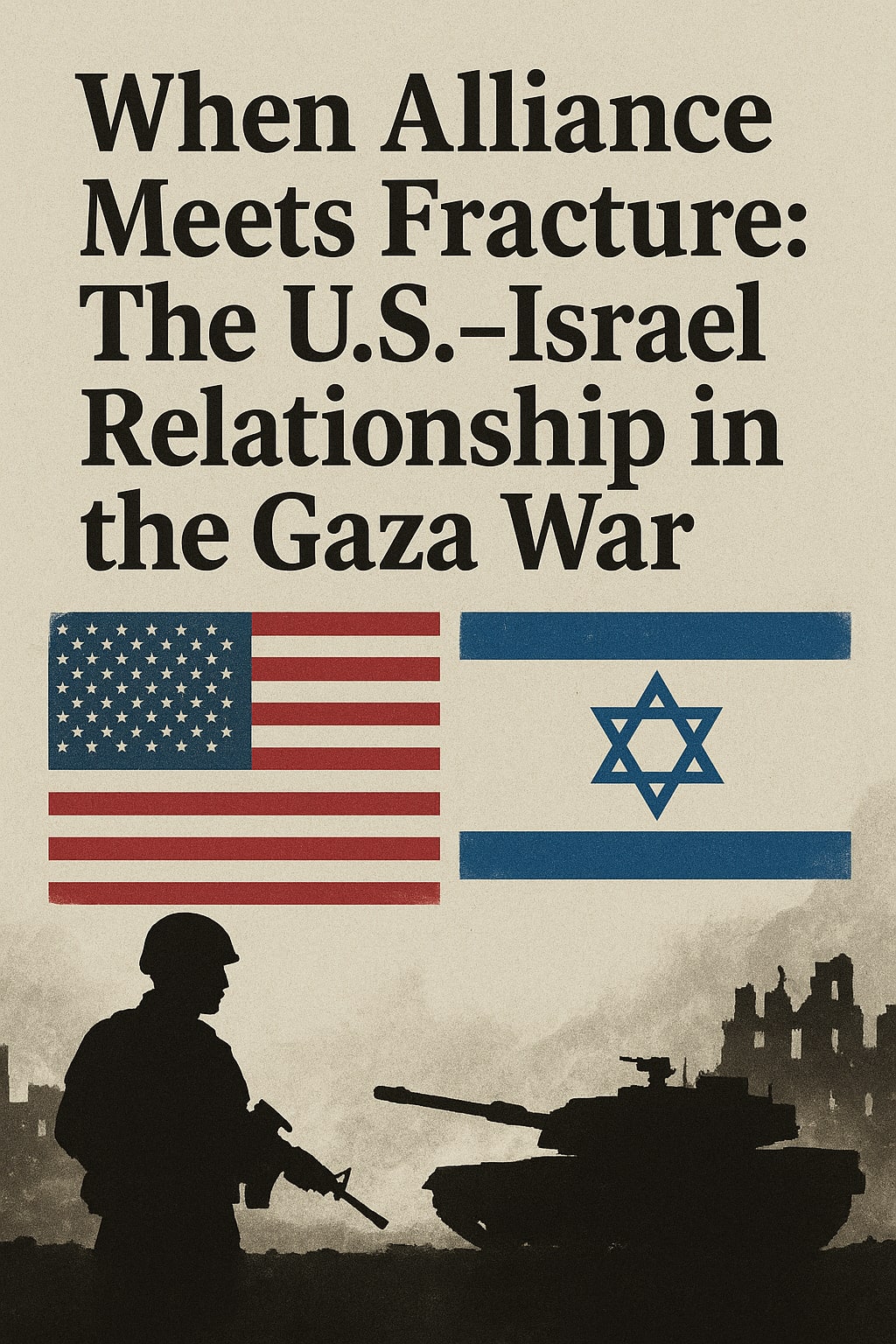
For decades, the alliance between Israel and the United States has been described as “unshakeable.” But as the war in Gaza enters its third year, the nature of that alliance is being tested — not only by the strategic realities on the ground, but by questions of power, agency, morality and diplomacy.
A Two-Way Street of Support — and Dependence
The U.S. has long backed Israel militarily and diplomatically. In the recent war with Hamas, the U.S. dispatched naval and air assets, sped up weapons transfers, and repeatedly used its veto power at the United Nations Security Council to shield Israel from unanimous censure.
For Israel, that backing has provided strategic reassurance. But for many observers, it has blurred the lines of independence and accountability. The notion that Israel is somehow a “client state” of the U.S. has been floated increasingly in the media and diplomatic discussions. That language sparked push-back this week, when Israeli Prime Minister Benjamin Netanyahu dismissed the idea as “hogwash,” and U.S. Vice President J.D. Vance publicly reaffirmed that Israel is an ally — not a vassal.
From Solidarity to Strain
The 2023 October 7 attack by Hamas marked a dramatic escalation. Israel opened a major military campaign in Gaza, and the U.S. response was swift and unequivocal. What followed, however, has strained the alliance in less visible ways.
One key shift: American public opinion. A recent survey by the Pew Research Center found that 39% of U.S. adults say Israel is going too far in its military operation against Hamas — up from 27% in late 2023. Meanwhile, only 16% say Israel is taking about the right approach.
On the Israeli side, the government is simultaneously pushing post-war plans—such as annexation bills for the West Bank—that complicate U.S. diplomacy. For the United States, the war is increasingly being viewed through the lens of global reputation, humanitarian credibility and balance in the Middle East.
The Ceasefire and the Diplomatic Tightrope
In mid-October 2025, a cease-fire brokered by the U.S., Egypt, Qatar and others came into effect in Gaza. As part of the deal, discussions shifted from open warfare to reconstruction, disarmament of Hamas (or at least containment), and the question of Gaza’s future governance. The U.S. is now visibly trying to reverse some of the narrative that it simply arms Israel and stands by.
Yet the cease-fire remains fragile. Vice President Vance admitted the path ahead is “very hard.” Meanwhile, Israel is resisting certain elements of American-backed plans—particularly the idea of a multinational peace-keeping or reconstruction force in Gaza, or Turkish involvement in it.
Aid, Accountability and the Humanitarian Question
One of the thorniest issues is humanitarian access. The International Court of Justice (ICJ) this week issued a non-binding opinion that Israel must allow the UN relief agency UNRWA to operate freely in Gaza, and uphold its obligations as occupying power. Israel disputes the findings, citing allegations of UNRWA links to Palestinian militant groups.
From the U.S. perspective, supporting Israel while remaining credible on human rights and international law is becoming a balancing act. Israeli military campaigns have created mounting civilian casualties and infrastructure destruction in Gaza. Publicizing support too visibly could undermine U.S. standing, while withdrawing too early risks alienating a key regional ally.
The Strategic and Geopolitical Stakes
Beyond U.S.–Israel bilateral ties, the war is part of a larger Middle Eastern chessboard. Iran, Hezbollah in Lebanon, regional Arab capitals, and global competitors like Russia and China all have stakes. The U.S. is seeking to shift its posture: less boots on the ground, more diplomatic architecture for stability. Analysts say the war has offered the U.S. an opportunity to begin “disentangling” from decades-old Middle East wars and refocusing on global competition.
Meanwhile, Israel wants to ensure that its future security does not become hostage to U.S. domestic politics. Netanyahu’s messaging—strongly asserting Israel’s independence—reflects concerns that political shifts in Washington might lead to strategic surprises.
Where the Alliance Stands Today
At its core, the U.S.–Israel alliance remains intact: shared democratic identity, heavy U.S. arms transfers, and close coordination on intelligence and defense. But the nature of the relationship is under evolution:
The U.S. is less willing to simply rubber-stamp Israeli policy without added caveats around humanitarian law and long-term strategy.
Israel is more insistent on acting as a sovereign actor—especially when it comes to Gaza’s future—and resisting what it perceives as external dictates.
U.S. public opinion and congressional sentiment are shifting; political cost for backing Israel unconditionally is rising.
Both parties now face increased pressure—from allies, adversaries and global civil society—to define the “after-war” scenario in Gaza, the West Bank and Israeli security beyond Hamas.
Looking Ahead: Pitfalls and Prospects
The biggest risk is that the cease-fire unravels, dragging the U.S. visibly back into direct confrontation. Equally risky: that Gaza remains a frozen zone of humanitarian crisis and reconstruction limbo. Either outcome could fracture the U.S.–Israel alliance if seen as failure.
On the positive side, the alliance could emerge stronger if the U.S. helps steer a viable political-economic reinvestment in Gaza, supports Israeli legitimate security needs, and simultaneously pushes for meaningful Palestinian governance reform. The alternative is drift: Israel operating unilaterally, the U.S. shifting focus elsewhere, and the Middle East becoming even more fragmented.
For platforms like Vocal, this moment offers a rich story: not just of war, but of alliances, shifting power dynamics, public opinion, and moral accountability. As the war evolves, so too must the narrative about who holds agency, what values guide intervention, and how partners like the U.S. and Israel redefine their relationship in a changing world.
Conclusion
The U.S.–Israel relationship in the Gaza war has moved from mutual certainty into nuanced tension. In an era of great-power competition and complex regional alignments, each side is recalibrating. The U.S. cannot simply fund and defend; Israel cannot simply fight and rebuild. The question now is how they act together to shape peace rather than war—and whether their alliance can adapt to the demands of this moment.
About the Creator
Keep reading
More stories from Fazal wahid and writers in Education and other communities.
Rich Dad Poor Dad: What the Rich Teach Their Kids About Money That the Poor and Middle Class Do
grew up with two fathers. One taught me how to work for money. The other taught me how to make money work for me. One said, “Go to school, get good grades, and find a safe job.”
By Fazal wahid 3 months ago in Education
Your phones camera isn't as good as you think
When the Visualphone VP210 hit the market in 1999, it advertised a never-before-seen feature: a camera. With only 0.11 megapixels and storage for 20 photos, the Visualphone is a relic compared to modern devices sporting three distinct cameras, each with up to 100 times more resolution. But while this technology has improved dramatically in the 21st century, engineers are rapidly approaching a hard limit on phone camera quality. To understand this limit, we first need to know how phone cameras work.
By Munesh Yadavabout 2 hours ago in Education
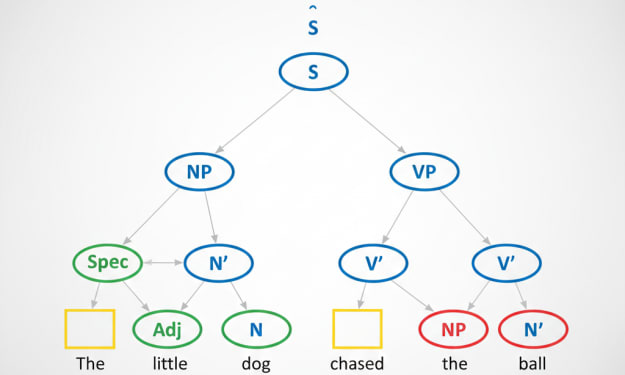
Mastering X-Bar Theory in Grammar in 10 Minutes
Grammar can often feel like a maze of confusing rules, especially when we dive into syntax — the study of sentence structure. One of the foundational tools in modern linguistics is X-Bar Theory, a framework that helps explain how words and phrases combine to form sentences. While it might sound intimidating, understanding X-Bar Theory can become straightforward if approached step by step.
By Games Mode Onabout 10 hours ago in Education
Miss Persephone's Manual to a Seemingly Ordinary Life
Miss Persephone was found at the dining table, her blue eyes swollen, her tears arriving and retreating like the tides of the ocean. Earlier that day, her family had visited her in the retirement home where she had lived for eight years. It was her eightieth birthday.
By Imola Tóth4 days ago in Fiction



Comments
There are no comments for this story
Be the first to respond and start the conversation.