
“What They Never Told Us About Critical Thinking”
“The Dangerous, Beautiful Skill That Changes Everything—If You Dare to Use It”
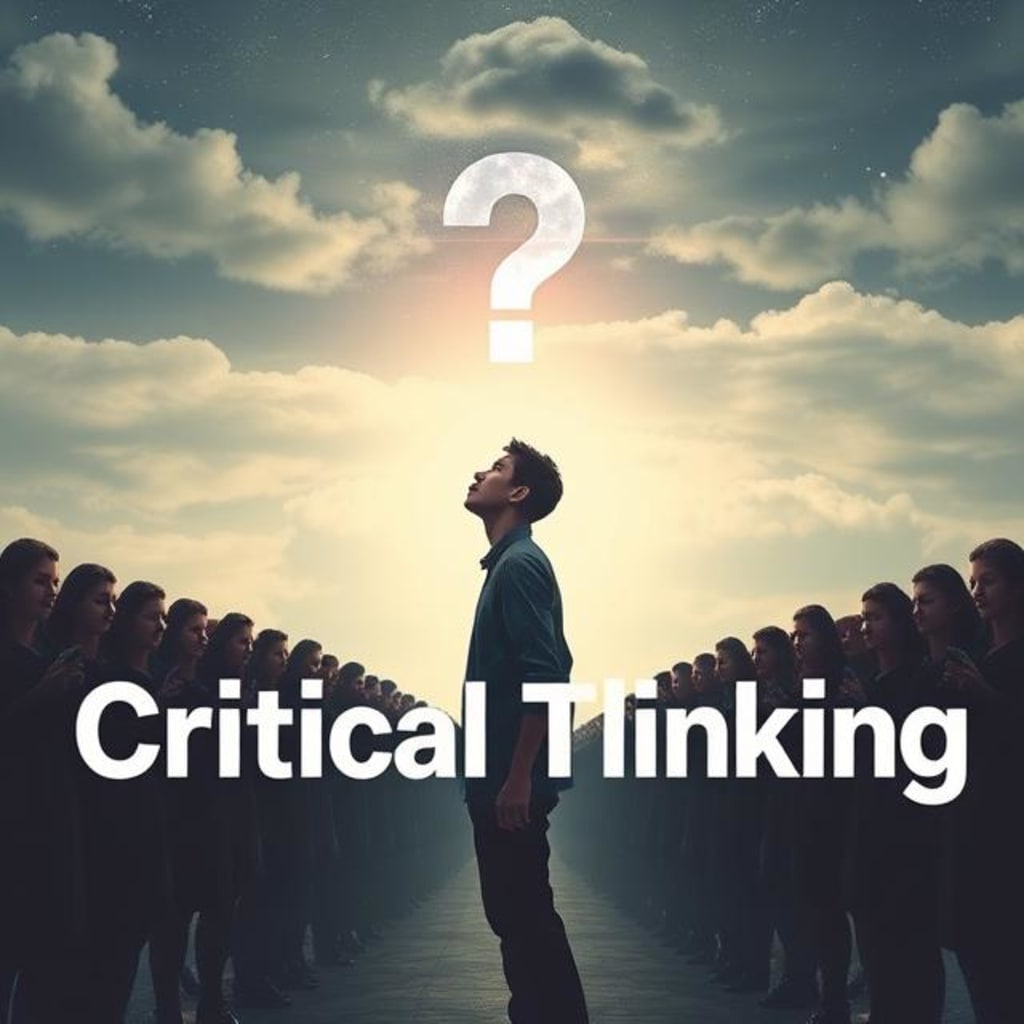
We were told to think.
We were told to analyze.
To solve problems.
To “use our heads.”
But what they never told us—what they conveniently left out—was that real critical thinking isn’t safe. It isn’t always comfortable. And once you start doing it, really doing it, there’s no going back.
I was 17 the first time I truly questioned something I was taught.
It was a history class. We were learning about colonialism, and the textbook summarized the British Empire’s global expansion as a "civilizing mission." Something about that phrase made my skin crawl.
I raised my hand and asked, “Did the people being colonized see it that way?”
My teacher paused. She gave me a look I couldn’t read. “That’s an interesting question,” she said. “Let’s stay on topic.”
And just like that, the door began to crack open.
Until then, I had done what I was told.
Raised my hand. Waited my turn. Memorized. Regurgitated.
I got A’s because I knew how to follow instructions.
But something shifted that day.
It wasn’t that I stopped trusting my teacher.
It’s that I started trusting my questions.
Over time, I began to see it everywhere.
In politics.
In textbooks.
In ads.
In sermons.
In conversations at the dinner table.
A pattern emerged:
We were surrounded by answers—
but rarely encouraged to ask the right questions.
They never told us that critical thinking could be dangerous.
They taught us formulas, not how to interrogate them.
They gave us headlines, not how to deconstruct them.
They told us what to believe, but never how belief is built.
I remember one day, during a debate unit in English class, we had to argue for or against a topic we were assigned. The teacher said, “You don’t have to agree with your side. Just argue it well.”
At first, it felt like a game.
But soon, it turned into something else.
I started to realize how easy it is to manipulate facts.
How a well-structured lie can sound like truth.
How confidence can eclipse accuracy.
It was thrilling—and terrifying.
So I asked myself the question that would change my life forever:
“What else have I accepted without thinking?”
The floodgates opened.
I questioned everything.
My faith.
My politics.
My assumptions about people I didn’t know.
My own identity.
Even my dreams.
It was messy. It was lonely. It was liberating.
Because when you start to think for yourself,
you start to realize how much of your life
has been built on borrowed thoughts.
No one warned us that critical thinking is a kind of rebellion.
Not the loud, flag-waving kind.
The quiet, internal revolt.
It’s the moment you read the fine print.
The moment you ask “Why?”
The moment you refuse to nod along.
It doesn’t make you popular.
It doesn’t make you the teacher’s pet.
Sometimes, it makes you the troublemaker.
In college, I majored in philosophy.
Not because I wanted to be a philosopher.
But because it was the only discipline
where questions mattered more than answers.
And in that space, I learned something crucial:
Critical thinking is not just about doubt—it’s about discernment.
It’s not cynicism.
It’s curiosity.
It’s asking better questions,
not just poking holes for sport.
It’s knowing that two things can be true at once.
That complexity is not confusion.
That admitting “I don’t know”
is often the beginning of real knowledge.
But here’s what they really never told us:
Critical thinking can cost you things.
It can cost you friendships.
Relationships.
Your sense of certainty.
Even your peace—temporarily.
Because once you begin to see,
you can’t unsee.
Once you begin to question,
you start to notice
how many people around you
don’t want to.
My cousin once said, “You always complicate things.”
She was right.
I didn’t want the easy version anymore.
I wanted the truth—even when it was inconvenient.
Especially then.
I learned that asking hard questions
can make people uncomfortable.
Especially when they’ve built their comfort
on not asking them.
But I also learned this:
Critical thinking is the birthplace of empathy.
When you begin to question your own beliefs,
you stop judging others so quickly.
When you realize how flawed your perspective can be,
you listen more—talk less.
And when you examine the roots of your opinions,
you begin to understand why others see the world differently.
It doesn’t mean you abandon your values.
It means you understand them more deeply.
You choose them with intention,
not inheritance.
They never told us that critical thinking is also a form of courage.
Because it takes bravery to change your mind.
To say, “I was wrong.”
To step outside the tribe and walk alone for a while.
But that bravery builds something priceless:
integrity.
And from that integrity comes wisdom.
Now, years later, I work in a field that thrives on questions.
I teach.
Not just subjects—but thinking.
I don’t reward answers; I reward thoughtfulness.
I tell my students what no one told me:
“Critical thinking will challenge everything you thought you knew.
But it will also give you back your mind.
And once you own your mind,
no one can ever take that from you.”
So here’s what I know now:
Critical thinking is a skill, yes. But it’s also a responsibility.
It’s not just for exams. It’s for life.
It will not always make things easier—but it will make them clearer.
And it’s one of the few tools that, when sharpened, cuts through noise, fear, and manipulation.
It is uncomfortable.
It is inconvenient.
It is beautiful.
What they never told us about critical thinking…
is that it can set you free.
But first, it will shake your foundation.
And that’s not a flaw—it’s the beginning.
About the Creator
Keep reading
More stories from Hamza Habib and writers in Education and other communities.
“I Failed Math—and It Made Me a Better Thinker”
For most of my school life, math was a monster lurking just beneath the surface—waiting to pounce every time I sat down for a test. I dreaded numbers, formulas, and the cold, precise logic that never seemed to fit into my world of ideas and imagination.
By Hamza Habib9 months ago in Education
Smart Strategies for Scaling a Coffee Bar Business
A thriving neighborhood coffee bar often begins with a simple mission: serve great coffee and create a welcoming place for people to gather. However, growth quickly introduces new challenges. Higher customer demand, operational complexity, and the need for consistent quality can stretch even the most passionate owners. Therefore, building a clear strategy early helps transform a small shop into a sustainable brand.
By Alexander Schifter4 days ago in Education
Using 3D Laser Scanning for Accurate Facility Upgrade and Renovation Planning
Facility upgrades and renovation projects require precise knowledge of existing building conditions. Many older facilities lack reliable documentation, and outdated drawings can lead to design conflicts, costly change orders, and construction delays.
By Matt Sharon4 days ago in Education




Comments
There are no comments for this story
Be the first to respond and start the conversation.