
“I Failed Math—and It Made Me a Better Thinker”
“How Struggling with Math Taught Me Creative Problem-Solving”
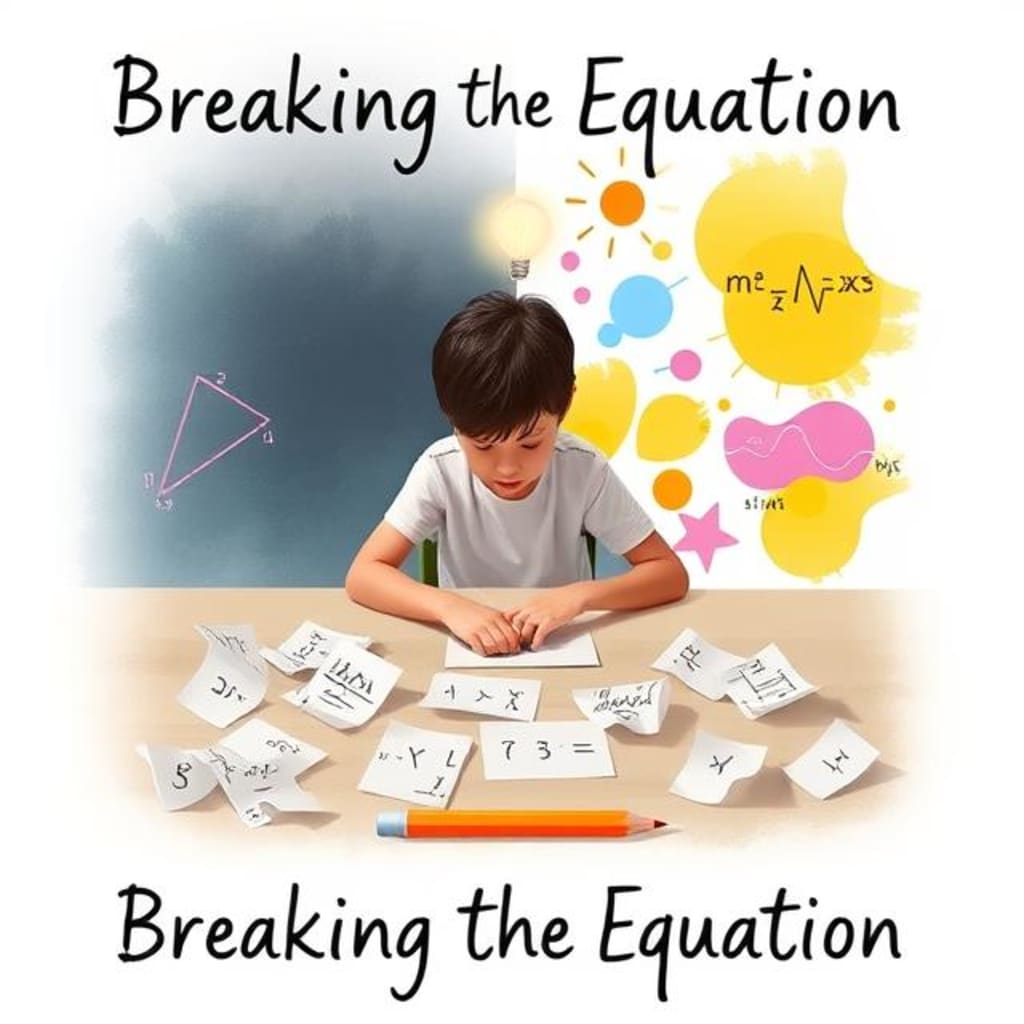
For most of my school life, math was a monster lurking just beneath the surface—waiting to pounce every time I sat down for a test. I dreaded numbers, formulas, and the cold, precise logic that never seemed to fit into my world of ideas and imagination.
I failed math.
Not just once or twice, but consistently enough to earn the label of “math-phobic” by my teachers and “hopeless” by my peers.
But what if I told you that failing math was the best thing that ever happened to me? That it didn’t just change my grades—it changed the way I think, learn, and solve problems in every part of my life?
Here’s my story.
The Beginning of the Struggle
I remember the first time I truly failed at math. It was a simple algebra test in seventh grade. I blanked. My mind raced to recall formulas, but they slipped away like sand through fingers. When I got my paper back, the red marks felt like a slap. I didn’t just get a bad grade—I felt dumb.
The pattern repeated year after year. Fractions, equations, geometry—none made sense. I studied, sure. I even asked for help, but the numbers refused to cooperate. I was trapped in a cycle of confusion and frustration.
My confidence plummeted. I began to believe I was simply not “math person.” The fear of failure became so strong that I avoided math-related challenges altogether.
The Turning Point
But failing math didn’t just teach me about numbers. It taught me about myself.
When I stopped pretending to be someone who understood math right away, I started asking questions differently. I began to wonder why the formulas worked—not just how. Why did algebraic expressions behave the way they did? Could there be more than one way to solve a problem?
I found myself sketching diagrams, drawing real-life examples, and talking through problems with friends. I started breaking the rigid rules I’d been taught, looking for patterns and connections rather than memorizing procedures.
Slowly, math stopped feeling like an enemy.
Learning to Think Differently
Failing math forced me to develop a new kind of intelligence—one rooted in creativity, curiosity, and resilience.
I learned that:
Failure is not the end. It’s a signal to change strategies, try new angles, and learn deeper.
Questions matter more than answers. Sometimes asking “why” opens more doors than having the “right” solution.
Different minds solve problems differently. My struggles pushed me to explore visual, verbal, and intuitive methods.
This wasn’t about being good at math anymore—it was about learning to think in ways that worked for me.
The Broader Impact
These lessons didn’t stay confined to math class.
In literature, I found myself analyzing stories not just by plot, but by the emotions beneath the words.
In science, I approached experiments with a hypothesis mindset—ready to adapt when results surprised me.
In life, I became more patient with setbacks and more open to unconventional solutions.
Failing math gave me the grit and flexibility to handle complex challenges with a fresh perspective.
Finding Success on My Terms
By the time I reached high school, I still wasn’t the top math student. But I was no longer afraid. I sought help from teachers who valued different learning styles, used online tools to explore concepts visually, and worked in study groups where mistakes were welcomed.
I didn’t ace every test, but I improved steadily—and more importantly, I gained confidence.
When I graduated, I chose a major in design, where problem-solving and creativity go hand-in-hand. Math was still part of it, but no longer the source of dread.
Reflections and Advice
Failing math was hard. It was humiliating. It challenged my identity and forced me to rethink what intelligence means.
But it also opened my mind.
If you’re struggling with math, or anything else, remember:
Failure is a step toward mastery, not proof of inability.
Think beyond formulas—understand principles.
Use your unique strengths to find solutions that work for you.
Ask questions, get curious, and don’t fear mistakes.
Math didn’t make me smarter in the traditional sense—it made me a better thinker.
And that has been the greatest gift of all.
About the Creator
Keep reading
More stories from Hamza Habib and writers in Education and other communities.
“In a World of Noise, Thinking Critically Is a Superpower”
We are constantly told to speak louder, scroll faster, consume more. But no one tells us to think better. I used to believe I was informed. After all, I read headlines. I followed influencers. I had opinions. So many opinions.
By Hamza Habib9 months ago in Education
Why the Sun’s Core Is Hotter Than Its Surface: The Science Behind the Sun’s Extreme Temperatures
Introduction: A Cosmic Mystery in the Sky Every day, the Sun rises and lights up our world. It warms the oceans, powers plants through photosynthesis, and drives Earth’s climate system. Yet behind this familiar glow lies one of the most fascinating mysteries of astrophysics: the Sun’s core is far hotter than its surface.
By shahkar jalal2 days ago in Education
A Memory I’ll Hold On to Forever
The hallway outside the classroom was unusually quiet that morning. Most of the students had already arrived. Their voices floated through the door; laughter, small conversations, the rustling sound of chairs being moved across the floor.
By Lori A. A.3 days ago in Education
Hottest in the Office
Dear Rafi, You’re very distracting to work around. For the first second I saw you the other day, I thought you were some type of executive. It took a moment to realize no, you were just the new guy, dressed up for the job he wants. Be still, my heart.
By Gabriel Shames5 days ago in Pride




Comments
There are no comments for this story
Be the first to respond and start the conversation.