
Using 3D Laser Scanning for Accurate Facility Upgrade and Renovation Planning
Enhancing Renovation Accuracy with High-Precision Reality Capture and BIM Integration

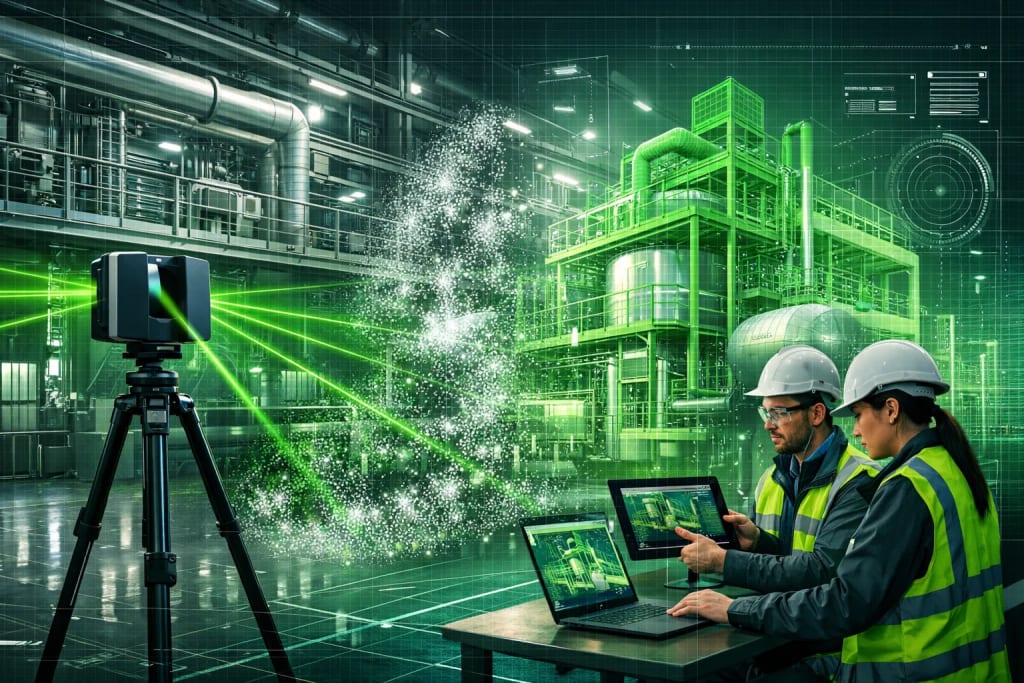
Facility upgrades and renovation projects require precise knowledge of existing building conditions. Many older facilities lack reliable documentation, and outdated drawings can lead to design conflicts, costly change orders, and construction delays.
Today, 3D laser scanning and reality capture technologies are transforming how architects, engineers, and facility managers approach renovation planning. By capturing millions of accurate spatial measurements, laser scanning creates a highly detailed digital representation of existing structures that can be used for BIM modeling, clash detection, and renovation planning.
This article explains how 3D laser scanning improves facility upgrade planning, how point cloud data integrates with BIM, and why it has become a critical tool in modern renovation workflows.
What Is 3D Laser Scanning?
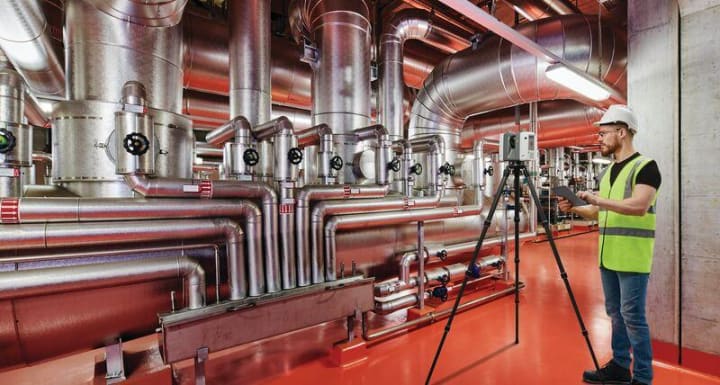
3D laser scanning is a reality capture technology that collects highly accurate measurements of physical spaces using laser beams. The scanner emits laser pulses that bounce off surfaces and return to the device, calculating precise distances and angles.
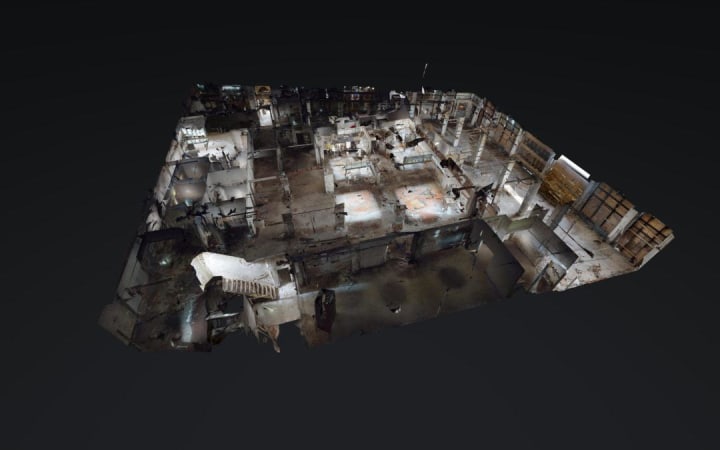
These measurements generate a point cloud, which is a dense collection of millions (or billions) of spatial data points representing the exact geometry of the scanned environment.
Each point contains information such as:
- X, Y, and Z spatial coordinates
- Surface location and geometry
- Reflectance or color values (when combined with imaging)
The resulting dataset provides a true-to-life digital representation of the building, capturing walls, floors, ceilings, structural elements, pipes, ducts, and equipment with millimeter-level accuracy.
Industries using 3D laser scanning include:
- Architecture and engineering
- Construction and renovation
- Facility management
- Infrastructure inspection
- Historic preservation
Capturing Accurate As-Built Building Conditions
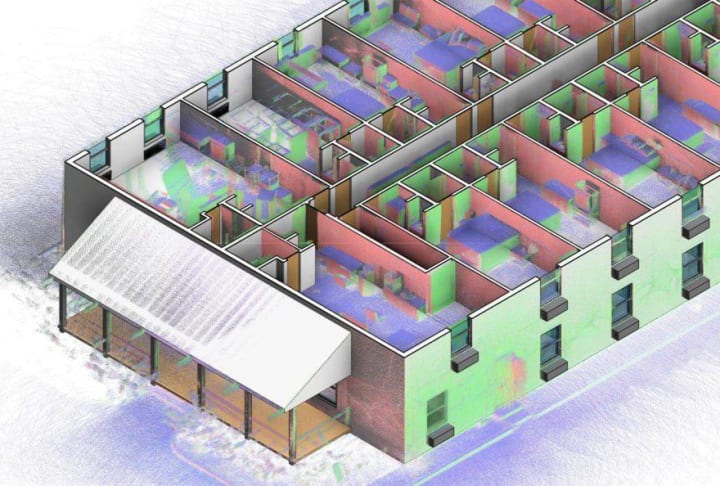
One of the most critical steps in renovation planning is accurate as-built documentation. Many facilities were constructed decades ago, and their original drawings often do not reflect later modifications or equipment installations.
Traditional measurement methods typically involve manual site surveys using tape measures or total stations, which can:
- Miss hidden elements
- Introduce measurement errors
- Require multiple site visits
- Produce incomplete documentation
3D laser scanning solves these challenges by capturing the entire environment in a single scanning session.
With laser scanning, project teams can document:
- Structural elements such as beams and columns
- Floor elevations and ceiling heights
- Mechanical, electrical, and plumbing (MEP) systems
- Equipment layouts and utility connections
- Architectural features and façade geometry
The resulting point cloud dataset provides a complete digital snapshot of the facility, allowing engineers and designers to review site conditions virtually without repeated field visits.
Benefits of Laser Scanning for Renovation Planning
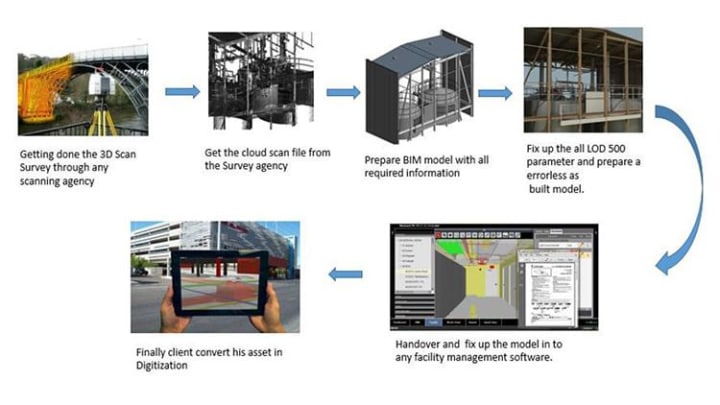
Using 3D laser scanning for renovation projects offers several significant advantages compared with traditional surveying methods.
1. High Accuracy and Precision
Laser scanners capture millions of measurements within minutes, delivering millimeter-level accuracy. This ensures that design teams work with reliable data when planning facility upgrades.
2. Reduced Design Errors
Accurate as-built documentation helps architects and engineers identify spatial constraints early in the design phase. This reduces the risk of design conflicts between structural and MEP systems.
3. Faster Project Planning
Because the entire facility is captured digitally, teams can perform measurements and design analysis remotely. This eliminates the need for repeated site visits.
4. Improved Collaboration
Point cloud data can be shared with architects, engineers, contractors, and facility managers, enabling collaborative decision-making during renovation planning.
5. Reduced Construction Rework
With precise existing-condition data, project teams can design upgrades with confidence, minimizing costly field adjustments during construction.
Point Cloud Data Integration with BIM
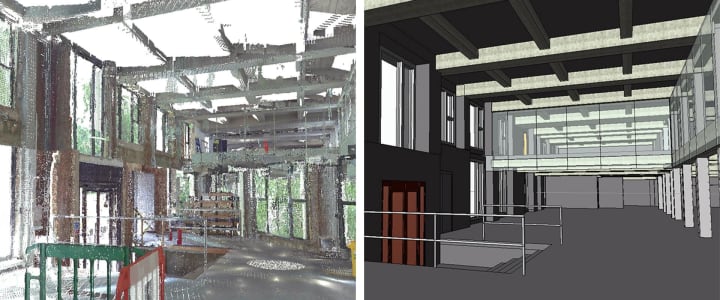
Once scanning is complete, the captured point cloud data can be imported into Building Information Modeling (BIM) platforms such as Autodesk Revit. This process is commonly known as Scan-to-BIM.
The workflow typically includes the following steps:
Data Capture - Laser scanners collect spatial data from multiple positions throughout the facility.
Point Cloud Registration - Individual scans are aligned and combined into a unified point cloud model.
Data Processing and Cleaning - Noise, duplicate points, and irrelevant elements are removed.
BIM Modeling - Architects and BIM specialists convert the point cloud into parametric building components such as:
- Walls
- Floors
- Structural elements
- MEP systems
Design and Coordination
Engineers use the BIM model to design upgrades, detect clashes, and plan installations.
This integration enables teams to create highly accurate digital twins of existing facilities, supporting renovation planning and lifecycle facility management.
Real-World Examples of Facility Upgrade Projects
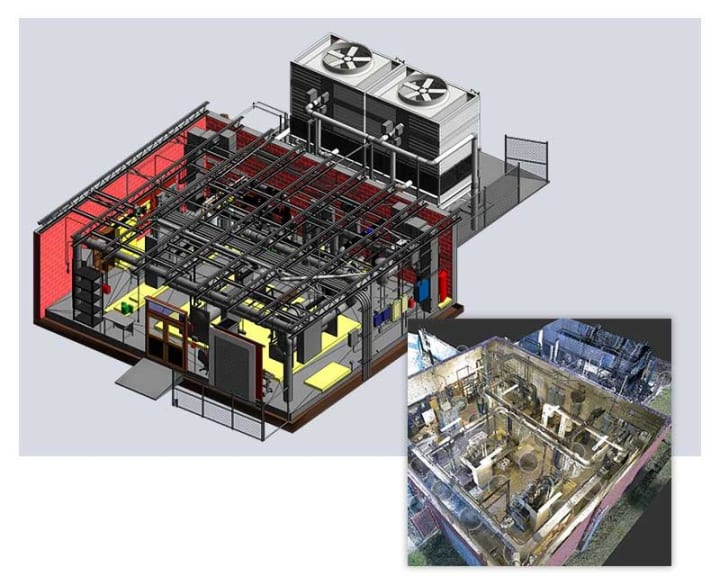
3D laser scanning is widely used across multiple facility types to support renovation and upgrade initiatives.
Healthcare Facilities
Hospitals and medical centers frequently undergo upgrades to accommodate new medical equipment and technologies. Laser scanning helps capture complex MEP systems and structural layouts, enabling engineers to design upgrades without disrupting critical operations.
Educational Campuses
Universities often renovate older buildings to improve energy efficiency and modernize learning spaces. Point cloud data allows architects to document existing conditions accurately and plan retrofits efficiently.
Industrial Plants
Manufacturing facilities contain dense mechanical systems and equipment. Laser scanning provides precise spatial data that helps engineers design equipment replacements and plant expansions.
Commercial Buildings
Office buildings, retail centers, and mixed-use developments often require tenant improvements or modernization projects. Laser scanning enables fast documentation and helps developers optimize renovation design.
Why Laser Scanning Is Essential for Modern Facility Upgrades
Facility upgrades are becoming more complex as buildings integrate advanced technologies, sustainability measures, and smart infrastructure systems. Accurate data is critical for making informed design decisions.
3D laser scanning provides:
- Reliable existing-condition documentation
- Improved renovation planning accuracy
- Seamless integration with BIM workflows
- Better collaboration between stakeholders
- Reduced construction risks and costs
For architects, engineers, and facility managers, laser scanning has become an essential technology for planning efficient and successful renovation projects.
✅ Conclusion
Renovating or upgrading an existing facility without accurate documentation can lead to costly mistakes and project delays. 3D laser scanning technology addresses this challenge by capturing precise spatial data that reflects the true condition of buildings.
When combined with BIM modeling and Scan-to-BIM workflows, point cloud data enables design teams to create accurate digital representations of facilities and plan upgrades with confidence.
As the architecture, engineering, and construction industry continues to embrace digital transformation, 3D laser scanning will remain a foundational technology for smarter renovation planning and facility modernization.
Further Reading
- Using Scan-to-BIM for Florida’s 30-Year Structural Recertification
- How BIM Improves MEP Coordination for Large-Scale Projects?
- Why BIM Coordination Is Critical for Boston’s Dense Urban Construction Projects?
- Why MEP BIM Is Essential for Modern Commercial Construction
- Why Data Centers in Virginia Rely on 3D Laser Scanning for Expansion Planning
About the Creator
Matt Sharon
A professional content writer. Having years of experience in Technology, health, finance, and construction and real estate field. Writing is my passion and I love to play with words Confidently.
Keep reading
More stories from Matt Sharon and writers in Education and other communities.
Using Scan-to-BIM for Florida’s 30-Year Structural Recertification
Florida’s coastal climate, aging buildings, and increasing safety regulations have made structural inspections more critical than ever. Following several high-profile building failures and growing concerns about aging infrastructure, the state has strengthened its building safety laws.
By Matt Sharon6 days ago in Education
Why Environmental Compliance Is Becoming a Business Priority for Companies in Dubai
Dubai continues to grow at a remarkable pace. Industrial zones expand, construction projects reshape the skyline, and logistics networks move goods through ports and airports every day. This growth creates strong economic opportunities, but it also increases environmental pressure across the city.
By Umar Quality Jounal3 days ago in Education
The Creative Kitchen Journey: Turning a Love for Cooking Into Everyday Inspiration
Cooking has evolved far beyond a simple daily responsibility. For many people, it has become a powerful source of creativity, relaxation, and personal satisfaction. After long hours spent working or managing daily responsibilities, the kitchen often becomes a place where individuals can unwind and reconnect with their passions. Preparing food allows people to experiment with flavors, textures, and presentation while enjoying the rewarding process of creating something from scratch.
By Greg Deshields3 days ago in Education



Comments
There are no comments for this story
Be the first to respond and start the conversation.