
What Is Quantum Gravity, and What Does It Have to Do with the Universe?
Space

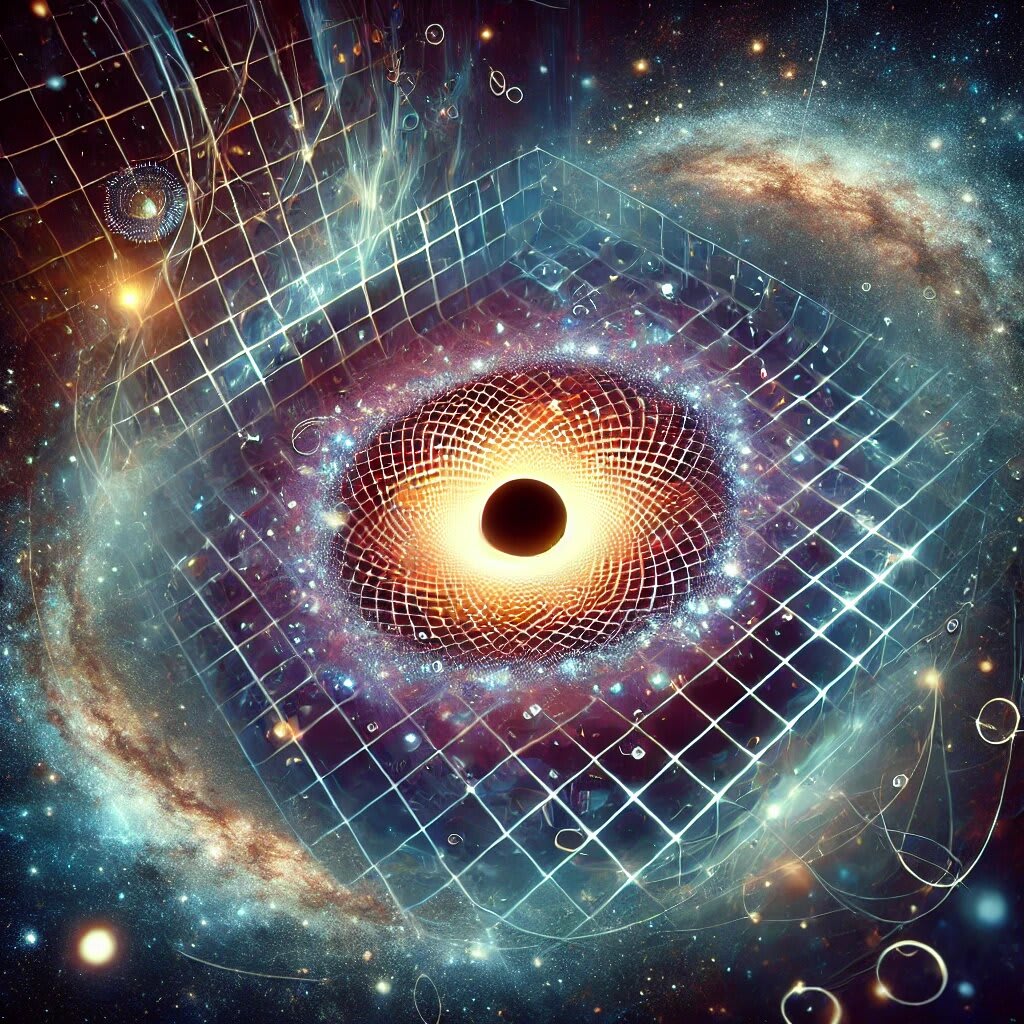
Quantum gravity is one of the most mysterious — and ambitious — ideas in modern physics. It sits at the edge of what we currently understand, where two of science’s most powerful theories meet: Einstein’s general relativity and quantum mechanics. But what exactly is quantum gravity, and why does it matter for our understanding of the cosmos?
Let’s dive in.
Gravity vs. the Quantum World
General Relativity
Back in 1915, Albert Einstein revolutionized our view of gravity. He showed that massive objects like planets and stars warp the fabric of space and time around them — and that’s what we experience as gravity. This theory explains everything from the orbits of planets to black holes and the expansion of the universe. It’s incredibly powerful — but only at large scales.
Quantum Mechanics
Zoom in to the tiniest parts of the universe — atoms, photons, quarks — and a completely different set of rules takes over. Welcome to the strange world of quantum mechanics, where particles behave like waves, uncertainty rules, and probabilities replace predictability.
The problem? These two theories don’t get along. They describe different scales of reality — the cosmic and the microscopic — and so far, no one has figured out how to make them work together.
That’s where quantum gravity comes in.
What Is Quantum Gravity?
Quantum gravity is the quest to blend gravity with the rules of quantum physics. Its goal: to describe how gravity behaves at the smallest possible scales — like at the heart of a black hole, or during the very first moments of the Big Bang.
In our everyday experience, gravity is just a pulling force — apples falling from trees, planets orbiting stars. But on the quantum level, gravity might work very differently. Some theories suggest that even gravity comes in tiny “packets” of energy, called gravitons (hypothetical particles we haven’t detected yet). In this view, space and time themselves aren’t smooth and continuous — they’re made of tiny, discrete building blocks.
How Is It Connected to the Universe? Quantum gravity holds the key to unlocking some of the universe’s biggest mysteries:
- The Birth of the Universe. At the moment of the Big Bang, all matter and energy were crammed into an infinitesimal point — a singularity. Einstein’s equations break down here. To understand what happened at “time zero,” we need quantum gravity.
- Black Holes. The center of a black hole is also a singularity — a place where our current understanding of physics falls apart. Quantum gravity might finally reveal what’s really going on inside black holes — and whether information is truly lost when it crosses the event horizon.
- The “Quantum Foam”. At unimaginably tiny scales, space-time may not be smooth at all. Instead, it could be wild and frothy — full of fluctuations and energy. Quantum gravity could describe this “quantum foam” — the true microscopic texture of the universe.
Theories of Quantum Gravity
Scientists have come up with a few bold ideas to explain quantum gravity. Here are the main contenders:
- String Theory. This theory says that particles aren’t actually points — they’re tiny vibrating strings. String theory naturally includes gravity and quantum mechanics, but it requires extra dimensions beyond the familiar three of space and one of time.
- Loop Quantum Gravity. Imagine space built from tiny loops linked into a network — like a cosmic web. This theory attempts to describe space-time itself as made of finite, quantized “chunks.”
- Quantum Field Theory on Curved Space-Time. This approach tries to apply quantum rules to particles in curved (gravitationally warped) space — a useful step, though it doesn’t fully unify gravity and quantum mechanics.
Why Does It Matter?
Quantum gravity isn’t just a fancy theory for physicists to argue about in chalk-filled lecture halls. It could:
- Help us understand how the universe began.
- Lead to a “Theory of Everything” — one ultimate formula that describes all physical laws.
- Open the door to revolutionary technologies (imagine manipulating gravity like we do with electromagnetism).
Final Thoughts
Quantum gravity is like the scientific version of the Holy Grail. It aims to unite the two greatest ideas in physics into one seamless theory — and in doing so, unlock the hidden mechanisms of the universe itself. For now, it remains a work in progress, a beautiful hypothesis on the edge of discovery. But one day, it just might reshape everything we know about the cosmos.
About the Creator
Keep reading
More stories from Holianyk Ihor and writers in Education and other communities.
What Will the Sky Look Like Millions of Years from Now?
The night sky feels eternal. The constellations seem fixed, the stars twinkle in familiar patterns, and the Moon and planets follow their predictable paths. But the universe is anything but static. It’s a cosmic dance of motion, transformation, and surprises. Fast-forward millions of years, and the sky above Earth will be almost unrecognizable.
By Holianyk Ihor8 months ago in Education
US Urges Its Citizens to Flee Venezuela Amid Reports of Paramilitaries
The United States has issued a strong warning urging its citizens to immediately leave Venezuela, citing growing security risks and alarming reports of armed paramilitary groups operating across the country. The advisory, released by the US State Department, reflects escalating concern over the deteriorating safety situation as political instability, armed violence, and lawlessness intensify.
By Aarif Lashari3 days ago in Education




Comments
There are no comments for this story
Be the first to respond and start the conversation.