
What Are Nucleic Acids?
A beginner-friendly guide to the molecules that store and transmit genetic information.

Nucleic Acids: Unlocking the Secret Code of Life
A beginner-friendly guide to the molecules that store and transmit genetic information.
What Are Nucleic Acids?
Have you ever wondered what makes you you? How does your body know how to grow, how your eyes know to be brown, or how your cells know how to divide and repair? The answer lies in a powerful, tiny code — the genetic code — stored inside molecules called nucleic acids.
Nucleic acids are acidic macromolecules found in the nucleus of cells. These molecules are the carriers of genetic information, and they form the basis of life as we know it. Without nucleic acids, life simply couldn’t exist.
There are two main types of nucleic acids:
DNA (Deoxyribonucleic Acid)
RNA (Ribonucleic Acid)
These two molecules work together to store, copy, and transfer the instructions that build and operate all living organisms.
What Does “Nucleic Acid” Mean?
Let’s break down the term nucleic acid to understand it better:
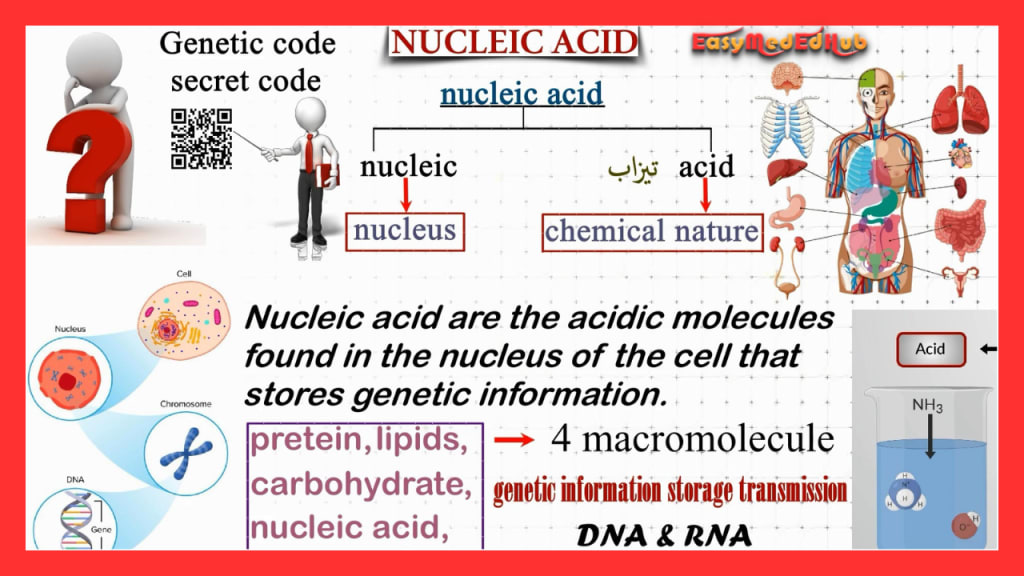
Nucleic comes from the word nucleus, because these molecules were first discovered in the cell nucleus.
Acid refers to their chemical nature — nucleic acids are acidic due to the phosphate groups in their structure.
So, nucleic acid literally means “acid from the nucleus” — a perfect name for molecules that live in the nucleus and carry our genetic blueprint.
Why Are Nucleic Acids Important?
Nucleic acids are not just important — they are essential for life. They are responsible for:
Storing genetic information (DNA)
Transmitting genetic instructions (RNA)
Guiding protein synthesis, which helps build our body
Passing traits from parents to offspring
Think of nucleic acids as the biological software that tells our cells what to do, when to grow, and how to function.
Where Are They Found?
As shown in the slide, nucleic acids are mainly found in the nucleus of cells. Let’s visualize the journey:
1. Cell → the basic unit of life
2. Inside the cell is the nucleus
3. Inside the nucleus are chromosomes
4. Chromosomes are made of DNA
5. DNA contains genes, the real units of heredity
This layered structure is how genetic information is organized and protected within every living cell.
One of the Four Major Macromolecules
Biologically, nucleic acids belong to one of the four essential macromolecules that make up living organisms:
1. Proteins – build structure and carry out reactions
2. Lipids – store energy and make cell membranes
3. Carbohydrates – provide quick energy
4. Nucleic Acids – store and transmit genetic information
This makes them a core part of every living thing — from bacteria to blue whales, from plants to people.
DNA & RNA: The Two Key Types
1. DNA – The Blueprint of Life
DNA holds all the instructions your body needs to develop, grow, and function. Every cell in your body has a copy of your DNA, which stays safely tucked away in the nucleus.
2. RNA – The Messenger
While DNA stays safe in the nucleus, RNA travels out of it to help carry out those instructions, especially in protein synthesis.
Together, DNA and RNA are like a manager and a messenger — working in harmony to keep life running smoothly.
The Genetic Code: A Secret Worth Decoding
The genetic code is like a biological language. It’s written using combinations of the nitrogenous bases in DNA (which you'll explore in the next slide). These combinations form genes, which determine everything from eye color to disease risk.
In other words, nucleic acids hold the master instruction manual for life.
Final Thoughts
This first look into nucleic acids reveals just how central they are to the structure and function of life. They are not only the language of life, but also the library that stores it, the messenger that delivers it, and the engine that drives it.
Whether you're a student stepping into the world of biology, or simply curious about how your body works on a molecular level — understanding nucleic acids is the perfect place to begin.
What’s Next?
In the next part, we’ll dive deeper into what nucleic acids are made of — exploring their building blocks called nucleotides, and how those blocks form complex, information-carrying molecules like DNA and RNA.
Stay tuned!
About the Creator
EasyMedEdHub
Welcome to EasyMedEdHub! 🎓
EasyMedEdHub simplifies complex science and medical concepts with clear, engaging content. Follow for tips, insights, and resources to help you succeed academically in biology and beyond!
Keep reading
More stories from EasyMedEdHub and writers in Education and other communities.
The Nucleus: The Command Center of the Cell
slide 1 The Nucleus: The Command Center of Life Every cell in your body is like a tiny, bustling city, and at its heart lies the nucleus —the ultimate control center. Think of it as the cell’s brain, the place where all the critical decisions are made. Without it, life as we know it wouldn’t exist.
By EasyMedEdHub9 months ago in Education
5 Essential Tools You Need to Work Remotely
Remote work has moved from being a perk to a permanent way of working for millions of professionals worldwide. While working from home or anywhere with an internet connection offers flexibility and freedom, success in a remote environment depends heavily on the tools you use.
By Bahati Mulishiabout 12 hours ago in Education
How Online Shopping Is Transforming Consumer Behavior and Business Models
The last ten years have seen a digital revolution changing the way we think about commerce and consumers, and how we understand and operate within the context of global trade. E-commerce has moved from a market niche to a global pillar of the economy. The ability to purchase a variety of products and services with a single click is no longer a luxury but a requirement for any modern-day consumer. Thanks to technological advances, a population that evolves rapidly each year, and a persistent focus on the user experience when it comes to online shoppers, the e-commerce industry is on the move in 2026.
By Bobby Yadav6 days ago in Education




Comments
There are no comments for this story
Be the first to respond and start the conversation.