
The Nucleus: The Command Center of the Cell
Discover how this tiny organelle controls life’s biggest processes—from genetic storage to cellular regulation.


The Nucleus: The Command Center of Life
Every cell in your body is like a tiny, bustling city, and at its heart lies the nucleus —the ultimate control center. Think of it as the cell’s brain, the place where all the critical decisions are made. Without it, life as we know it wouldn’t exist.
What Does the Nucleus Do?
The nucleus holds the cell’s DNA, the genetic blueprint that dictates everything from how you look to how your body functions. It’s like a library of instructions, ensuring proteins are made correctly, cells grow properly, and energy is used efficiently.
But it’s more than just storage—the nucleus actively manages these processes. It decides which genes are turned on or off, ensuring your liver cells don’t accidentally start acting like skin cells. Without this precise control, chaos would ensue.
Why Is the Nucleus So Important?
Survival: Without a nucleus, most cells would quickly die. It’s essential for growth, repair, and reproduction.
Structure & Function: Protected by a double-layered membrane (the nuclear envelope), the nucleus keeps DNA safe while allowing communication with the rest of the cell.
Role in Life: From development to aging, the nucleus plays a key part in every stage of life. It ensures genetic information is passed accurately when cells divide—a process crucial for healing, growth, and even fighting diseases.
Final Thought
The nucleus isn’t just another cell part—it’s the command center, the guardian of DNA, and the key to life itself. In the next slides, we’ll dive deeper into how this tiny powerhouse keeps you alive and thriving.

The Nucleus: The Core of the Cell
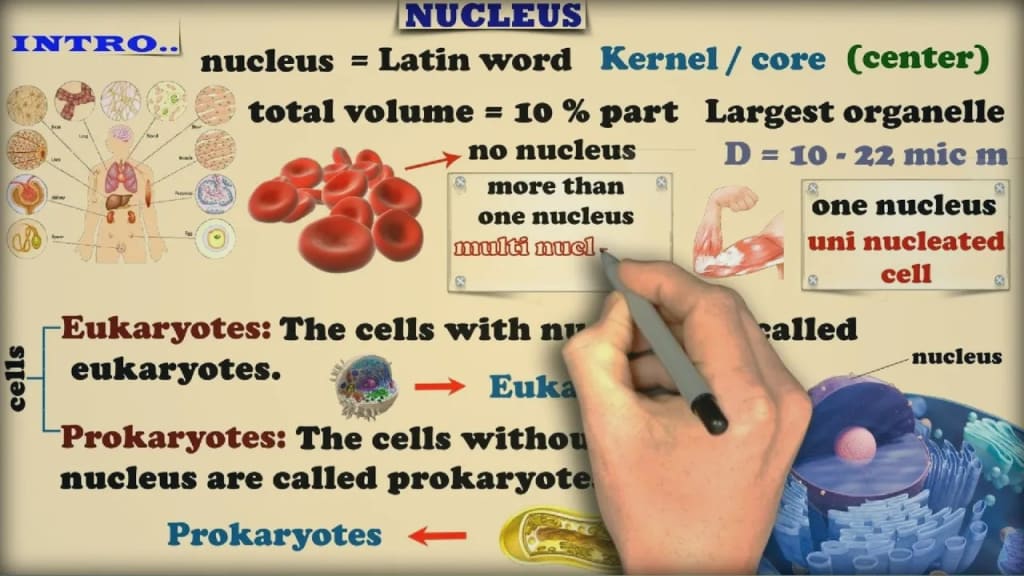
The nucleus isn’t just any cell part—it’s the command center, the kernel of life (literally!). The word nucleus comes from Latin, meaning core or center, and that’s exactly what it is—the central hub of a cell.
Size & Structure
-Largest organelle in the cell (10–22 micrometers in diameter).
- Takes up about 10% of the cell’s total volume.
- Most cells have one nucleus (uninucleated), but some, like muscle cells, have multiple nuclei (multinucleated).
- Red blood cells are unique—they lose their nucleus as they mature, allowing more space for oxygen transport.
Eukaryotes vs. Prokaryotes: The Great Divide
Eukaryotes (like human, plant, and animal cells) have a true nucleus —their DNA is safely enclosed in a membrane.
Prokaryotes (like bacteria) lack a nucleus—their DNA floats freely in the cell.
This simple difference is what separates complex life (eukaryotes) from ancient, simpler life forms (prokaryotes).
Why Does This Matter?
The nucleus isn’t just a storage unit—it’s a gatekeeper, protecting DNA and controlling what the cell becomes. Without it, complex life wouldn’t exist.
Next up: We’ll explore what’s inside the nucleus and how it controls everything in the cell.
Thoughts? Want me to tweak this for better flow or engagement? Maybe add a fun fact or analogy? Let me know!

The Nucleus: Discovery and Intricate Structure
The nucleus isn't just the cell's command center - it's a marvel of biological engineering with a fascinating history and complex architecture. Let's explore its discovery and structural brilliance.
A Historic Discovery That Changed Biology
- First identified in 1831 by Scottish botanist Robert Brown
- This 19th century breakthrough revolutionized our understanding of:
- Heredity (how traits are passed down)
- Cellular function (how cells operate)
- The discovery paved the way for modern genetics
Anatomy of a Control Center
The nucleus boasts an elegant structure with specialized components:
1. Nuclear Envelope (Membrane):
- Double-layered protective barrier
- Outer membrane connects to the cell's endoplasmic reticulum
- Inner membrane provides structural support
- Total thickness: 80-100 nanometers (about 1/1000th of a human hair)
2. Nuclear Pores:
- Tiny gatekeepers (7-9 nm in diameter)
- Act like security checkpoints, controlling what enters/exits
- Crucial for communication between nucleus and cytoplasm
3. Internal Components:
- Nucleoplasm: The "cytoplasm" of the nucleus - a gel-like matrix
- Chromatin: DNA-protein complex that forms chromosomes
- Nucleolus: Dense region where ribosome production begins
Specialized Adaptations
- In muscle cells, the nuclear membrane has unique features to accommodate their stretched shape during contraction
- The circular shape of the nucleus maximizes space for genetic material
Why This Matters
This intricate design allows the nucleus to:
✔️ Protect precious DNA
✔️ Precisely regulate gene expression
✔️ Coordinate cellular activities
✔️ Facilitate rapid response to cellular needs
Inside the Nucleus: Exploring the Genetic Control Room
Beneath the protective nuclear membrane lies a dynamic world where life's instructions are stored and processed. Let's journey into the nucleus's interior to understand its vital components.
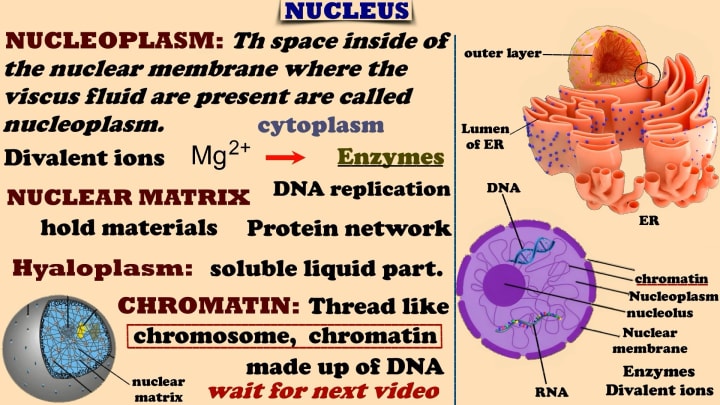
1. Nucleoplasm: The "Cytoplasm" of the Nucleus
Definition: The gel-like fluid filling the nuclear interior, similar to cytoplasm but more specialized.
Composition:
- Hyaloplasm: The soluble liquid portion that suspends other structures.
- Divalent ions (like Ca²⁺ and Mg²⁺): Critical for enzyme function and DNA stability.
- Enzymes: Drive essential processes like DNA replication and repair.
- Function: Provides a medium for nuclear activities and supports chromatin and the nucleolus.
2. Nuclear Matrix: The Nucleus's Scaffold
- A protein network that maintains the nucleus's 3D structure (like cellular scaffolding).
- Roles:
- Anchors chromatin (DNA threads) in place.
- Organizes DNA replication and gene expression.
- Helps the nucleus retain its shape under mechanical stress.
3. Chromatin: The Blueprint of Life
- What it is: Long, thread-like DNA strands wrapped around proteins (histones).
- Two Forms:
1. Euchromatin: Loosely packed, "active" DNA (genes being used).
2. Heterochromatin: Tightly packed, "silent" DNA (genes turned off).
- Function:
- Stores genetic instructions.
- Condenses into chromosomes during cell division.
- Works with RNA to produce proteins.
Why This Matters
The nucleus isn’t just a storage unit—it’s a highly organized factory
where:
✔️ DNA replication ensures genetic continuity.
✔️ Gene expression is carefully controlled.
✔️ RNA synthesis translates DNA code into actionable proteins.
The Nucleolus: The Cell's Protein Factory Manager
Tucked inside the nucleus lies its most industrious resident—the nucleolus, a small but mighty structure that keeps your cells running. Let’s uncover why this dark-stained, round organelle is so crucial to life.
What Is the Nucleolus?
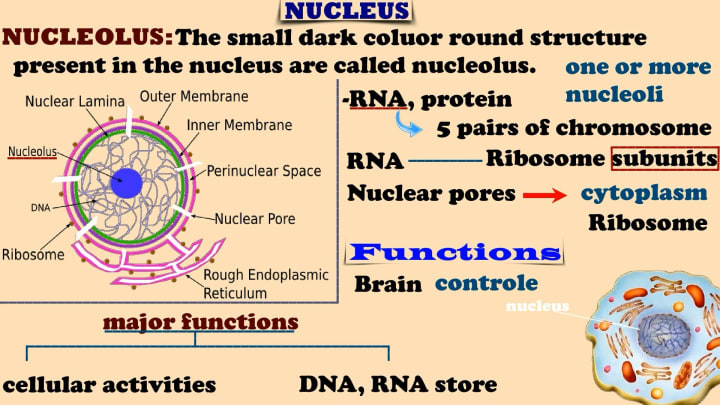
- Appearance: A dense, dark-colored sphere (often multiple per nucleus).
- Location: Suspended in the nucleoplasm, near chromosomes (like the 5 pairs highlighted here).
- Composition: Made of RNA, proteins, and DNA segments.
Key Functions: More Than Just a Dot
1. Ribosome Production Hub:
- Synthesizes ribosomal RNA (rRNA) and assembles ribosome subunits.
- Exports these subunits through **nuclear pores** to the cytoplasm, where they form full ribosomes.
2. Cell Cycle Sentinel:
- Disassembles during cell division and reforms afterward—a sign of its dynamic role.
3. Stress Responder:
- Alters its activity under stress (e.g., heat or toxins) to protect cell survival.
How It Connects to the Cell
- Teamwork with Ribosomes:
Ribosomes (built by the nucleolus) link to the rough endoplasmic reticulum (RER), creating a protein-making "assembly line."
- Nuclear Membrane Synergy:
The outer/inner membranes and perinuclear space protect nucleolus activities, while nuclear pores shuttle its products out.
Why the Nucleolus Matters
- Brain of the Nucleus? While the nucleus controls the cell, the nucleolus acts like its "operations manager," ensuring protein synthesis never stops.
- Disease Links: Dysfunctional nucleoli are tied to cancers, neurodegenerative diseases, and aging.

The Nucleus: Master Conductor of Cellular Life
The nucleus isn't just another organelle - it's the cell's CEO, genetic library, and command center rolled into one. This final slide reveals why this remarkable structure is truly indispensable for life. Let's break down its six supreme functions:
1. The Ultimate Control Center
The nucleus governs all critical cellular operations:
- Metabolism: Regulates energy production and usage
- Protein Synthesis: Directs creation of every protein in your body
- Growth & Reproduction: Orchestrates cell division (mitosis/meiosis)
Like a maestro conducting an orchestra, the nucleus synchronizes thousands of cellular processes simultaneously.
2. RNA Production Factory
- Synthesizes all types of RNA:
- mRNA (messenger RNA) - genetic blueprints
- tRNA (transfer RNA) - protein building assistants
- rRNA (ribosomal RNA) - protein-making machinery
This is the first step in the central dogma of biology: DNA → RNA → Protein
3. Ribosome Assembly Line
- Creates ribosome subunits in the nucleolus
- Exports them to cytoplasm for final assembly
Your cells contain about 10 million ribosomes - all thanks to the nucleus!
4. Genetic Instruction Dispatch
- Sends mRNA messengers through nuclear pores
- These couriers deliver protein recipes to ribosomes
Imagine mRNA as emails sent from the nucleus' main office to factory workers (ribosomes) in the cytoplasm
5. Cell Division Supervisor
- Controls the cell cycle through regulatory genes
- Ensures DNA replicates perfectly before division
*Errors here can lead to uncontrolled growth (cancer) or cell death*
6. The Ultimate Biological Archive
- Stores all hereditary information in DNA
- Transmits this genetic legacy during reproduction
Your nucleus contains about 2 meters of DNA packed into a space just 10 microns across - like fitting 40km of thread in a tennis ball!
Why This Matters:
The nucleus' multitasking abilities explain why it's found in all complex life forms. From enabling your muscles to move to preserving your unique genetic identity, this cellular command center makes you who you are.
Final Thought:
Next time you look in the mirror, remember - every cell in your reflection is powered by these incredible nuclear functions working tirelessly to keep you alive and thriving.
About the Creator
EasyMedEdHub
Welcome to EasyMedEdHub! 🎓
EasyMedEdHub simplifies complex science and medical concepts with clear, engaging content. Follow for tips, insights, and resources to help you succeed academically in biology and beyond!
Keep reading
More stories from EasyMedEdHub and writers in Education and other communities.
Exploring the Endoplasmic Reticulum: The Cell’s Internal Highway System
slide 1 Imagine walking into a massive factory with conveyor belts running in every direction—moving, folding, and transporting essential materials. Inside every cell, a similar structure exists: the Endoplasmic Reticulum (ER). It's a vital, membrane-bound organelle that plays a central role in the cell’s internal transport system.
By EasyMedEdHub9 months ago in Education
Smart Steps to Finance and Manage a New Construction Spec Home
A spec home is short for "speculative home." It means a house built without a specific buyer in mind. Builders construct it based on what they believe buyers want. This type of home can be profitable, but it needs careful planning. The goal is to build it, sell it quickly, and make a solid return. To succeed, you must understand your costs, timeline, and market.
By Ruvim Khemchan4 days ago in Education


Comments
There are no comments for this story
Be the first to respond and start the conversation.