
How BIM Improves MEP Coordination for Large-Scale Projects?
Reducing Rework, Optimizing System Integration, and Streamlining Multi-Trade Collaboration

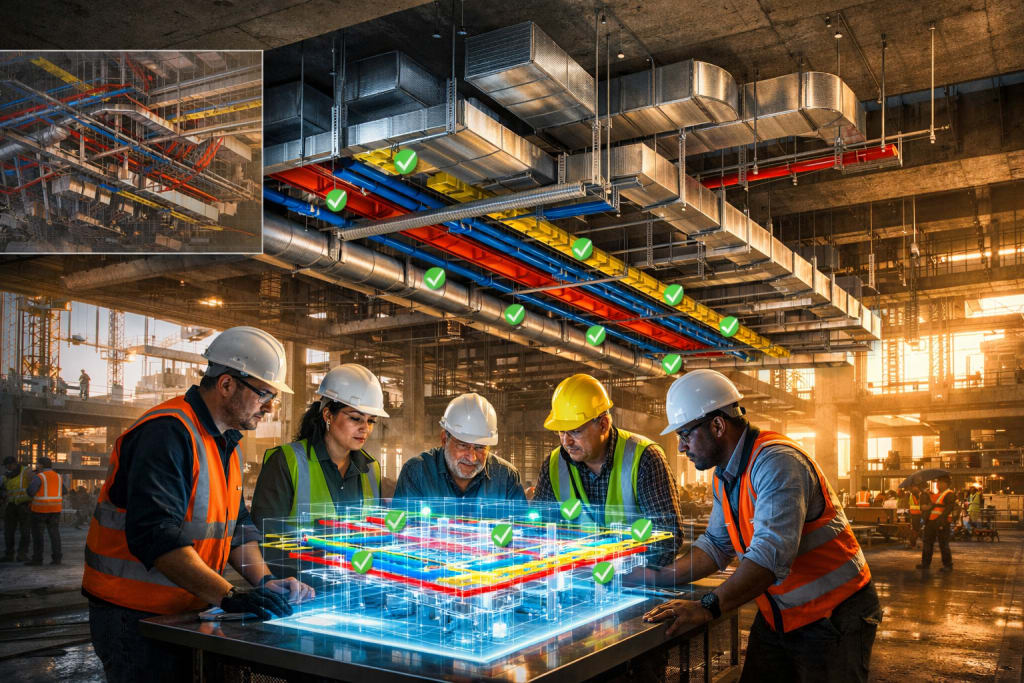
In large-scale construction projects—such as hospitals, airports, commercial towers, data centers, and industrial facilities—MEP (Mechanical, Electrical, and Plumbing) systems account for nearly 30–50% of total project cost. Yet, they are also the most coordination-intensive disciplines.
Traditional 2D coordination often leads to clashes, rework, cost overruns, and delays. This is where Building Information Modeling (BIM) transforms the process.
In this guide, we’ll explore how BIM improves MEP coordination in large-scale projects, why it’s critical for AEC firms, and how it reduces risks while improving construction efficiency.
Why MEP Coordination Is Challenging in Large-Scale Projects
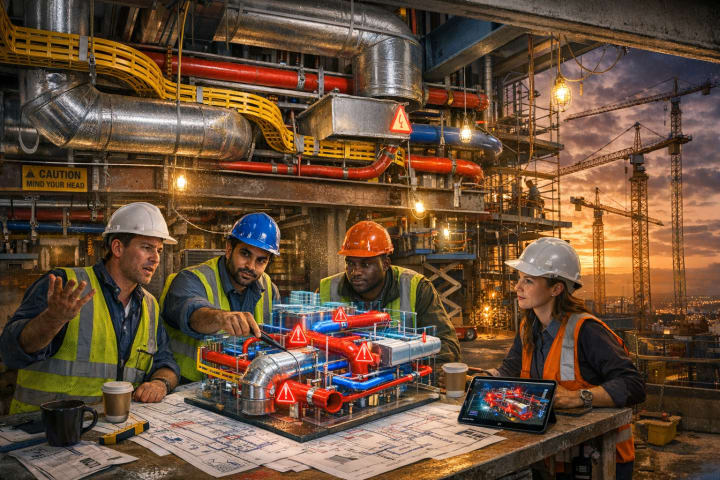
Large projects involve:
- Multiple consultants (architectural, structural, MEP)
- Complex ductwork, piping, cable trays, and equipment
- Tight ceiling and plant room spaces
- Compliance with local building codes and standards
- Phased construction and fast-track schedules
Without digital coordination, conflicts between structural beams, HVAC ducts, fire sprinkler systems, and cable trays become inevitable.
What Is BIM in MEP Coordination?
Building Information Modeling (BIM) is a collaborative digital process that creates intelligent 3D models integrating architectural, structural, and MEP systems into one coordinated environment.
Using tools like:
- Autodesk Revit
- Navisworks
- AutoCAD MEP
MEP engineers can design, simulate, and coordinate building systems before construction begins.
How BIM Improves MEP Coordination
1. Early Clash Detection & Conflict Resolution
One of BIM’s biggest advantages is clash detection.
Using tools like Navisworks Manage, teams can detect:
- Ducts intersecting beams
- Pipes clashing with cable trays
- Equipment overlapping structural walls
- Ceiling height conflicts
Benefits:
- Reduced rework
- Fewer site conflicts
- Lower change order costs
- Faster approvals
For large-scale projects, this can save millions in rework costs.
2. Integrated 3D Visualization for All Stakeholders
In 2D drawings, coordination depends heavily on interpretation. BIM provides a federated 3D model where:
- Architects see how services impact ceiling design
- Structural engineers validate penetrations
- Contractors review constructability
- Owners visualize maintenance access
This visual clarity improves communication across teams.
3. Improved Space Management in Tight Zones
In large commercial buildings, ceiling plenums and plant rooms are highly congested.
With BIM:
- Routing of ducts and pipes is optimized
- Equipment clearance is validated
- Maintenance access zones are checked
- Ceiling heights are preserved
This is especially important in projects targeting certifications like LEED, where efficient building performance is critical.
4. Accurate Quantity Takeoffs & Cost Control
BIM models contain embedded data such as:
- Material types
- Pipe sizes
- Duct dimensions
- Equipment specifications
This allows accurate quantity takeoffs and cost estimation, reducing budgeting errors.
For large-scale projects, this supports:
- 5D BIM (cost integration)
- Procurement planning
- Waste reduction
- Budget forecasting
5. Enhanced Prefabrication & Modular Construction
BIM enables fabrication-level modeling (LOD 400–500), which supports:
- Offsite duct fabrication
- Preassembled pipe racks
- Modular MEP corridors
- Coordinated spool drawings
This reduces:
- On-site labor
- Installation time
- Material wastage
- Safety risks
Prefabrication is especially effective in hospitals, airports, and data centers.
6. Better Scheduling with 4D BIM
When BIM integrates scheduling (4D), project teams can:
- Sequence MEP installation logically
- Avoid trade stacking
- Coordinate crane lifts
- Plan phased execution
This improves workflow efficiency in mega projects where multiple trades operate simultaneously.
7. Improved Compliance & Code Validation
Large-scale projects must comply with:
- Fire safety regulations
- Energy codes
- Accessibility standards
- Seismic requirements
BIM enables performance simulations and compliance verification before construction begins.
For example:
- HVAC load analysis
- Lighting simulations
- Energy modeling
- Fire sprinkler layout validation
This reduces approval delays.
8. Digital Handover & Facility Management Integration
BIM models can be handed over to facility managers for lifecycle management.
Integration with:
- Autodesk BIM 360
- Autodesk Construction Cloud
Allows owners to manage:
- Equipment maintenance schedules
- Warranty tracking
- Asset lifecycle planning
- Renovation planning
This turns BIM from a design tool into a long-term asset management solution.
Real-World Impact of BIM on Large Projects
On complex projects such as airports or healthcare facilities, BIM-driven MEP coordination typically results in:
- 30–50% reduction in RFIs
- 20–40% reduction in change orders
- Faster installation timelines
- Improved safety performance
- Higher construction quality
For general contractors and MEP subcontractors, this means better profitability and predictable project delivery.
BIM Levels of Detail (LOD) in MEP Coordination
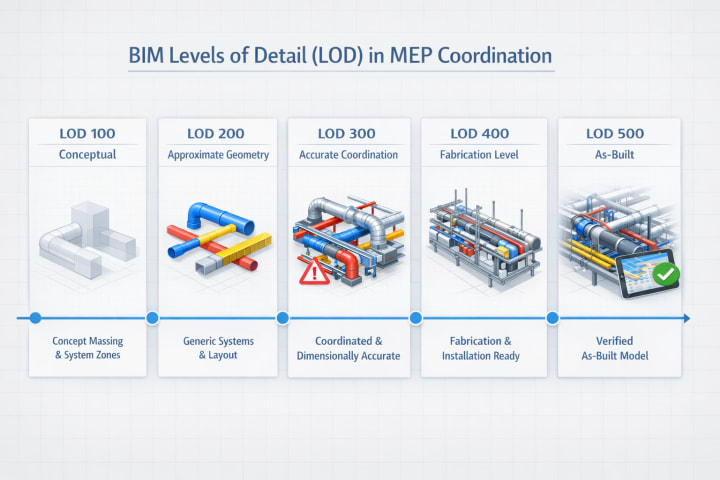
Large-scale projects often use:
- LOD 300 – Design coordination
- LOD 350 – Clash detection & interfacing
- LOD 400 – Fabrication modeling
- LOD 500 – As-built models
Higher LOD ensures better precision and smoother field execution.
Why BIM Is Essential for Mega Infrastructure & Commercial Projects
BIM becomes indispensable when projects include:
- High-rise buildings
- Airports
- Hospitals
- Industrial plants
- Data centers
- Mixed-use developments
In such projects, MEP systems are too complex to coordinate manually.
Conclusion
BIM has revolutionized MEP coordination in large-scale construction projects by:
- Eliminating design clashes early
- Enhancing multi-disciplinary collaboration
- Improving cost and schedule predictability
- Enabling prefabrication
- Supporting lifecycle asset management
For AEC firms, adopting BIM is no longer optional—it’s a strategic necessity for delivering complex projects efficiently and competitively.
About the Creator
Matt Sharon
A professional content writer. Having years of experience in Technology, health, finance, and construction and real estate field. Writing is my passion and I love to play with words Confidently.
Keep reading
More stories from Matt Sharon and writers in Education and other communities.
Why BIM Coordination Is Critical for Boston’s Dense Urban Construction Projects?
Boston’s construction landscape is unlike most U.S. cities. With its dense urban fabric, historic buildings, narrow streets, underground utilities, and strict regulatory environment, even small construction errors can cause major delays and cost overruns. In such a complex environment, BIM coordination is no longer optional—it is essential.
By Matt Sharonabout a month ago in Education
Where Real Growth Is Happening in Hospitality Today
On a recent trip, I checked into a small boutique hotel that remembered my name before I reached the front desk. The lobby felt less like a transaction point and more like a living room. The café next door doubled as a coworking space, and the staff moved with a kind of calm confidence that suggested they were part of something thoughtful, not rushed. It struck me that growth in hospitality no longer announces itself solely through grand openings. It shows up in subtler, smarter ways.
By Asad Malik5 days ago in Education
Why Adaptive Testing Is the Future of Healthcare Licensing?
Healthcare is evolving at a pace never seen before. Patient acuity is increasing, clinical environments are becoming more complex, and accountability standards are rising across every healthcare system. In response, healthcare licensing exams are also transforming. Traditional fixed-length exams are no longer sufficient to measure real-world competence. This shift is why adaptive testing is rapidly becoming the future of healthcare licensing.
By Sulcus Learningabout 4 hours ago in Education



Comments
There are no comments for this story
Be the first to respond and start the conversation.