
Unveiling the Extraordinary: The Marvel of Spider Silk and Its Potential
From Nature's Masterpiece to Groundbreaking Innovations

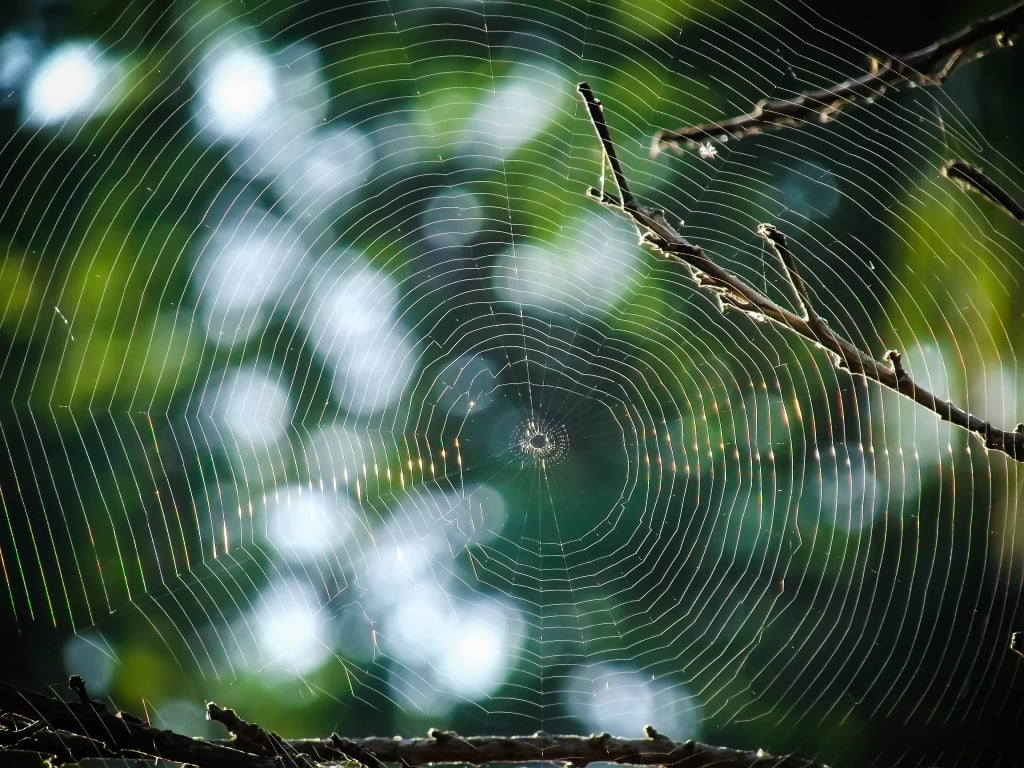
Witness the creation of a remarkable vibrant cape and shawl, the largest pieces of cloth ever crafted from spider silk. In the highlands of Madagascar, a dedicated team of around 100 individuals embarked on a three-year journey to collect the silk, spin the threads, weave the fibers, and meticulously embroider intricate details. Astonishingly, 1.2 million golden orb weaver spiders, each producing 30 to 50 meters of luminous yellow thread, contributed to this extraordinary masterpiece before being released back into the wild.
But what could drive someone to devote such immense effort to working with this peculiar and challenging material? The answer lies in the seemingly magical properties of spider silk. For millennia, humans have been captivated by its allure. Ancient Greeks employed cobwebs to treat wounds, while traditional hunters in the South Pacific utilized spider silk to ensnare fish, exploiting its formidable strength that entangled the fish's serrated teeth. With its exceptional flexibility surpassing man-made nylon, biocompatibility, biodegradability, and even outperforming steel in terms of strength-to-weight ratio, spider silk has become a subject of intrigue for geneticists, biochemists, and material scientists who endeavor to unravel its enigmatic secrets.
Delving into the mysteries of spider silk leads us to explore its unique characteristics—its flexibility, durability, and extraordinary strength. How strong is spider silk? What confers upon it such remarkable properties, and could we ever harness this power for ourselves? Crafting this incredible material is an innate part of spiders' biology. The earliest proto-spiders, dating back 380 million years to the Devonian period, possessed spinnerets, silk-producing organs located in the middle of their abdomens. These ancient spiders likely utilized their silk to cover eggs or line their burrows in sheets rather than spinning intricate webs.
It wasn't until around 250 million years ago that spiders with spinnerets at the end of their abdomen emerged, enabling the creation of more elaborate silk structures. While not all spiders can intricately weave patterned webs, the adeptness with which orb-weaving spiders—roughly 12,500 out of the 45,000 spider species—craft their spiral wheel-shaped webs is a testament to their mastery. The process of silk production begins in the spider's silk glands, with the silk initially existing as a liquid. As it travels through the spider's abdomen, a combination of water extraction, acid, and tension transforms it into its final solid form. It then passes through the spinnerets, where it is spun into various types of silk, including structural silk, spiral silk, and sticky silk, with dragline silk being the most extensively studied.
Dragline silk, also known as the spider's lifeline, enables spiders to hang from ceilings and serves as a constant connection to their webs, allowing them to escape when danger lurks. This particular silk is a remarkable material, often drawing comparisons to steel for its combination of toughness, strength, and elasticity. Its composite nature, consisting of amorphous non-crystalline matrices and embedded crystalline regions, endows it with remarkable properties.
While the tensile strength, the ability to resist breaking under tension, of spider silk rivals or even surpasses that of steel, it is crucial to understand the various material properties involved. Different types of steel possess varying tensile strengths, with mild steel, commonly used in construction, averaging around 0.4 gigapascals. In contrast, the golden orb spider silk exhibits tensile strengths of up to 1.6 gigapascals, impressively comparable when considering their respective diameters. Moreover, spider silk's lower density, approximately one-sixth that of steel, further highlights its strength-to-weight advantage. Additionally, spider silk excels in its ductility, allowing it to stretch and deform without breaking, resulting in high toughness, surpassing even the toughness of materials like Kevlar.
Over hundreds of millions of years, spiders' survival and evolution have relied upon these exceptional properties. The stretching of the silk matrix enables webs to withstand the impact of flying prey, securing spiders' sustenance. Such extraordinary material properties have sparked the attention of scientists from various fields who tirelessly work to unlock the secrets of spider silk's potential.
Despite its incredible attributes, the mass production of spider silk remains a formidable challenge. Attempts to farm spiders at scale or collect silk from the wild have proven impractical and time-consuming. Consequently, scientists have turned to alternative methods, including genetically modifying host organisms. Initially, plants seemed promising due to their ability to produce large proteins. However, the proteins produced by plants fall short in size compared to those of spiders, resulting in silk with a less repetitive protein structure and lower quality.
Surprisingly, goats have emerged as an unexpected host for spider silk production. By targeting milk protein genes, genetically modified spider goats can produce spider silk proteins in their milk. Although early attempts yielded significant quantities of spider silk proteins, the protein size remained smaller than natural spider silk proteins. Silkworms, with their natural spinning apparatus, have also shown potential for producing spider silk proteins, yet their resulting silk falls behind natural spider silk in terms of mechanical properties.
The most recent breakthrough involves genetically modified bacteria, particularly E. coli, which can produce large quantities of desired proteins. By inserting repeating sequences into the bacteria's genetic code, researchers have successfully generated proteins larger than ever before, reaching 556 kilodaltons. Spinning these proteins into fibers that mimic natural spider silk remains a challenge, but scientists are making progress toward an artificial spinning process that emulates the real thing.
While bringing spider silk to the mass market has eluded previous attempts, recent advancements offer hope for the replacement of petroleum-based synthetic fibers. Collaborations between companies like AM Silk and Adidas have explored the potential of spider silk in concept sneakers, while Omega has created a special edition spider silk watch strap. Even aviation giant Airbus is exploring its applications. Spider silk has the potential to play a role akin to carbon fiber in today's world, revolutionizing industries across textiles, medicine, and more.
Innovation inspired by nature's wonders unveils extraordinary possibilities. Creatures such as spiders, ants, and termites, often overlooked or even despised, demonstrate remarkable engineering prowess. Researchers now turn to termites, studying their biocementation process of fusing soil into durable structures, as inspiration for human architecture. Discover the awe-inspiring world of termites and their intricate nests by watching "Termites: The Inner Sanctum" on Curiosity Stream—a captivating 45-minute film that takes you deep into their remarkable chambers in Borneo and Africa. Explore the untapped corners of evolution through a plethora of detailed and beautiful nature films on Curiosity Stream, where nature's wisdom offers solutions to our toughest challenges.
About the Creator
Aya Aathif Ali allooh
Hello Friends...
My Name is Aya Aathif and I'm from Sri Lanka
I'm a Student and I love Sharing my stories with All of You
Hope You Enjoy and Have A Nice Day!!!
Keep reading
More stories from Aya Aathif Ali allooh and writers in Education and other communities.
"Peter The Grape Takes You on an Unforgettable Adventure Through the Human Body"
Hey there! I'm Peter, or you can call me Peter The Grape. Yeah, my dad came up with that name. Today, I'm embarking on an incredible journey... through the human body! Care to join me? It all starts in the office lunchroom, where our host opens his lunchbox and finds me, alongside a turkey sandwich and some yogurt. After he takes a bite of his sandwich, it's my turn! I'm swallowed, and the adventure begins. The mouth, the gateway to the digestive system, begins breaking down the food with saliva. Chewing helps with the process, but I skip that part and move straight down the esophagus. A few mishaps later, I reach the stomach, where the food is mashed up. However, the stomach acid is a bit harsh, so I'm protected in a bubble. Moving into the small intestine, I encounter bile and intestinal bacteria, who are hard at work. Finally, I reach the large intestine, where water is absorbed, and I transform into stool. The rectum signals the need for a bathroom break, and off we go! It's been a unique experience, but now it's time for me to make my grand exit. Thanks for joining me on this wild journey through the human body!
By Aya Aathif Ali allooh3 years ago in Fiction




Comments
There are no comments for this story
Be the first to respond and start the conversation.