
Are We Living in a Multiverse?
Introduction For centuries, humanity believed that the universe was everything that existed—an all-encompassing cosmos containing all matter, energy, space, and time. However, modern physics has introduced a radical and fascinating possibility: What if our universe is only one of many? The idea that multiple universes may exist alongside our own is known as the multiverse theory. Once considered pure science fiction, the multiverse has emerged from serious scientific research in cosmology, quantum mechanics, and theoretical physics. But is the multiverse real—or merely a mathematical idea? Are we truly living in one universe among countless others? This educational article explores what the multiverse is, why scientists consider it possible, the major scientific models behind it, the evidence for and against it, and whether the idea can ever be proven.

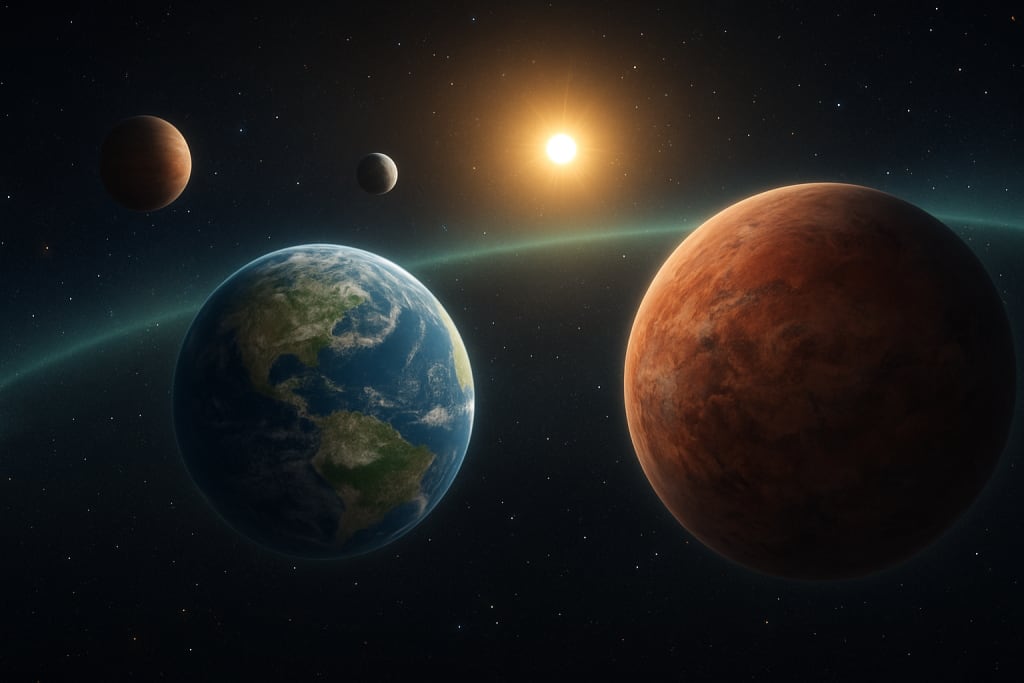
What Is the Multiverse?
The multiverse refers to a hypothetical collection of multiple universes, each potentially having different:
• Physical laws
• Fundamental constants
• Dimensions of space and time
• Particle properties
In this view, our observable universe is just one small region within a much larger cosmic reality.
The multiverse does not arise from imagination alone—it emerges naturally from several well-established scientific theories.
________________________________________
Why Scientists Take the Multiverse Seriously
The multiverse is not a single theory but a consequence of multiple independent ideas in physics.
Scientists consider it because:
• Current theories mathematically predict it
• It may explain puzzling cosmic observations
• It helps address deep questions about fine-tuning
While still unproven, the multiverse is grounded in legitimate scientific reasoning.
________________________________________
The Major Types of Multiverse Theories
1. The Inflationary Multiverse
The most widely studied multiverse model comes from cosmic inflation.
Inflation theory states that the universe underwent extremely rapid expansion shortly after the Big Bang.
Some versions predict:
• Inflation never completely stops
• New regions of space constantly form
• Each region becomes a separate universe
These universes are called bubble universes, and our universe may be one of them.
This model naturally leads to an enormous—possibly infinite—multiverse.
________________________________________
2. The Quantum Multiverse (Many-Worlds Interpretation)
Quantum mechanics allows particles to exist in multiple states simultaneously.
According to the many-worlds interpretation:
• Every quantum decision creates new branches of reality
• All outcomes occur
• Each outcome exists in a separate universe
In this view:
• The universe constantly splits
• Parallel realities exist for every possibility
This form of multiverse arises directly from quantum physics.
________________________________________
3. The String Theory Landscape
String theory suggests that fundamental particles are tiny vibrating strings existing in higher dimensions.
The mathematics allows:
• Around 10^500 possible vacuum states
• Each corresponding to a different universe
This vast set of possibilities is known as the string landscape, strongly supporting a multiverse framework.
________________________________________
4. Mathematical Multiverse
Physicist Max Tegmark proposed that:
• Every mathematically consistent structure exists physically
• Reality itself is mathematics
In this extreme view, all possible universes exist—not just those predicted by physics.
________________________________________
The Fine-Tuning Problem
One of the strongest motivations for the multiverse comes from the fine-tuning of physical constants.
Examples include:
• Gravity strength
• Electron mass
• Cosmological constant
If these values were slightly different:
• Stars would not form
• Chemistry would collapse
• Life would be impossible
The multiverse offers an explanation:
• Many universes exist with random constants
• We observe this one because it supports life
This is known as the anthropic principle.
________________________________________
Is There Any Evidence for the Multiverse?
Currently, there is no direct observational evidence for other universes.
However, scientists have explored indirect possibilities:
• Unusual patterns in the cosmic microwave background
• Cold spots or anomalies
• Possible signatures of bubble collisions
So far, none have provided conclusive proof.
________________________________________
Why the Multiverse Is Difficult to Test
Scientific theories must be testable. The multiverse presents serious challenges:
• Other universes may lie beyond our cosmic horizon
• No signals can travel between universes
• Direct observation may be impossible
This raises debate over whether the multiverse is science or philosophy.
________________________________________
Criticism of the Multiverse Theory
Many scientists remain skeptical.
Common criticisms include:
• Lack of testable predictions
• Risk of unfalsifiable explanations
• Overreliance on mathematics
Some argue that without experimental verification, the multiverse may never qualify as a scientific theory.
________________________________________
Support from Leading Physicists
Despite criticism, many respected physicists support multiverse research, including:
• Alan Guth
• Andrei Linde
• Stephen Hawking (in limited form)
• Leonard Susskind
They argue that if a theory strongly predicts the multiverse, rejecting it may mean rejecting the theory itself.
________________________________________
Could We Ever Prove the Multiverse?
Possible future approaches include:
• Detection of primordial gravitational waves
• Improved cosmic microwave background mapping
• Mathematical consistency tests
• Evidence supporting inflation or string theory
Even then, proof may remain indirect.
________________________________________
Multiverse vs. Single-Universe Models
Some alternative explanations exist:
• Unknown physical laws may explain fine-tuning
• Deeper symmetry principles may exist
• Constants may not be truly variable
The debate remains open.
________________________________________
Educational Importance of the Multiverse
Studying the multiverse helps students:
• Understand modern theoretical physics
• Learn scientific reasoning at the frontier
• Distinguish evidence from speculation
• Appreciate limits of observation
It shows how science advances through bold ideas tested against reality.
________________________________________
What Science Currently Knows
Scientists agree that:
• The observable universe is vast but limited
• Inflation and quantum mechanics are well supported
• Multiverse models arise naturally from existing theories
However:
• No direct evidence exists
• The multiverse remains hypothetical
________________________________________
Conclusion
So, are we living in a multiverse?
At present, science cannot say for certain.
The multiverse is a powerful idea supported by modern physics, offering explanations for cosmic fine-tuning and the structure of reality itself. Yet without direct evidence, it remains one of the most controversial concepts in cosmology.
If the multiverse is real, our universe is not unique—but one small region within an unimaginably vast cosmic system.
If it is not, then nature must still reveal why the universe’s laws appear so precisely balanced.
Either way, the multiverse debate pushes science to its limits, reminding us that the universe—or universes—may be far stranger than we ever imagined.
________________________________________
are we living in a multiverse, multiverse theory explained, parallel universes science, multiverse cosmology, quantum multiverse, inflationary universe, astrophysics education, universe theories
About the Creator
Keep reading
More stories from shahkar jalal and writers in Education and other communities.
The 15-Minute Reading Habit That Can Transform Your Mind
Reading for just 15 minutes a day may sound like a small goal, but it can create a major shift in the way your mind works. In today’s fast-paced world, many people feel overwhelmed by constant notifications, short-form content, and nonstop distractions. This makes it harder to focus, think clearly, and stay mentally calm. The good news is that you don’t need hours of free time to improve your brain—you only need consistency. A daily reading habit, even for a short time, can strengthen your focus, sharpen your thinking, and support long-term personal growth.
By Paul Wiedmaier7 days ago in Education
A Guide to Centerburg, Ohio, Musical Heritage Through Its Venues and Community Festivals
Centerburg, Ohio's, has a musical heritage shaped by people who value tradition, creativity, and togetherness. Music in this village is not treated as a separate attraction. It is part of daily life, woven into gatherings, celebrations, and shared moments. Visitors often notice that music here feels sincere and welcoming, not rushed or commercial.
By Kevin Knasel6 days ago in Education
The Path to Salvation
The late autumn evening air filled the monk's lungs, but it wasn't the season that chilled his bones. The heavy-handed presence of evil he had sensed upon entering the woods surrounding this mountain village had not bothered to conceal itself from him.
By Made in DNA6 days ago in Fiction


Comments
There are no comments for this story
Be the first to respond and start the conversation.