
What Is Dark Matter Made Of? Exploring the Greatest Mystery in Modern Physics
Dark matter is one of the most profound and perplexing mysteries in modern science. It does not emit light, reflect radiation, or interact with matter in any familiar way—yet it makes up about 85% of all matter in the universe. Without dark matter, galaxies would fly apart, cosmic structures would never form, and the universe as we know it could not exist. This leads to a fundamental question: What is dark matter actually made of? Despite decades of research, scientists still do not know the answer. However, physics has narrowed down the possibilities, ruled out many candidates, and proposed several compelling theories. This article explores what dark matter is, how we know it exists, what it cannot be, and the leading candidates for what it might be made of.

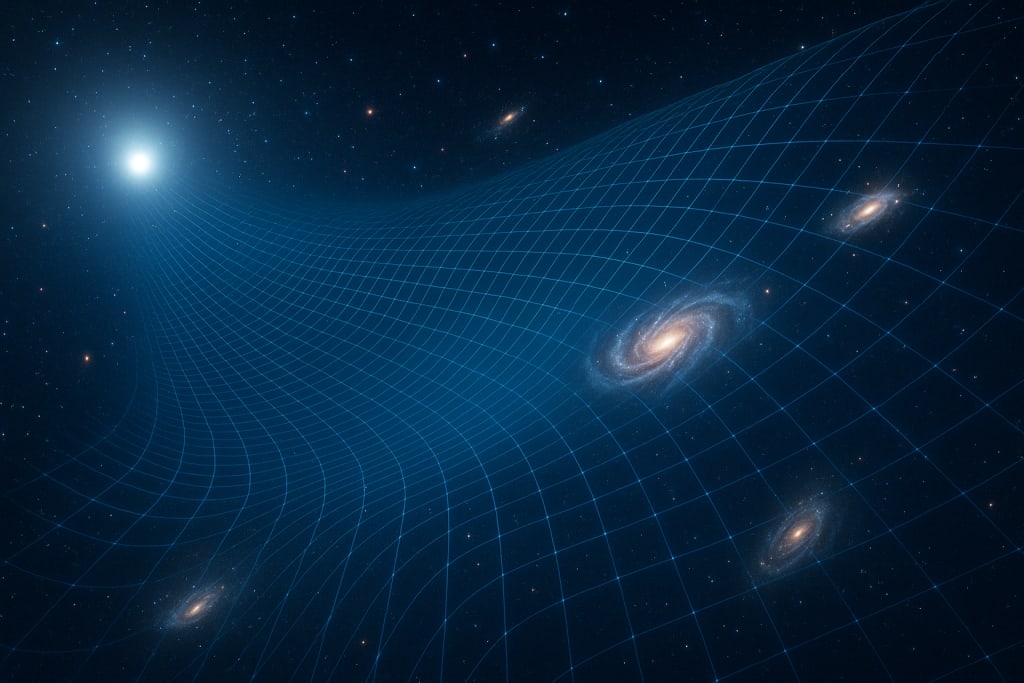
What Is Dark Matter?
Dark matter is a form of matter that:
• Has gravitational effects
• Does not emit or absorb light
• Does not interact electromagnetically
• Is invisible to telescopes
It is called dark not because it is black, but because it is transparent to light.
Dark matter reveals itself only through gravity.
________________________________________
How Do We Know Dark Matter Exists?
1. Galaxy Rotation Curves
Stars in galaxies orbit much faster than visible matter alone can explain. According to Newton’s laws, galaxies should fly apart—but they don’t.
An unseen mass must be holding them together.
That mass is dark matter.
________________________________________
2. Gravitational Lensing
Mass bends light. Observations show that light from distant galaxies bends more than visible matter allows.
The extra bending comes from invisible mass.
________________________________________
3. Cosmic Microwave Background
The leftover radiation from the Big Bang shows patterns that require dark matter to explain the structure of the universe.
________________________________________
4. Galaxy Clusters (Bullet Cluster)
In colliding galaxy clusters, dark matter separates from visible gas, proving it is not ordinary matter.
________________________________________
What Dark Matter Is NOT Made Of
Before exploring candidates, it is crucial to understand what dark matter cannot be.
Not Ordinary Matter
Dark matter is not made of:
• Atoms
• Protons or neutrons
• Stars, planets, or dust
This kind of matter is called baryonic matter, and it accounts for only about 5% of the universe.
________________________________________
Not Black Holes (Mostly)
Primordial black holes were once considered candidates, but observations show they cannot account for most dark matter.
They may contribute a small fraction—but not all.
________________________________________
Not Antimatter
Antimatter interacts with light and annihilates with matter. Dark matter does neither.
________________________________________
Leading Candidates for Dark Matter
1. WIMPs (Weakly Interacting Massive Particles)
WIMPs are the most studied dark matter candidates.
They are:
• Massive particles
• Electrically neutral
• Weakly interacting
• Stable over cosmic timescales
WIMPs naturally arise in theories beyond the Standard Model, such as supersymmetry.
Despite extensive searches, none have been detected so far.
________________________________________
2. Axions
Axions are extremely light, hypothetical particles proposed to solve a problem in quantum chromodynamics.
They are:
• Extremely weakly interacting
• Abundant
• Cold and stable
Axions are one of the strongest remaining candidates.
Experiments are actively searching for them using ultra-sensitive detectors.
________________________________________
3. Sterile Neutrinos
Unlike normal neutrinos, sterile neutrinos:
• Do not interact via the weak force
• Interact only through gravity
• Are heavier than regular neutrinos
They could explain some astrophysical observations, but evidence remains inconclusive.
________________________________________
4. Dark Sector Particles
Some theories propose an entire dark sector:
• Dark matter particles interact with each other
• They may have dark forces and dark photons
• They remain invisible to normal matter
This idea suggests a hidden universe parallel to our own.
________________________________________
Cold, Warm, or Hot Dark Matter?
Dark matter is classified by how fast it moves.
Cold Dark Matter
• Moves slowly
• Forms small structures
• Best fits observations
Most leading candidates fall into this category.
________________________________________
Warm Dark Matter
• Moves moderately fast
• Suppresses small-scale structure
Sterile neutrinos are possible warm dark matter candidates.
________________________________________
Hot Dark Matter
• Moves near light speed
• Cannot form galaxies properly
Hot dark matter is ruled out as the dominant component.
________________________________________
Why Dark Matter Has Not Been Detected Yet
Dark matter is elusive because:
• It barely interacts with normal matter
• Signals are extremely weak
• Background noise overwhelms detectors
Experiments are becoming more sensitive each year, but nature may be subtler than expected.
________________________________________
Major Dark Matter Experiments
Scientists search for dark matter using three main approaches:
1. Direct Detection
Underground detectors look for rare collisions with dark matter particles.
2. Indirect Detection
Telescopes search for radiation from dark matter annihilation.
3. Particle Accelerators
The Large Hadron Collider attempts to create dark matter particles.
So far, results remain inconclusive.
________________________________________
Could Gravity Itself Be Wrong?
Some scientists have proposed alternatives to dark matter, such as modified gravity theories.
However:
• These theories struggle to explain all observations
• Dark matter fits data across multiple scales
Most physicists agree dark matter is real.
________________________________________
What If Dark Matter Is Something Entirely New?
It is possible that:
• Dark matter is not a particle
• It involves new physics
• Our current models are incomplete
Discovering dark matter could revolutionize physics as much as relativity or quantum mechanics.
________________________________________
Why Dark Matter Matters
Dark matter:
• Shapes galaxies
• Controls cosmic structure
• Influences the fate of the universe
• Reveals limits of known physics
Understanding it could unlock a deeper theory of reality.
________________________________________
What We Know for Certain
Despite uncertainty, scientists are confident that dark matter:
• Exists
• Is not ordinary matter
• Dominates cosmic mass
• Interacts primarily through gravity
What remains unknown is its true identity.
________________________________________
The Current Scientific Consensus
There is no confirmed answer yet.
But the most promising candidates are:
• Axions
• WIMPs
• Sterile neutrinos
• Dark sector particles
The coming decades may finally reveal the truth.
________________________________________
Final Answer
What is dark matter made of?
We do not yet know.
But we know it is not made of atoms, stars, or anything familiar. It is something new—possibly a particle, possibly a hidden sector, possibly a clue to deeper laws of nature.
Dark matter remains invisible, but its gravitational fingerprints are everywhere.
________________________________________
Final Conclusion
Dark matter is the scaffolding of the universe—an unseen framework that holds galaxies together and shapes cosmic evolution.
Although we do not yet know what it is made of, decades of evidence leave no doubt that it exists.
Solving the mystery of dark matter will not just explain what fills the universe—it will redefine our understanding of matter, forces, and reality itself.
The universe is telling us a secret.
We are still learning how to listen.
About the Creator
Keep reading
More stories from shahkar jalal and writers in Education and other communities.
The 15-Minute Reading Habit That Can Transform Your Mind
Reading for just 15 minutes a day may sound like a small goal, but it can create a major shift in the way your mind works. In today’s fast-paced world, many people feel overwhelmed by constant notifications, short-form content, and nonstop distractions. This makes it harder to focus, think clearly, and stay mentally calm. The good news is that you don’t need hours of free time to improve your brain—you only need consistency. A daily reading habit, even for a short time, can strengthen your focus, sharpen your thinking, and support long-term personal growth.
By Paul Wiedmaier5 days ago in Education
A Guide to Centerburg, Ohio, Musical Heritage Through Its Venues and Community Festivals
Centerburg, Ohio's, has a musical heritage shaped by people who value tradition, creativity, and togetherness. Music in this village is not treated as a separate attraction. It is part of daily life, woven into gatherings, celebrations, and shared moments. Visitors often notice that music here feels sincere and welcoming, not rushed or commercial.
By Kevin Knasel4 days ago in Education



Comments
There are no comments for this story
Be the first to respond and start the conversation.