
Unlocking the Secrets of the Periodic Table: Why It’s Important and How to Master It
Unlocking the Secrets of the Periodic Table: Why It’s Important and How to Master It
Unlocking the Secrets of the Periodic Table: Why It’s Important and How to Master It
The Periodic Table is one of the most powerful tools in chemistry, and its significance cannot be overstated. For students preparing for CAIE O Level, A Level, or IGCSE Chemistry, understanding the structure and organization of the Periodic Table is crucial for success. Not only does it help you predict the behavior of elements, but it also provides valuable insights into their properties, reactivity, and atomic structure. In this post, we’ll explore the importance of the Periodic Table, the information it holds, and practical tips to help students learn it by heart.
Why the Periodic Table Is Important
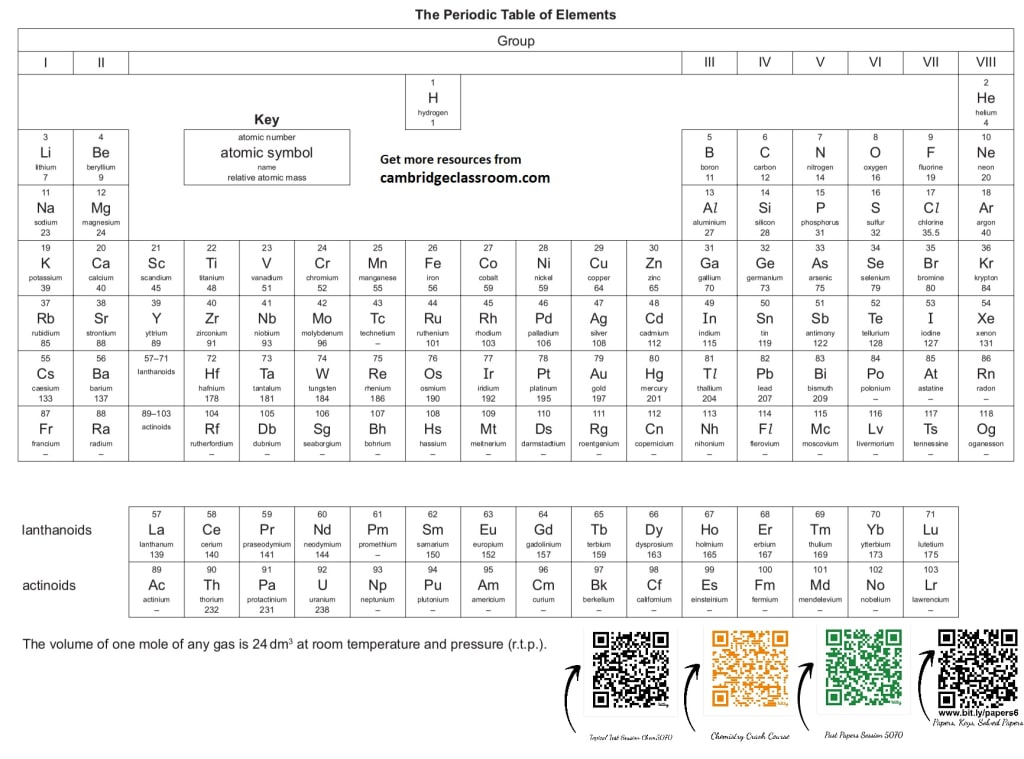
The Periodic Table organizes all known elements in a structured and logical manner, grouping them based on their atomic number, electron configuration, and recurring chemical properties. This arrangement makes it a powerful reference for predicting element behavior, understanding trends, and solving complex chemical problems. Here are some key reasons why the Periodic Table is essential:
Understanding Atomic Structure: The table allows students to quickly determine the atomic number (the number of protons), atomic mass, and electron configuration of an element, which are foundational to solving chemistry problems.
Predicting Chemical Behavior: Elements within the same group (vertical columns) have similar chemical properties, such as valency and reactivity. For example, Group 1 elements (alkali metals) are highly reactive and lose one electron easily to form positive ions.
Identifying Trends: The Periodic Table reveals patterns in properties like electronegativity, ionization energy, and atomic radius. These trends are critical when explaining chemical bonding and reactivity in exams.
Classifying Elements: The table classifies elements into metals, non-metals, metalloids, and noble gases. This classification helps students understand how different elements behave in chemical reactions.
What Information Can Be Obtained from the Periodic Table?
The Periodic Table is a treasure trove of information, and once you understand how to read it, you can extract key data about any element. Here’s a breakdown of what you can learn:
Atomic Number: This number, located above the element symbol, tells you the number of protons and electrons in a neutral atom of that element.
Atomic Mass: Found beneath the element symbol, the atomic mass represents the weighted average of the isotopes of an element, and it’s important for calculating molar masses and performing stoichiometric calculations.
Electron Configuration: The position of an element in the table allows you to deduce its electron configuration, especially the number of valence electrons. For example, elements in Group 1 have one valence electron, making them highly reactive.
Group and Period Trends: As you move across a period (left to right) or down a group (top to bottom), various trends emerge. For instance:
Electronegativity tends to increase across a period and decrease down a group.
Ionization energy follows a similar trend, making it easier to predict which elements will lose or gain electrons.
Atomic radius decreases across a period but increases down a group.
Reactivity: The reactivity of metals increases as you move down a group, while the reactivity of non-metals decreases. This is useful for predicting how elements will behave in chemical reactions.
How Students Can Learn the Periodic Table by Heart
Memorizing the entire Periodic Table might seem daunting, but there are strategies to make this task manageable and even fun. Here are some effective techniques:
Chunking the Table: Instead of trying to learn all 118 elements at once, divide the table into smaller, more manageable sections. Focus on learning one group or period at a time. Start with key groups like the alkali metals (Group 1), halogens (Group 17), and noble gases (Group 18).
Use Mnemonics: Create mnemonics to remember the order of elements in a specific group or period. For example, for Group 1 (Li, Na, K, Rb, Cs, Fr), you can use: "Little Naughty Kids Rub Cats Fur."
Flashcards: Flashcards are a tried and tested method for memorization. Write the element’s symbol on one side and its atomic number and properties on the other. Quiz yourself regularly to reinforce your memory.
Periodic Table Songs: There are various songs and videos available that set the elements of the Periodic Table to music. Listening to these can make memorization easier and more enjoyable.
Interactive Learning Tools: Many online resources, such as interactive Periodic Tables and apps, help make learning engaging. These tools often include quizzes, games, and interactive features that make learning the elements more dynamic.
Group Trends: Pay attention to the trends within groups and periods. Understanding the relationships between elements will not only help you remember their order but also their chemical behaviors. For example, all elements in Group 1 lose one electron to form +1 ions.
Regular Practice: Like any memorization task, regular review and practice are key. Make a habit of reviewing the Periodic Table daily for 5-10 minutes, and it will gradually become second nature.
Applying Your Knowledge in Exams
Knowing the Periodic Table by heart allows you to quickly answer questions on atomic structure, chemical bonding, and element properties. Here are some practical applications of this knowledge in exams:
Predicting Reaction Products: By knowing which elements are more reactive, you can predict the products of chemical reactions. For example, knowing that Group 1 metals react vigorously with water helps you understand their reactions in exam questions.
Balancing Equations: The Periodic Table helps you deduce the charges on ions, making it easier to balance chemical equations.
Understanding Compounds: By recognizing the group an element belongs to, you can predict the type of compound it will form (e.g., ionic or covalent) and the ratio of elements in the compound.
The Periodic Table is not just a chart—it’s a gateway to understanding the entire field of chemistry. By learning it thoroughly and mastering the information it contains, students can enhance their understanding, improve their performance in exams, and develop a deep appreciation for the subject.
Start your journey to mastering chemistry today! If you want to focus on learning the Periodic Table in-depth, enroll in our dedicated course The Periodic Table: Unlock Chemical Insights here, or for comprehensive revision, join our Crash Course for Chemistry 5070/0620 here. With the right guidance, mastering the Periodic Table becomes a rewarding experience!
About the Creator
Half Dollars That Defied Time: Kennedy, Franklin & Walking Liberty
If you’ve found yourself holding an old half dollar, you’ve probably wondered: is this just pocket change, or could it be something more? I’ve had that same conversation with countless collectors in my eight years as a numismatist. The answer often hinges on three legendary names: Walking Liberty, Franklin, and Kennedy. More than just silver, these coins are tangible pieces of 20th-century America. This guide will help you understand their stories, values, and which one might be the perfect fit for your goals, whether you're building a collection or an investment.
By Laura Bennett5 days ago in Education
Rewiring Wellness: How Neuroscience Is Redefining the Mind-Body Connection in Therapy
In recent years, neuroscience has reshaped the understanding of how emotional and physical processes interact, offering therapists new insight into healing. The mind-body connection, once viewed as more philosophical than scientific, now has clear biological explanations. Studies show that thoughts, emotions, and physical sensations are deeply intertwined, influencing everything from stress responses to overall wellbeing. This knowledge is transforming modern therapeutic practices by providing clinicians with evidence-based tools that support integrated healing.
By Debra Bailey PHDabout 21 hours ago in Education
Center Stage with Paul Stewart
*** I'm keen to republish the interviews I did for my series with Vocal creators. It's been a few years and I thought it might be nice to revisit these wonderful conversations. I'll be releasing them one at a time for a few weeks/months.
By Heather Hubler4 days ago in Interview



Comments
There are no comments for this story
Be the first to respond and start the conversation.